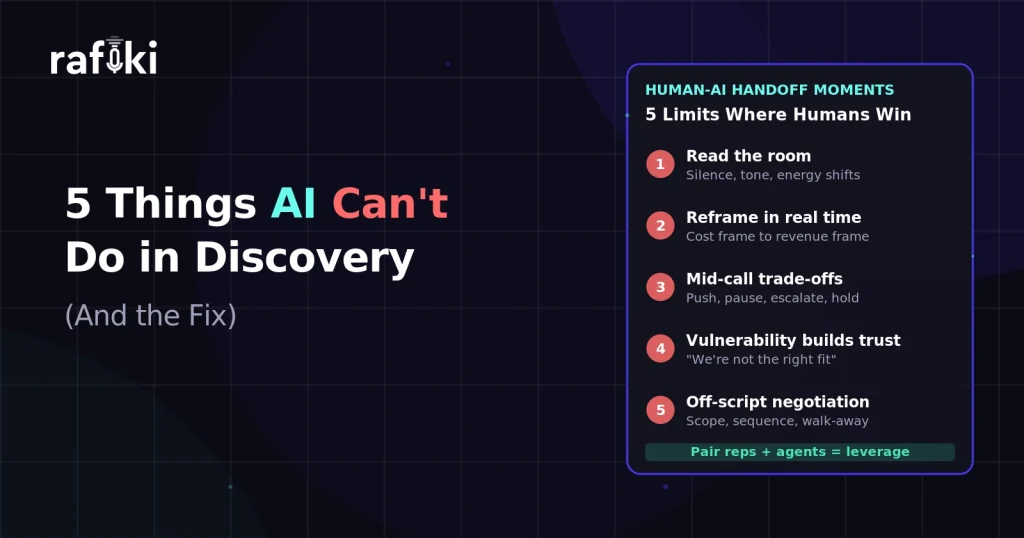
Most AI sales content is selling you a fantasy — that a model can run a discovery call as well as your best AE if you just give it the right prompt. It cannot, and pretending otherwise is the fastest way to lose deals and burn rep trust in the same quarter.
There is a more useful conversation to have in 2026, and it is the one that vendors avoid: what does AI genuinely fail at inside a discovery call, and how do you design a workflow that pairs reps with autonomous AI agents so the failures never reach the buyer? Frontline managers and AEs who have actually used current-generation tools already know the limits. They have watched a summary miss the most important sentence of a call. They have read a coaching tip that flagged "discovery weakness" on a call where the rep made the right judgment to slow down. They have seen agents draft a follow-up that contradicted the verbal commitment the buyer just made.
None of that means AI does not belong in discovery. It means AI belongs in a specific role, with specific guardrails, and with humans doing the parts that humans are still uniquely good at. This piece lays out the five things AI still cannot do in a discovery call as of 2026, and then walks through how to pair reps with agents so the human and the machine each play to their strengths.
The hype cycle around AI in sales has done real damage. Sales leaders who believed the marketing pitches in 2024 and 2025 rolled out tools that promised autonomous discovery, autonomous objection handling, and autonomous coaching. Many of those rollouts produced a familiar pattern: a strong first quarter of demo-driven enthusiasm, then a slow drift back to manual workflows as reps lost trust in the AI's judgment on the calls that mattered most.
The lesson from that cycle is not that AI is useless. The lesson is that pretending AI is more capable than it is destroys the very adoption you need to extract the leverage that AI genuinely offers. Harvard Business Review research on human-AI collaboration in sales has shown that human expertise remains decisive for complex and high-stakes purchases — and that gap is still wide in the messiest part of the sales motion, which is live human conversation.
Honest framing earns you three things skeptical reps and managers desperately want:
Skeptical sales leaders are not wrong to push back on overclaims. They are usually the ones who will sponsor the right rollout once the limits are named clearly. The rest of this piece is for them.
The single largest gap between current AI and a strong AE is the ability to read the room. Tone, pacing, silence, the energy shift when a prospect's CFO joins the call, the half-second hesitation before a buyer answers a budget question — these signals carry an enormous amount of the meaning in a discovery call, and current models capture only a thin sliver of them.
Modern conversation intelligence can transcribe accurately, score sentiment at a coarse level, and flag talk-to-listen ratios. What it cannot reliably do is distinguish between a thoughtful silence that means "I'm calculating whether this fits our budget" and an avoidant silence that means "I don't want to tell you we already chose your competitor." A human rep with five years of experience picks up that distinction in real time and adjusts the next question. The AI does not.
What still belongs to humans in this dimension:
The right design move is not to have the AI guess at these signals and risk being wrong. The right design move is to have the AI capture the transcript, flag the surface-level sentiment, and trust the rep to layer human judgment on top. Anything else trains your team to override the tool — which is the same as not having the tool at all.
The highest-leverage move in a discovery call is often not asking another question. It is reframing how the buyer is thinking about the problem. The best AEs do this constantly — they hear a prospect describe their challenge in cost terms, recognize the real problem is a revenue-retention issue, and gently shift the frame mid-conversation so the rest of the call lands on the larger problem.
This is not a scripted move. It depends on understanding the buyer's industry, the buyer's role, the buyer's likely incentives, the company's recent earnings narrative, the competitive landscape, and the specific words the buyer chose. The rep has to assemble all of that in the moment and produce a single sentence that opens a new frame without making the buyer feel managed.
Current AI agents can suggest reframes after the call. Some can even prompt a rep with a possible reframe in real time. What they cannot do is judge whether this is the right moment to deploy one, whether the buyer is receptive enough to accept it, or whether the reframe will land as insight or as condescension. That call has to be made by a human who is reading the buyer in the moment.
Where AI can genuinely help with reframes:
Treat AI as the rep's preparation engine and pattern library, not as the on-call reframe generator. The reframe itself is still a human craft.
Every discovery call is a series of micro trade-offs. Do I push for a next step now or let the conversation breathe? Do I introduce pricing context or wait until I understand the budget owner? Do I bring up the competitor the buyer just mentioned or ignore it? Do I escalate to a sales engineer on this call or hold the technical depth for the next one?
These are judgment calls. They depend on stakes, on the buyer's apparent state, on the rep's read of where the deal is in the larger account context. An AI can recommend one path. It cannot weigh the second-order consequences of choosing it on this specific account at this specific moment.
The risk of letting AI make these calls autonomously is asymmetric. When it is right, you get a small efficiency gain. When it is wrong on a live call, you lose a deal — and you usually do not find out for weeks, when the prospect quietly disengages and the rep wonders what changed. That asymmetry is why mid-call trade-offs should stay with the rep, with the AI supplying context rather than making the call.
What AI can do well to support these decisions:
The output of all of this should be a better-informed rep, not an AI overriding the rep's judgment. Gartner's sales research consistently shows that buyer trust in sellers is built through perceived competence and care — and a rep who is visibly executing someone else's script loses both.
Some of the strongest moments in a discovery call are the ones where a rep says something the AI would never say. "Honestly, we are probably not the right fit if that is the only outcome you need." "I am not sure — let me come back to you with a real answer rather than guess." "That feature is on the roadmap, but I would not bet your project on the timeline." These are vulnerability moves, and they build trust faster than any positioning statement.
Current AI agents are systematically biased away from these moves. They are trained to be helpful, to keep the conversation moving, to surface a benefit when a buyer raises a concern. Asking an AI to volunteer "we cannot do that well" runs against the grain of how the model was optimized. Even when it is the right move for the deal, the AI will not make it consistently.
This matters more than it sounds. Buyers in 2026 have been pitched by enough AI-assisted reps to be allergic to overly smooth conversations. The cleanest discovery calls are now the suspicious ones. A rep who pauses, admits a gap, and pivots to what is actually true earns disproportionate trust. That earned trust is a competitive advantage that pure AI workflows do not produce.
Behaviors humans need to keep doing:
None of this is a prompt engineering problem. It is a judgment problem, and it requires a human in the conversation.
Discovery calls increasingly contain micro-negotiations: scope of the next meeting, who needs to attend, what the prospect will share before that meeting, what the rep will share. Real negotiations require trade-offs the model has not been trained on — granting flexibility in one place to earn commitment in another, agreeing to a non-standard sequence because the buyer's procurement timeline demands it, signaling willingness to walk away from a deal that is heading the wrong direction.
AI is good at executing within a defined script. It is poor at deciding when to step outside the script. The patterns it learned from training data are an average, and the deals that matter most are usually not the average. Mid-call negotiation requires reading the buyer's flexibility on multiple dimensions at once, then offering a combination the AI was never explicitly trained to offer.
This shows up most painfully when an AI agent drafts a follow-up that locks the rep into terms the rep would have softened in person. The rep then has to walk back the follow-up, which signals disorganization and loses momentum. The cleaner pattern is to let the AI draft a follow-up based strictly on what was committed, and have the rep adjust the framing before send.
Where AI helps and where humans must hold the line:
The principle is the same one that applies across all five limits: the AI prepares, captures, and proposes. The human commits.
Once the limits are clearly named, the design pattern for pairing reps with autonomous AI agents becomes much easier to write. The AI takes the parts of the discovery motion that are repeatable, structured, and high-volume. The human takes the parts that require judgment, vulnerability, and reading the room. The handoff between the two happens continuously, before, during, and after the call.
A workable pairing looks like this:
The right mental model is the AI as a very capable sales assistant who handles the structured work the rep used to do at midnight, never pretends to know what only the rep can know, and never makes a promise on the rep's behalf. McKinsey's research on the state of AI consistently finds that the highest-performing AI deployments are the ones designed around human-AI collaboration rather than automation alone — and discovery selling is one of the clearest examples of why.
Rafiki AI is built explicitly for this pairing model. The platform's autonomous AI agents handle the structured, repeatable parts of the discovery motion — capturing the conversation, scoring it against the qualification framework the team has chosen, syncing the resulting fields into the CRM, drafting the follow-up — and they do all of that without crossing into the judgment calls that belong to the rep.
The pieces that matter for human-AI pairing in discovery:
None of this is positioned as a replacement for the rep's judgment inside the room. The agents do not interrupt the call to suggest a reframe, do not autonomously offer concessions, and do not send follow-ups without the rep's approval. The platform integrates natively with Salesforce, HubSpot, Zoho, Pipedrive, Freshworks, and Monday.com on the CRM side, plus Zoom, Microsoft Teams, and Google Meet on the conferencing side, and Slack, Aircall, and OpenPhone for messaging and dialing — so the pairing model plugs into the stack the team already runs. Pricing starts at $19/seat with no seat minimums and no annual commitment, and setup runs about 15 minutes — which means teams can pilot the pairing pattern on a single pod before rolling it across the org.
The rollout matters as much as the tool. Teams that earn durable adoption follow a predictable pattern — they start small, they let reps see the AI's work and judge it themselves, and they avoid forcing the AI into roles where the limits described above will erode trust.
Two principles separate rollouts that stick from rollouts that drift back to manual:
The teams that follow these two principles tend to find that adoption snowballs. The teams that skip them tend to find that reps quietly turn the tools off, and the leadership team is the last to know. HBR's research on how successful sales teams are embracing agentic AI reinforces the point — the teams that win pair human judgment with agents that prepare, capture, and reflect at scale, which is exactly where pairing pays off.
The honest version of the AI-in-sales story is that AI cannot run a great discovery call alone, and it probably will not for years. It cannot read the room. It cannot reframe in real time. It cannot make the mid-call trade-offs that close deals. It cannot be vulnerable in a way that builds trust. It cannot negotiate outside the script it was trained on.
What it can do, when paired correctly with a rep, is take the structured work that used to consume a rep's evenings — the transcripts, the methodology updates, the CRM hygiene, the follow-up drafts, the pattern surfacing — and turn that work into leverage. The reps who get this pairing right will run more discovery calls per week, prepare better for each one, and remember more of what was said. They will not be replaced by AI. They will be amplified by it.
The frontline managers and AEs who have been skeptical of AI in sales are not wrong. They are early. The right move is not to capitulate to the hype, and not to refuse the tools. The right move is to insist on a design where the AI plays the role it can actually play, and the rep plays the role only a human can play. That is the hybrid era of discovery, and it is already here for the teams that built it on honest foundations.
If you are evaluating how autonomous AI agents should fit into your discovery motion without overstepping the limits described here, see how Rafiki AI's autonomous AI agents pair with reps across notetaking, coaching, CRM sync, and follow-up. Start at $19/seat with no seat minimums and no annual commitment, or book a demo to see how methodology-aware scoring and 60+ language coverage give frontline teams the leverage of AI without the loss of trust.
Start for free — no credit card, no seat minimums, no long contracts. Just better sales intelligence.