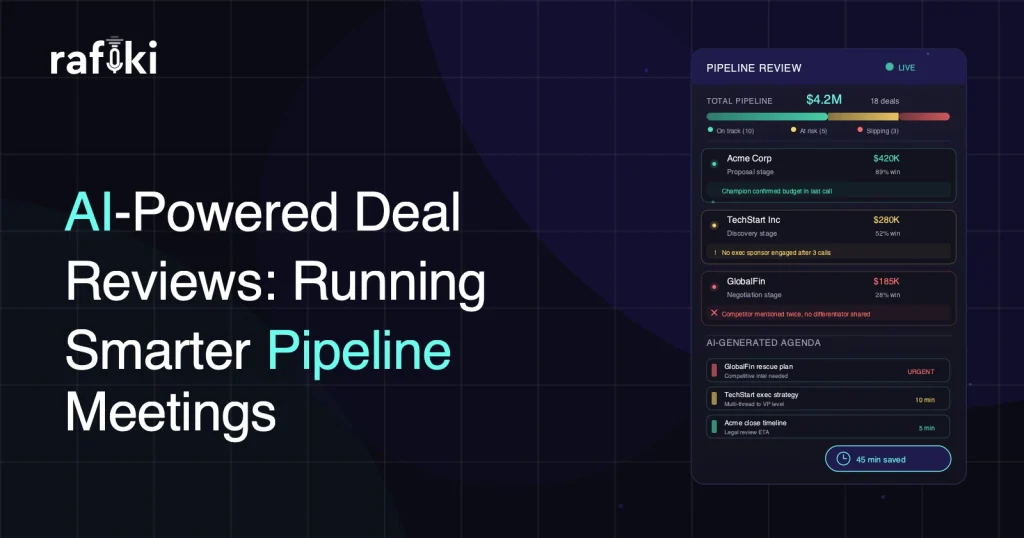
The Weekly Pipeline Meeting Is Broken — And Everyone Knows It. Every revenue leader has lived this moment.
Monday morning. Forecast call.
A CRO asks:
“How confident are we in this deal?”
An AE replies:
“They’re engaged. It looks good.”
Then comes the familiar dance:
The meeting ends with numbers adjusted — mostly based on confidence.
Weeks later, the deal slips.
The problem isn’t forecasting software.
It’s that pipeline meetings are still driven by memory, optimism, and incomplete CRM fields.
In 2026, high-performing revenue teams are replacing opinion-based pipeline reviews with AI-powered deal reviews.
And conversation intelligence platforms like Rafiki are the engine behind that shift.
Deal reviews are meant to reduce uncertainty.
But most increase it.
Here’s why.
CRM stage doesn’t tell you:
CRM reflects what was logged — not what was said.
Deal risk often appears first in conversations.
In a team with:
That’s hundreds of conversations monthly.
No manager can manually review that volume.
Critical signals go unnoticed.
Research from Gartner has shown that B2B buying groups now involve 6–10 stakeholders on average, increasing deal complexity and internal alignment challenges.¹
Yet forecast calls rarely evaluate:
Instead, they reward narrative confidence.
That’s not scalable.
AI-powered deal reviews shift pipeline meetings from:
Opinion-based → Evidence-based
Static → Continuous
Anecdotal → Pattern-driven
Instead of asking reps what they think, leaders review structured conversation intelligence.
The key shift is this:
Every deal review becomes grounded in what the customer actually said — not what the rep remembers.
This requires a conversation intelligence foundation.
This is where Rafiki becomes central.
Rafiki captures and analyzes every meeting across:
But the transformation happens in the structuring.
Rafiki extracts:
This turns unstructured dialogue into structured deal intelligence.
A single call might look fine.
Three calls showing:
Signal real risk.
Rafiki tracks conversation trends over time, not just snapshots.
In an AI-powered deal review, managers can see:
This adds temporal intelligence to forecasting.
Instead of subjective “Red/Yellow/Green” ratings, AI-powered deal reviews use structured signals such as:
Rafiki surfaces these signals automatically before pipeline meetings.
Managers walk into reviews informed.
Let’s compare traditional vs AI-powered deal reviews.
Manager: “Is this deal solid?”
Rep: “Yes, they’re excited.”
Manager: “Any risks?”
Rep: “Nothing major.”
Discussion based on perception.
Manager sees:
Now discussion becomes:
“What’s our plan to bring in the economic buyer?”
“How do we address recurring pricing pushback?”
“Should we reset close expectations?”
The meeting shifts from reporting to strategy.
AI doesn’t eliminate managers from deal reviews.
It upgrades them.
Instead of hunting for weak spots, managers:
Rafiki reduces cognitive load by surfacing what matters most.
Managers spend time deciding — not discovering.
One of the hardest conversations for CROs is board-level forecasting.
AI-powered deal reviews strengthen:
Because every forecast claim can be tied back to conversation evidence.
This dramatically reduces:
AI-powered deal reviews don’t only benefit AEs.
They inform:
Because Rafiki structures intelligence across accounts, insights extend beyond pipeline meetings.
The meeting becomes a revenue-wide intelligence sync.
Here’s a practical structure:
Before meeting:
Rafiki can surface these insights automatically.
Instead of reviewing “safe” deals first:
AI signals risk.
Humans decide action.
Examples:
Deal reviews become weekly intelligence updates — not one-time judgments.
Rafiki continuously updates structured signals between meetings.
No blind spots.
Companies that adopt AI-powered deal reviews experience:
Companies that rely solely on CRM stages continue to:
In modern B2B environments, complexity demands intelligence.
AI-powered deal reviews only work if the AI understands conversations deeply.
Surface-level summaries are insufficient.
Rafiki provides:
It transforms every meeting into analyzable revenue signals.
Without that layer, “AI-powered” becomes “dashboard-driven.”
With Rafiki, deal reviews become grounded in customer reality.
In 2026, pipeline meetings cannot rely on optimism.
They must rely on intelligence.
AI-powered deal reviews don’t eliminate human judgment.
They enhance it.
They replace:
“Feels strong.”
With:
“Here’s what the customer actually signaled.”
They replace:
“Let’s hope it closes.”
With:
“Here’s our structured risk mitigation plan.”
Rafiki turns conversations into structured pipeline intelligence.
That intelligence powers smarter deal reviews.
And smarter deal reviews lead to:
In the agentic era, the companies that win won’t have louder forecast calls.
They’ll have smarter ones.
Start for free — no credit card, no seat minimums, no long contracts. Just better sales intelligence.