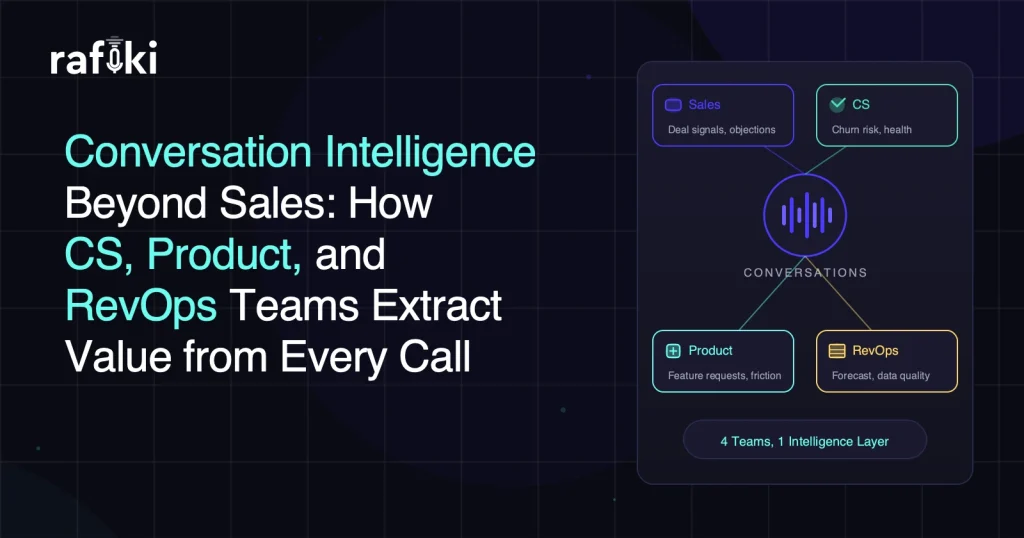
Conversation Intelligence Beyond Sales: How CS, Product, and RevOps Teams Extract Value from Every Call
Aruna Neervannan
Feb 2, 2026
11 min read
Here's a pattern that plays out at nearly every B2B company: the sales team adopts a conversation intelligence platform, reps start getting call summaries and coaching insights, and leadership celebrates the win. Meanwhile, three floors down, the customer success team is manually reviewing QBR recordings. The product team is begging PMs to "sit in on a few calls" to understand user pain. And RevOps is reconciling CRM fields that haven't matched reality since last quarter.
The data was always there. Nobody outside sales was listening.
In 2026, the companies pulling ahead aren't the ones with the best sales tools. They're the ones that treat conversation intelligence as organizational infrastructure — a foundational layer that serves every revenue-facing team. The shift from "sales enablement tool" to "revenue intelligence platform" isn't a rebrand. It's a fundamentally different way of operating. And it changes who gets access to the most honest, unfiltered source of customer truth your company produces: the actual conversations.
Why Conversation Intelligence Got Stuck in Sales
It's not hard to understand how we got here. Conversation intelligence platforms were built for sales. The original use case was clear: record calls, transcribe them, coach reps, close more deals. Naturally, sales leaders were the buyers. Their workflows became the integration points, and their metrics defined the success criteria.
As a result, that narrow framing created an accidental silo. The technology could analyze any customer conversation — onboarding calls, QBRs, support escalations, product feedback sessions — but the permissions, workflows, and dashboards were all pointed at one team. In practice, other departments either didn't know the data existed or had no way to access it in a format that made sense for their work.
The result? Companies are sitting on thousands of hours of customer conversations that contain answers to questions every team is asking. They just can't reach them.
Customer Success: Hearing Churn Before It Happens
Customer success teams live and die by their ability to detect risk early. However, most CS organizations are working with lagging indicators — NPS scores that arrive quarterly, usage dashboards that show what happened but not why, and CRM notes that reflect what a CSM chose to write down rather than what the customer actually said.
Conversations, in contrast, tell a different story. They capture tone, hesitation, the specific words a customer uses when they're frustrated versus when they're genuinely satisfied. For example, the gap between "we're evaluating our options" spoken with a sigh and the same phrase spoken with curiosity is enormous — and it's invisible in a CRM dropdown.
When CS teams get access to conversation intelligence, the workflow transforms:
Churn signals surface automatically. Rafiki's sentiment analysis flags calls where customer tone shifts negative, where concerns about pricing or value arise, or where executive sponsors go silent — all without a CSM manually reviewing every recording.
QBR insights become searchable. Instead of a CSM taking notes during a quarterly business review and hoping they captured the right details, Ask Rafiki Anything lets anyone query across all QBRs: "Which customers mentioned budget cuts in the last 90 days?" Instant answers, cited to the exact moment in the conversation.
Expansion signals get captured at the source. When a customer casually mentions they're "rolling out to two more regions" or "hiring a bigger team," that's an expansion cue. Rafiki surfaces these mentions through topic categorization and Smart Call Summaries so CSMs and account managers can act on them — not weeks later when someone remembers to update the CRM, but the same day.
Adoption blockers become visible. Product onboarding calls and training sessions reveal exactly where customers struggle. Rafiki structures these conversations so CS leaders can identify patterns — if eight customers in a row are confused by the same workflow, that's a systemic issue, not a training gap.
Consequently, the shift is profound. CS moves from reactive account management to proactive intelligence — powered by what customers actually say, not what gets filtered through three layers of internal reporting.
Product Teams: Voice of the Customer at Scale
Product managers have always known that talking to customers is essential. The problem has never been willingness — it's scale. A PM can sit in on five calls a week, maybe ten. Meanwhile, the company runs hundreds of customer conversations in the same period. As a result, the gap between what product teams hear and what customers actually say is vast.
Conversation intelligence closes that gap — not by asking PMs to listen to more calls, but by bringing the insights to them.
Feature Requests Aggregated, Not Anecdotal
Every sales and CS call contains implicit and explicit product feedback. "I wish it could do X" is obvious. That said, "we built a workaround using spreadsheets" is equally valuable — it tells you where the product falls short without the customer framing it as a request. Rafiki's Gen AI Reports can analyze hundreds of conversations and surface these patterns: which features are requested most, which workflows cause friction, which integrations customers keep asking about.
Competitive Mentions Without the Bias
When a prospect mentions a competitor on a sales call, the rep might capture it in a deal note — or might not. Similarly, when a customer mentions evaluating alternatives on a CS call, the CSM might flag it — or might assume it's not worth escalating. Conversation intelligence, however, captures every mention systematically. This means product and marketing teams can track competitive mentions over time, spot emerging threats, and understand exactly what customers compare you against and why.
Adoption Friction from Real Users
Usage analytics tell you that customers drop off at step three of a workflow. Conversations, on the other hand, tell you why. Specifically, Rafiki's topic categorization automatically tags discussions about onboarding struggles, UI confusion, missing features, and integration issues. Product teams can then query this data directly — "What do customers say about our reporting dashboard?" — and get answers grounded in actual user language, not survey responses filtered through a five-point scale.
RevOps: The Truth Layer Between CRM and Reality
Revenue operations teams are responsible for the accuracy and reliability of the data that drives every forecast, territory plan, and compensation calculation. In practice, it's an impossible job when the primary data source — the CRM — depends on humans manually entering information after every interaction.
Conversation intelligence gives RevOps something they've never had: an independent, automated record of what actually happened in customer interactions. More importantly, that changes everything about how pipeline data gets validated.
Forecast validation from real conversations. A rep says a deal is "90% likely to close this quarter." The conversation data shows the economic buyer hasn't attended a call in six weeks and the last discussion centered on "revisiting timing." Rafiki surfaces these discrepancies so RevOps and sales leadership can pressure-test forecasts against conversational reality, not just CRM stage updates.
Pipeline hygiene automated.Rafiki's Smart CRM Sync automatically captures key deal data from conversations — stakeholders mentioned, next steps committed to, objections raised, competitors discussed — and writes it back to the CRM. RevOps stops chasing reps for field updates. The data arrives automatically, structured, and timestamped.
Methodology compliance measured, not assumed. If your org runs MEDDIC, BANT, or any structured sales methodology, conversation intelligence can verify whether reps are actually executing it. Are discovery calls covering the required qualification criteria? Are champions being identified and engaged? Rafiki's analysis turns methodology from a training exercise into a measurable operational standard.
Data quality that improves over time. Every conversation that Rafiki processes adds structured data to the CRM — data that didn't depend on a rep remembering to log it. Over weeks and months, the CRM transforms from a system of manual entry to a system of record that actually reflects what's happening in the pipeline.
Marketing: Win/Loss Intelligence Straight from the Source
Marketing teams spend significant budget on messaging, positioning, and competitive differentiation. Yet how do they know if it's working? Traditionally, they rely on win/loss surveys (low response rates), sales anecdotes (biased and incomplete), or competitive intelligence tools that track what competitors say about themselves rather than what customers say about them.
Conversation intelligence gives marketing a direct line to the truth:
Win/loss analysis grounded in real language. Why did deals close? Why did they stall? Rafiki enables marketing teams to analyze winning and losing conversations at scale — identifying the messaging that resonated, the objections that weren't overcome, and the competitive dynamics that influenced decisions.
Messaging validation in real time. When sales reps deliver the new pitch deck, does the customer react with interest or confusion? Do they repeat back the value proposition in their own words, or do they immediately redirect the conversation? Gen AI Reports can surface these patterns across dozens of calls, giving marketing near-real-time feedback on positioning effectiveness.
Content gap identification. If customers consistently ask questions about a topic that sales can't answer confidently, that's a content gap. Conversation data reveals exactly what materials, case studies, or competitive battle cards the field team needs — no guesswork required.
The Organizational Shift: From Sales Tool to Revenue Intelligence
Making conversation intelligence cross-functional isn't just a matter of adding user licenses. Instead, it requires rethinking how insights flow through the organization.
In the old model, conversation data went into a platform that sales managers checked for coaching opportunities. By contrast, in the new model, conversation data feeds into workflows across CS, product, RevOps, and marketing — each team accessing the same underlying intelligence through lenses designed for their specific questions.
This is where the architecture of your conversation intelligence platform matters. Legacy tools built exclusively for sales coaching struggle to serve cross-functional use cases. Specifically, they lack the flexible query interfaces, role-based reporting, and integration depth that non-sales teams need.
Why Chose Rafiki
Rafiki was built differently. Ask Rafiki Anything lets any team member — regardless of department — ask natural-language questions across the entire conversation dataset. A CS leader can ask, "Which enterprise customers expressed frustration about onboarding in the last quarter?" Similarly, a product manager might query, "How often do customers mention our API limitations?" And a RevOps analyst can pull up, "Which deals in the pipeline have had no executive sponsor engagement in 30 days?"
Same data. Different questions. Immediate answers.
How Gen AI Reports Democratize Conversation Insights
Gen AI Reports take this a step further. Instead of requiring each team to know what questions to ask, Rafiki generates complete analytical reports on any topic — synthesizing patterns across hundreds or thousands of conversations into structured, actionable intelligence.
Consider the possibilities:
A CS leader requests a report on "customer sentiment trends across renewals due in Q2" and receives a breakdown of risk signals, positive indicators, and specific accounts that need attention.
Meanwhile, a product VP asks for "top feature requests from enterprise customers in the last 6 months" and gets a prioritized list with frequency counts, customer segments, and verbatim quotes.
A RevOps director pulls up "MEDDIC compliance across the mid-market team" and sees a scorecard showing which qualification criteria are consistently covered and which are consistently skipped.
Similarly, a CMO generates a report on "competitive mentions and positioning effectiveness for Q1 deals" and receives an analysis of which competitors appeared most, what customers said about them, and how the team's win rates varied by competitive situation.
Importantly, these aren't hypothetical scenarios. They're the kinds of questions that every revenue organization asks — and that conversation data can uniquely answer.
Breaking Down the Data Silos: What It Takes
According to Forrester's research on insights-driven organizations, companies that break down data silos and share customer insights across teams grow revenue faster than competitors who keep information locked in departmental tools. The principle applies directly to conversation intelligence.
Making the shift requires three things:
1. Universal Access with Role-Based Views
Every team that interacts with customers — or makes decisions based on customer behavior — should have access to conversation intelligence. However, they don't all need the same view. For instance, sales needs coaching dashboards, while CS needs health indicators. Product, in turn, needs feature and friction analysis, and RevOps needs pipeline accuracy metrics. The platform must support all of these without overwhelming any single user.
2. Structured Data, Not Just Transcripts
Raw transcripts are useful for search, but they're not scalable for insight. Instead, the real value comes from structured extraction — topics categorized, sentiment scored, action items identified, stakeholders mapped, competitive mentions tagged. Rafiki handles this structuring automatically, turning unstructured conversation audio into queryable, reportable data that any team can work with.
3. CRM Integration That Closes the Loop
Insights are only valuable if they reach the systems where decisions happen. For most revenue organizations, that's the CRM. Because of this, Rafiki's Smart CRM Sync ensures that conversation-derived insights don't stay trapped in a separate platform. Key data points flow back into Salesforce, HubSpot, or whatever system of record the organization uses — enriching existing workflows rather than creating new ones.
The Before and After: How Work Changes
The difference is concrete. Here's what cross-functional conversation intelligence looks like in practice:
Slack messages to AEs asking for anecdotal feedback; 3 responses over 2 weeks
Ask Rafiki Anything — type a question, get answers citing specific calls and segments. Weeks → seconds
RevOps
Quarterly CRM audit finds next-step fields empty on 40% of opportunities
Next steps captured from every conversation and synced to CRM automatically. Data quality improves passively
Marketing
Win/loss surveys with low response rates; competitive intel based on anecdotes
Gen AI Reports analyze winning vs. losing conversations at scale. Real positioning data, not guesswork
The Formula That Changes GTM Organizations
The formula is simple:
Conversation Data + Cross-Functional Access = Revenue Intelligence
Every customer-facing conversation generates intelligence that's valuable far beyond the team that hosted the call. For example, sales discovery calls contain product insights, while CS onboarding sessions reveal competitive positioning gaps. In addition, support escalations surface feature priorities, and QBRs contain forecast signals.
Ultimately, the companies that win in 2026 aren't the ones generating the most conversations. They're the ones extracting the most intelligence from the conversations they already have — and routing that intelligence to every team that can act on it.
Rafiki sits at the center of this model. Not as a sales tool that other teams borrow. As a revenue intelligence platform that serves the entire go-to-market organization — from the first prospecting call to the five-year renewal.
Conclusion: The Intelligence Was Always There
Your company runs hundreds of customer conversations every week. Each one contains signals — about risk, opportunity, product gaps, competitive dynamics, messaging effectiveness, and forecast accuracy. Yet for years, most of that signal was captured by one team and invisible to everyone else.
That era is ending. Conversation intelligence in 2026 isn't a sales enablement category. Rather, it's an organizational capability — one that connects CS, product, RevOps, and marketing to the same source of customer truth.
The data was always there. In reality, the question was never whether customer conversations contained valuable intelligence for every revenue team. It was whether your platform could make that intelligence accessible, structured, and actionable for people who aren't sales reps.
With capabilities like Ask Rafiki Anything, Gen AI Reports, Smart Call Summaries, and Smart CRM Sync, Rafiki answers that question definitively. Every team, every conversation, every insight, no silos.
The conversation intelligence era isn't beginning. It's expanding. Make sure your entire organization is part of it.
Ready to see what you've been missing?
Start for free — no credit card, no seat minimums, no long contracts. Just better sales intelligence.