AI

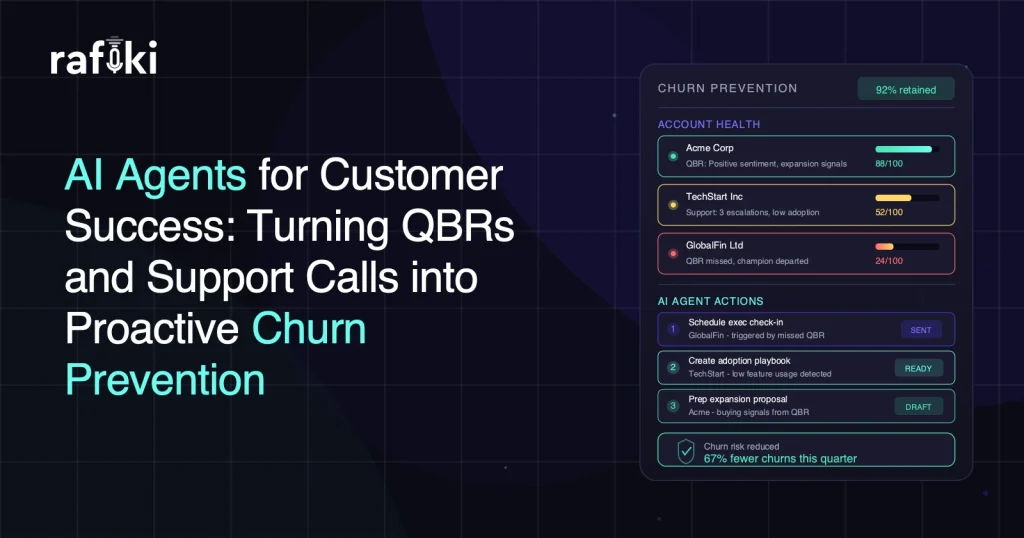
AI Agents for Customer Success: Turning QBRs and Support Calls into Proactive Churn Prevention
Mar 12, 2026
5 min read
Customer Churn Rarely Happens Suddenly — It Builds Quietly. Most churn doesn’t look dramatic.
It doesn’t start with a cancellation email.
It starts months earlier in subtle ways:
These signals appear in conversations.
But most CS teams don’t systematically track them.
They rely on:
Those are lagging indicators.
By the time usage drops, churn is already forming.
In 2026, high-performing Customer Success organizations are using AI agents for customer success to detect churn from call signals — before the account formally shows risk.
This is where conversation intelligence platforms like Rafiki become foundational.
Customer health scores typically rely on:
But churn often begins before any of those move.
For example:
Health scores built purely on product telemetry miss emotional and political signals.
Those signals live in conversations.
AI agents for customer success now analyze:
This is not manual review.
It’s structured conversation analysis at scale.
Rafiki captures CS conversations and transforms them into structured health indicators.
Instead of relying solely on usage metrics, CS teams now combine:
Usage Data + Conversation Signals = Predictive Health
Quarterly Business Reviews are gold mines of churn signals.
But most teams treat QBRs as slide presentations — not intelligence sources.
AI agents can extract:
Rafiki analyzes QBR conversations and structures:
A SaaS analytics company noticed churn spikes in accounts where QBR language shifted from:
“We’re excited about scaling.”
to
“We’re evaluating options internally.”
Usage hadn’t dropped.
But sentiment drift was visible in QBR transcripts.
By integrating Rafiki’s conversation signals into health scoring, they flagged accounts 90 days earlier than before.
Proactive executive alignment reduced churn by 18% in that segment.
Escalations rarely explode without warning.
They simmer.
AI agents monitor:
Rafiki categorizes blockers and tracks recurrence across meetings.
If the same integration issue appears in three calls, that’s no longer a one-off complaint.
It’s systemic risk.
A B2B fintech platform found that churn correlated strongly with repeated API integration complaints.
Rafiki surfaced that 73% of churned accounts had mentioned integration blockers in at least three CS calls prior to renewal.
They implemented:
Churn decreased by 12% over two quarters.
Escalation signals, once invisible, became actionable.
CSMs often manually create:
But AI agents can now build these automatically from conversations.
Rafiki extracts:
This structured intelligence feeds:
Instead of scrambling 30 days before renewal, CS teams operate with rolling renewal intelligence.
One of the biggest churn drivers is misalignment between CS and product teams.
Customers often say:
“We’ve mentioned this feature gap multiple times.”
Without structured conversation tracking, product never sees the pattern.
AI agents can:
Rafiki structures voice-of-customer signals from CS calls and enables closed-loop handoff to:
This prevents churn caused by repeated unmet expectations.
Traditional CS motion:
Problem appears → React → Mitigate → Renew (maybe)
Agentic CS motion:
Signal detected → Risk flagged → Intervention triggered → Alignment restored
AI agents for customer success shift the timeline left.
The earlier you detect risk, the cheaper it is to resolve.
Modern CS health models in 2026 include:
Rafiki provides the conversation layer necessary to feed these models with structured data.
Without structured call intelligence, churn prediction remains incomplete.
Renewals are rarely decided at the renewal call.
They’re decided months earlier.
AI agents now evaluate:
Instead of waiting for renewal stage updates, CS leaders get rolling renewal confidence indicators.
Not all signals are negative.
AI agents also detect:
Rafiki surfaces expansion readiness alongside churn risk.
Customer Success shifts from defensive to proactive growth.
AI-driven CS workflows result in:
The conversation becomes the leading indicator of customer health.
AI agents require structured conversation intelligence.
Rafiki provides:
It turns CS calls into structured health signals.
Without structured conversation intelligence, AI agents rely only on usage data.
With Rafiki, agents operate on both behavioral and emotional context.
That’s the difference between reactive retention and predictive churn prevention.
The modern CS stack looks like:
Product Usage Data
+
Rafiki Conversation Intelligence
+
AI Health Modeling Agents
+
Automated Intervention Workflows
+
Human Strategic Oversight
The AI surfaces risk.
The CSM executes alignment.
The loop closes faster.
Customers tell you they’re at risk long before they cancel.
They just don’t say it directly.
It appears in tone.
In hesitation.
In repeated blockers.
In shifting priorities.
In stakeholder absence.
In subtle competitive references.
AI agents for customer success turn those signals into structured intelligence.
Rafiki transforms QBRs, adoption reviews, and support calls into churn alerts and expansion indicators.
The future of Customer Success isn’t about reacting to declining usage.
It’s about listening systematically — and acting early.
As we move deeper into 2026, the CS teams that win won’t just track product metrics.
They’ll track conversations.
Start for free — no credit card, no seat minimums, no long contracts. Just better sales intelligence.