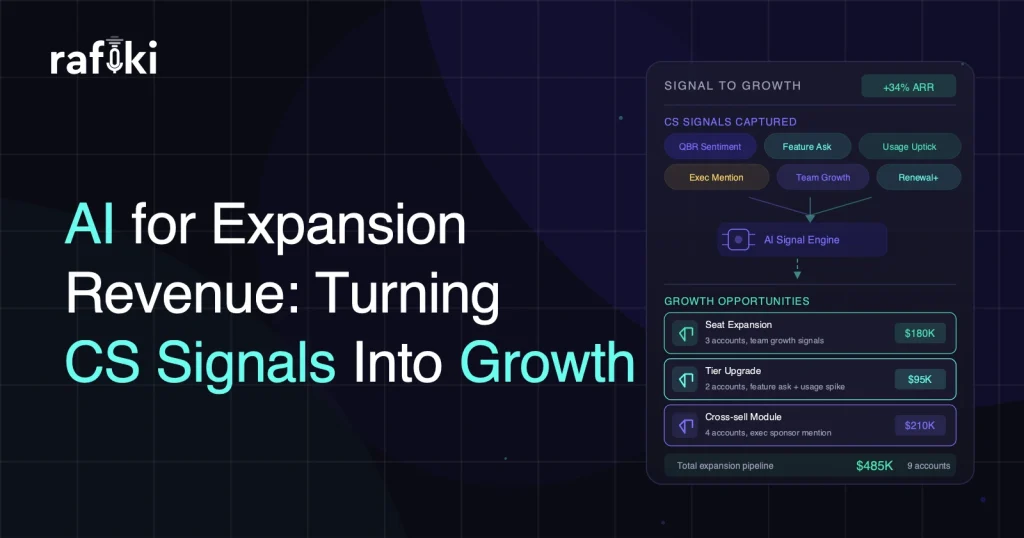
Expansion Revenue Is Won in Conversations — Not at Renewal. Most companies treat expansion as a sales event.
Renewal approaching.
Quota target rising.
New module launched.
“Let’s pitch the upsell.”
But the most successful expansions don’t feel like pitches.
They feel inevitable.
That inevitability starts long before the contract conversation.
It starts in subtle signals during:
In 2026, leading revenue teams are using AI for expansion revenue to detect these signals early and convert them into structured growth opportunities.
The shift is simple but powerful:
Expansion is no longer reactive.
It is predictive.
And platforms like Rafiki are making that shift operational by turning Customer Success conversations into structured growth intelligence.
Most expansion workflows rely on:
The limitations are clear.
Usage does not always equal readiness.
Renewal timing does not equal alignment.
Intuition does not scale.
Expansion fails when:
What’s missing is structured signal detection.
Expansion readiness rarely appears as a direct request.
It appears as:
These are growth signals.
Without AI, they remain buried in meeting notes.
With structured conversation intelligence, they become measurable expansion triggers.
AI for expansion revenue works by identifying four major signal groups inside CS conversations.
Customers often reveal expansion intent indirectly.
Signals include:
Rafiki analyzes QBRs and adoption calls to extract strategic language patterns.
If “scale,” “rollout,” “centralize,” or “standardize” language increases over time, growth readiness increases.
This allows CSMs to engage expansion conversations organically.
Deep product adoption often precedes expansion.
AI can detect:
Rafiki structures topic and subtopic tracking across meetings.
If customers consistently discuss features outside their current license scope, expansion becomes contextual — not forced.
Executive participation is a strong predictor of growth.
AI tracks:
Rafiki extracts stakeholder roles and participation depth.
If executive engagement increases, expansion probability increases.
Conversely, executive absence may signal stagnation.
Expansion depends on budget flexibility.
AI monitors:
Rafiki structures timeline specificity and budget-related cues.
This helps CSMs time expansion conversations around planning cycles.
AI for expansion revenue goes beyond detection — it quantifies readiness.
A predictive growth score may include:
Rafiki provides the structured conversation data required to feed this model.
Without structured call intelligence, expansion scoring relies solely on product metrics.
A vertical SaaS company selling compliance software struggled with inconsistent expansion.
Usage was high, but upsell rates varied unpredictably.
After implementing conversation intelligence:
They discovered:
Using AI-triggered expansion alerts powered by Rafiki’s structured conversation analysis, they improved expansion revenue by 23% year-over-year.
The key shift was timing.
Here’s how AI for expansion revenue works in practice.
Rafiki analyzes:
It extracts structured growth signals in real time.
When two or more expansion indicators appear, the system flags the account.
Examples:
Instead of pushing product features, CSMs:
Expansion feels natural because it’s signal-driven.
AI expansion signals also inform:
Rafiki ensures sales and CS operate from shared conversation intelligence.
Not all signals indicate growth readiness.
AI also detects:
If risk signals outweigh growth signals, expansion should pause.
Rafiki surfaces these friction indicators, protecting account health and preventing premature upsell attempts.
Expansion revenue is a primary driver of Net Revenue Retention.
In the agentic era, NRR improves when:
AI turns NRR from a passive metric into an actively managed growth system.
AI-driven expansion workflows result in:
Expansion stops being quota pressure.
It becomes structured growth enablement.
AI agents require structured intelligence to operate reliably.
Rafiki provides:
It turns CS conversations into structured growth intelligence.
Without this layer, expansion signals remain anecdotal.
With Rafiki, they become measurable and actionable.
Modern expansion architecture includes:
Product Usage Metrics
+
Rafiki Conversation Intelligence
+
AI Growth Modeling
+
Automated Expansion Alerts
+
Human Strategic Alignment
Conversation intelligence is the bridge between product behavior and revenue action.
As markets become more competitive and budgets tighten, expansion efficiency matters more than ever.
The companies that grow fastest will:
AI for expansion revenue makes this scalable.
Expansion revenue is not created by aggressive pitching.
It’s created by alignment.
Customers signal growth readiness long before they approve expanded contracts.
They reveal it in strategy discussions, QBR language, stakeholder shifts, and curiosity about advanced capabilities.
AI for expansion revenue turns those signals into structured opportunity.
Rafiki transforms every CS conversation into growth intelligence.
And in 2026, the companies that listen systematically will expand systematically.
Because growth doesn’t start with a proposal.
It starts with a signal.
Start for free — no credit card, no seat minimums, no long contracts. Just better sales intelligence.