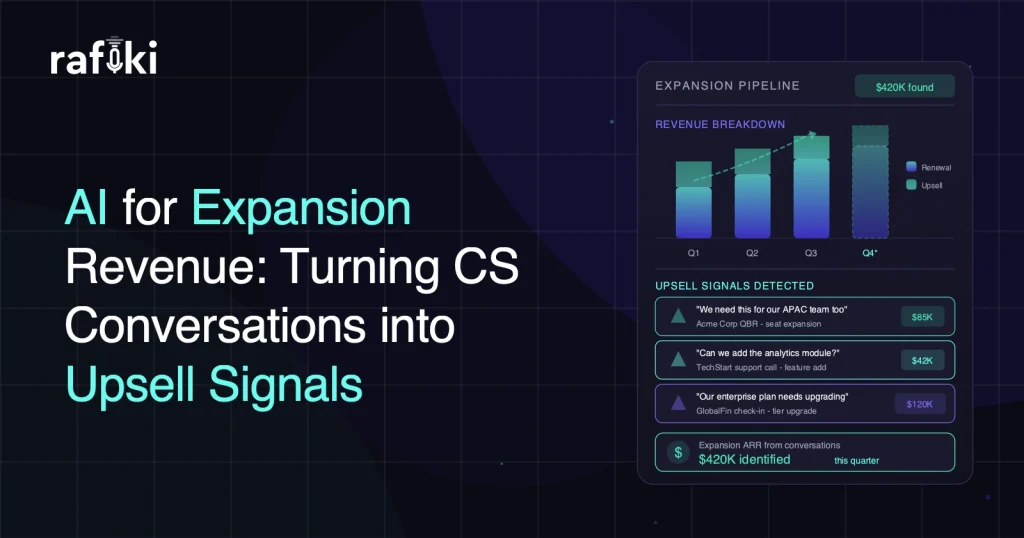
Expansion Doesn’t Start with a Pricing Conversation — It Starts with a Signal. Most companies treat upsells like events.
Renewal approaching.
Quota pressure rising.
New product launched.
“Let’s pitch expansion.”
But expansion rarely succeeds when it feels sudden.
The best expansions don’t feel like sales.
They feel like the natural next step.
And that “next step” signal almost always appears months earlier — in Customer Success conversations.
In 2026, AI for expansion revenue is transforming how teams identify and act on those signals.
Instead of waiting for renewal cycles, leading CS teams use structured conversation intelligence to predict upsell readiness long before the pitch.
This is where platforms like Rafiki become strategic growth infrastructure — not just call recording tools.
Expansion is often reactive because teams rely on:
These inputs are helpful — but incomplete.
Expansion opportunity often appears in subtle ways:
If these signals aren’t structured and tracked, they’re forgotten.
Expansion becomes guesswork.
AI for expansion revenue changes the trigger point.
Instead of:
Renewal approaching → Propose upsell
The motion becomes:
Signal detected → Validate need → Align → Expand
That’s a fundamentally different workflow.
It requires structured analysis of CS conversations.
And that’s where Rafiki plays a critical role.
Expansion signals surface in three primary CS touchpoints:
Each contains distinct growth cues.
Quarterly Business Reviews are often under-leveraged for expansion.
Customers may mention:
AI conversation intelligence extracts:
Rafiki structures QBR signals such as:
These are expansion triggers.
Without structured tracking, they disappear into notes.
Expansion often correlates with deep adoption.
AI can detect:
Rafiki categorizes topics and subtopics across CS calls.
If advanced features are repeatedly discussed but not licensed, that’s a strong upsell signal.
Instead of pushing blindly, CSMs can:
Expansion becomes consultative.
Executive participation often predicts expansion.
AI tracks:
Rafiki surfaces stakeholder participation depth.
If a VP or C-suite stakeholder begins joining QBRs and asking future-oriented questions, expansion probability increases.
This isn’t guesswork — it’s pattern recognition.
Conversation signals become actionable when structured into a growth readiness model.
Example weighted factors:
Rafiki provides the structured input required to feed this model.
Without conversation intelligence, expansion scoring relies solely on usage thresholds.
That misses emotional and strategic cues.
A mid-market SaaS company selling workflow automation tools struggled with unpredictable expansion revenue.
Usage was high across accounts, but upsell conversion was inconsistent.
After integrating conversation intelligence:
They discovered:
By triggering proactive “growth alignment calls” when two conversation signals appeared, expansion revenue increased by 21% in one year.
The insight came from structured CS call analysis — not renewal reminders.
Here’s how AI for expansion revenue operates in 2026.
Rafiki analyzes:
It extracts structured expansion indicators.
If system detects:
CSMs receive expansion readiness alerts.
Instead of pitching immediately, CSM validates:
AI-generated account briefs summarize:
Rafiki’s structured conversation intelligence makes this plan contextual and specific.
High usage does not equal upsell readiness.
Customers may:
Conversation intelligence captures nuance that telemetry misses.
For example:
Usage steady, but QBR language includes:
“We’re standardizing across business units.”
That’s growth signal.
Usage high, but tone shifts to:
“We need to justify spend next year.”
That’s risk signal.
Predictive expansion requires both.
AI doesn’t just detect growth — it prevents mistimed expansion.
If conversation analysis shows:
Then upsell motion should pause.
Rafiki surfaces these friction signals, protecting account health.
Expansion should follow alignment — not precede it.
Conversation-derived expansion signals also inform:
If advanced feature curiosity spikes across multiple accounts, product marketing can respond proactively.
Conversation intelligence becomes growth intelligence.
AI for expansion revenue changes:
Growth signals quantified earlier.
Upsell opportunities handed off with context.
Expansion probability grounded in structured signals.
NRR predictions backed by conversation data.
Modern expansion architecture includes:
Product Usage Metrics
+
Rafiki Conversation Intelligence
+
AI Growth Readiness Modeling
+
Automated Expansion Alerts
+
Human Strategic Alignment
Conversation intelligence sits at the core.
Without it, expansion remains opportunistic.
With it, expansion becomes predictive.
Companies adopting AI-driven expansion workflows see:
Growth compounds when timing improves.
Timing improves when signals are structured.
Expansion revenue isn’t created at renewal.
It’s seeded in conversations months earlier.
Customers tell you they’re ready to grow.
They say:
“We’re scaling.”
“Our team is expanding.”
“Can this handle more complexity?”
“We’re onboarding another department.”
If those signals aren’t captured and structured, they vanish.
AI for expansion revenue transforms CS conversations into growth intelligence.
Rafiki structures:
This enables proactive, contextual upsell motion.
In 2026, expansion will not be driven by quotas.
It will be driven by signals.
And the teams that listen systematically will grow systematically.
Start for free — no credit card, no seat minimums, no long contracts. Just better sales intelligence.