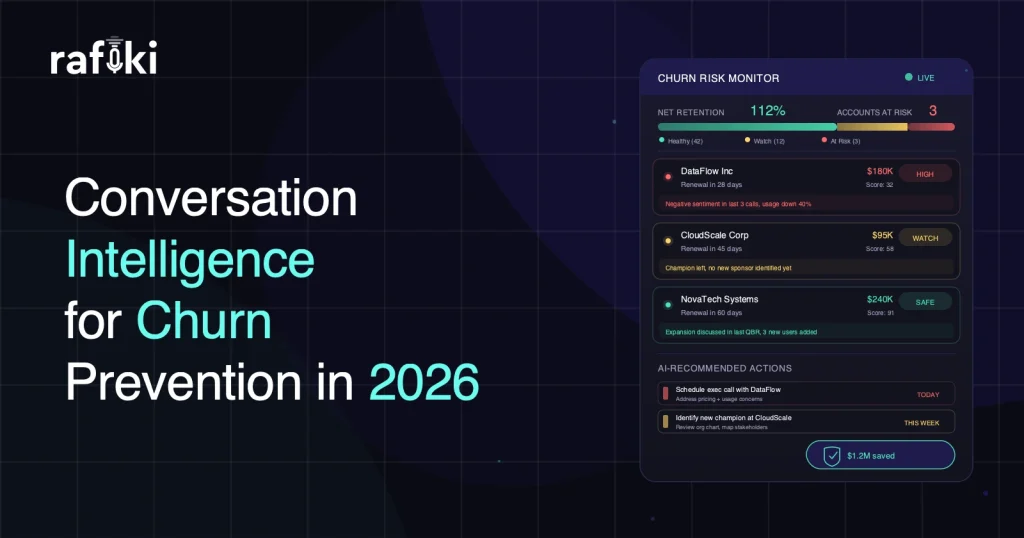
Customer churn rarely happens suddenly — it builds quietly over months of missed signals and deteriorating relationships.
Your customer success team catches the obvious red flags. The angry escalation calls. The contract renewal that gets pushed three times. The executive sponsor who stops responding to emails. But by then, the relationship is already on life support.
The real challenge with churn prevention isn't identifying customers who are already gone. It's spotting the subtle shifts in engagement patterns, conversation tone, and stakeholder dynamics that predict churn months before renewal comes up. Most organizations rely on lagging indicators like NPS scores and support tickets to gauge customer health. Meanwhile, the most predictive signals are hiding in plain sight within every customer conversation — if you know how to extract them.
Traditional churn prevention operates like an emergency room. Teams wait for symptoms to become severe before taking action. Customer Success Managers juggle hundreds of accounts with limited visibility into relationship health until quarterly business reviews surface problems that have been brewing for months.
This reactive approach fails because it misses the early warning system embedded in every customer interaction:
The result is churn prevention that kicks in too late, when relationship repair requires heroic efforts rather than course corrections. Teams find themselves fighting uphill battles to save customers who showed warning signs months earlier.
Effective churn prevention starts with treating every customer conversation as a data source for relationship health. Your customers tell you exactly what they think about your product, your service, and their likelihood to renew. The challenge is systematically capturing and analyzing these signals at scale.
This approach requires shifting from event-based monitoring to conversation-based intelligence:
The goal is building predictive models that flag at-risk accounts when intervention can still change outcomes. Instead of reacting to churn symptoms, you're identifying and addressing root causes while relationships remain salvageable.
Customer conversations contain predictable patterns that precede churn decisions. These patterns appear weeks or months before formal renewal discussions, giving teams time to intervene strategically rather than defensively.
The most predictive conversation signals include changes in stakeholder participation and engagement quality:
These patterns represent relationship erosion that traditional health scores miss. Product usage might remain stable while decision-maker engagement deteriorates. Support satisfaction scores might look healthy while budget priorities shift toward competing initiatives.
Churn prevention requires understanding not just what customers think, but who influences renewal decisions and how their perspectives evolve over time. Most customer success teams focus on primary contacts while losing visibility into broader stakeholder dynamics.
Conversation intelligence enables continuous stakeholder mapping that reveals changing decision-making patterns:
This intelligence transforms customer success from contact management to relationship orchestration. Instead of hoping primary contacts represent broader organizational sentiment, teams gain visibility into the full decision-making ecosystem.
Identifying churn risk is worthless without systematic intervention processes that address root causes before they become renewal obstacles. The most effective interventions are conversation-driven, addressing specific concerns and stakeholder dynamics rather than generic retention tactics.
Proactive intervention strategies should be tailored to the specific risk signals detected in customer conversations:
The key is matching intervention strategies to conversation context rather than applying blanket retention approaches. A customer questioning budget allocation needs different engagement than one expressing frustration with implementation progress.
Rafiki transforms churn prevention from reactive firefighting to proactive relationship management by automatically analyzing every customer conversation for risk signals and intervention opportunities. The platform's AI agents work continuously to surface insights that human teams would miss or identify too late.
The Smart Call Scoring capability evaluates customer conversations against churn risk frameworks, automatically flagging accounts showing early warning signs like stakeholder disengagement or value realization challenges. Instead of waiting for quarterly business reviews to surface problems, teams get real-time alerts when conversation patterns indicate relationship erosion.
Rafiki's conversation intelligence specifically supports churn prevention through systematic pattern recognition:
The Gen AI Reports feature enables Customer Success leaders to analyze churn patterns across their entire portfolio, identifying systematic issues that affect multiple accounts rather than treating each at-risk customer as an isolated incident.
Customer Success teams use Rafiki's conversation intelligence to transform from reactive account management to predictive relationship orchestration, intervening strategically when outcomes can still be influenced.
Successfully implementing conversation intelligence for churn prevention requires systematic changes to customer success processes and team workflows. The most effective implementations start with pilot programs that demonstrate value before scaling across entire customer portfolios.
Phase 1: Foundation Building (Weeks 1-4)
Phase 2: Risk Detection Optimization (Weeks 5-12)
Phase 3: Scale and Systematize (Weeks 13+)
Success requires treating conversation intelligence as infrastructure rather than a point solution, embedding insights into existing customer success workflows and decision-making processes.
Conversation-driven churn prevention enables more sophisticated measurement approaches that track leading indicators alongside traditional lagging metrics. Instead of only measuring gross revenue retention after customers leave, teams can track relationship health improvements and intervention effectiveness.
Advanced churn prevention metrics focus on early signal detection and intervention success rates:
These metrics provide visibility into churn prevention as a systematic capability rather than ad-hoc retention efforts. Teams can identify which intervention strategies work best for different risk scenarios and continuously improve their predictive models.
Organizations that master conversation-driven churn prevention create sustainable competitive advantages that compound over time. While competitors react to churn symptoms, these companies prevent churn by systematically strengthening customer relationships before problems develop.
This advantage extends beyond retention metrics to influence entire go-to-market strategies. Conversation intelligence reveals why customers choose to stay, providing insights that inform product development, market positioning, and expansion opportunities. Customer Success becomes a strategic function that drives growth rather than just defending existing revenue.
The most sophisticated revenue organizations treat conversation intelligence as core infrastructure that powers not just churn prevention, but customer success, sales effectiveness, and strategic planning. Every customer interaction becomes data that improves decision-making across multiple functions and time horizons.
Ready to transform churn prevention from reactive firefighting to proactive relationship management? Rafiki's conversation intelligence platform starts at $19 per seat per month with no annual commitment and no user minimums. Start your free trial today or book a personalized demo to see how conversation-driven churn prevention works for your customer portfolio.
Start for free — no credit card, no seat minimums, no long contracts. Just better sales intelligence.