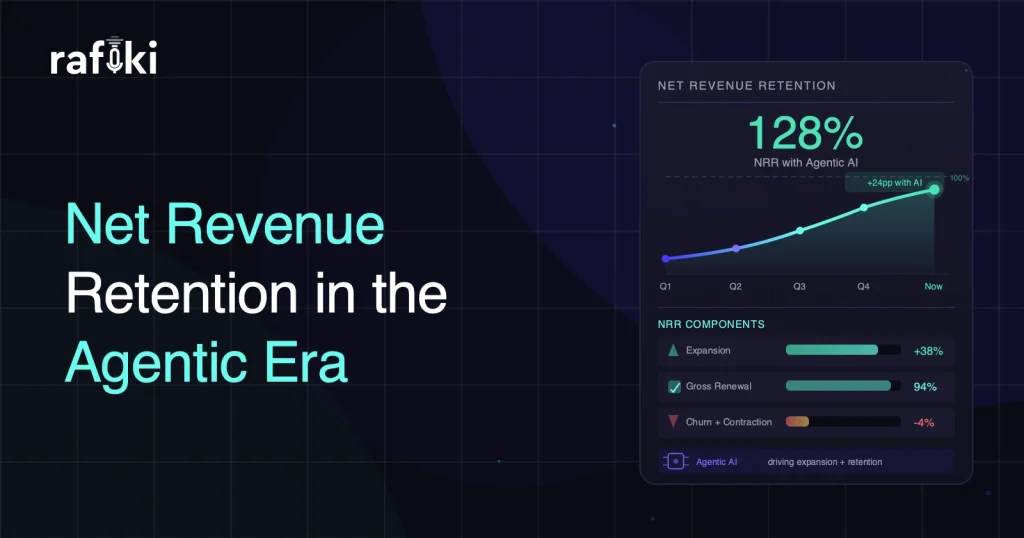
Net Revenue Retention Is No Longer a Metric — It’s a System. For years, Net Revenue Retention (NRR) was treated as an outcome.
You measured it quarterly.
You reported it to the board.
You celebrated when it rose.
You investigated when it fell.
But you rarely controlled it directly.
NRR was the result of:
In 2026, that mindset is outdated.
Net Revenue Retention in the agentic era is not just reported.
It is engineered.
AI systems now allow revenue teams to detect churn risk early, surface expansion readiness, and align Sales and Customer Success in real time.
And at the center of this shift is structured conversation intelligence — the layer that turns customer dialogue into actionable revenue signals.
Platforms like Rafiki are redefining how NRR is managed, predicted, and optimized.
The term “agentic” refers to AI systems that:
In revenue teams, this means AI agents now:
NRR in 2026 is influenced not by manual dashboards — but by AI-driven signal detection.
Historically, NRR strategy depended on:
The flaw?
These are lagging indicators.
By the time:
Churn is already forming.
Expansion opportunity may also be missed.
NRR was monitored — not actively shaped.
To engineer NRR in 2026, revenue teams focus on three AI-powered pillars:
1️⃣ Predictive Retention
2️⃣ Proactive Expansion
3️⃣ Continuous Signal Orchestration
Churn rarely begins with cancellation intent.
It begins with language shifts.
Examples:
These signals often appear 60–120 days before churn.
Rafiki analyzes:
This structured conversation intelligence feeds predictive churn models.
Instead of waiting for product usage decline, AI agents flag risk early.
This allows:
Predictive retention increases NRR stability.
Expansion is often opportunistic.
But in the agentic era, it becomes signal-driven.
Customers signal growth readiness through:
Rafiki extracts structured signals such as:
AI models can assign growth readiness probability.
CSMs act before renewal windows.
Expansion becomes consultative — not quota-driven.
NRR improves because upsell timing improves.
NRR does not live solely within Customer Success.
It depends on:
Agentic revenue orchestration connects:
Sales conversations
→ Onboarding insights
→ QBR signals
→ Renewal readiness
→ Expansion triggers
Rafiki acts as the conversation intelligence layer that connects these lifecycle stages.
Every meeting — from discovery to renewal — becomes part of the NRR intelligence system.
Traditional health scores focus on:
Predictive revenue scores incorporate:
Rafiki structures these signals across:
This allows AI agents to continuously recalculate:
NRR becomes a dynamic forecast, not a retrospective metric.
A mid-market SaaS company struggled with inconsistent NRR (ranging 101–112%).
After integrating conversation intelligence into their CS workflows, they discovered:
By implementing AI-triggered interventions when two conversation risk factors appeared, they:
The difference wasn’t more outreach.
It was better signal detection.
Net Revenue Retention in the agentic era requires:
Renewal stage is late-stage intelligence.
Conversation signals are early-stage intelligence.
NRR projections must incorporate structured dialogue signals.
Early qualification gaps often cause later churn.
Rafiki connects qualification signals from sales calls into CS onboarding context.
Recurring feature gaps influence retention risk.
Structured conversation analysis quantifies those themes.
Agentic systems need structured data.
Without structured conversation intelligence:
Rafiki provides:
It turns qualitative dialogue into quantitative revenue intelligence.
That intelligence powers predictive NRR models.
Companies adopting AI-driven NRR systems see:
NRR becomes less fragile.
And more controllable.
In the agentic era, the NRR stack looks like:
Product Usage Telemetry
+
Rafiki Conversation Intelligence
+
AI Retention & Expansion Modeling
+
Automated Intervention Triggers
+
Human Strategic Oversight
This layered system creates compounding revenue stability.
In 2026, Net Revenue Retention in the agentic era is engineered through intelligence.
Not hope.
Not late-stage interventions.
Not quarterly reporting.
Every customer conversation contains signals about:
The companies that structure and act on those signals first will control NRR — not just measure it.
Rafiki transforms conversations across Sales and Customer Success into structured revenue intelligence.
That intelligence powers predictive retention, proactive expansion, and coordinated lifecycle execution.
In the agentic era, NRR is not a number on a dashboard.
It is the outcome of listening systematically — and acting intelligently.
And the companies that build that system will outpace those still reacting to churn after it happens.
Start for free — no credit card, no seat minimums, no long contracts. Just better sales intelligence.