The Health Score Is Broken — But Nobody Says It Out Loud. Every Customer Success leader has a health score.
Green.
Yellow.
Red.
It’s typically built from:
But here’s the uncomfortable truth:
Most churned accounts were “green” at some point before they left.
Health scores based solely on usage are reactive.
They tell you when the house is already on fire.
In 2026, leading CS organizations are building predictive customer health scores that incorporate not just product telemetry — but conversation intelligence.
Because churn is rarely a usage problem first.
It’s a signal problem.
Usage metrics are clean and measurable.
That’s why teams love them.
But they miss critical dimensions of customer reality.
A customer can:
While internally deciding to evaluate alternatives.
Usage doesn’t capture emotional alignment.
Conversations do.
Support tickets show:
They do not show:
Those appear in meetings.
NPS is:
It doesn’t track sentiment drift across multiple conversations.
Conversation analysis does.
Predictive customer health scores combine:
Quantitative signals
+
Behavioral signals
+
Conversational signals
This creates a multidimensional risk profile.
The biggest advancement in 2025–2026 has been the integration of AI-driven conversation intelligence into health scoring.
This is where platforms like Rafiki are transforming Customer Success.
Still important.
Includes:
But this is just the baseline.
Signals include:
Still reactive.
But useful.
This is where predictive scoring becomes powerful.
Rafiki analyzes QBRs, adoption calls, renewal conversations, and escalations to extract:
These signals often appear 60–120 days before usage declines.
Health models must also track:
AI conversation analysis makes these patterns visible.
Let’s examine what predictive churn indicators look like in practice.
Sentiment isn’t about positivity.
It’s about direction.
A predictive health model tracks:
Rafiki structures sentiment analysis across meetings, not just single-call tone.
A gradual decline in enthusiasm is often a leading churn indicator.
If a customer mentions:
“We’re still struggling with integration.”
In three separate calls, that’s not noise.
That’s risk.
Rafiki categorizes blockers and tracks recurrence across QBRs and adoption calls.
Repeated blockers correlate strongly with churn probability.
Predictive health models must track:
Rafiki extracts stakeholder mentions and authority language.
If executive presence drops before renewal, risk increases.
Customers rarely announce:
“We are switching.”
Instead, they say:
“We’re exploring alternatives.”
Rafiki tracks competitive references across calls.
Even a single mention early in renewal cycle increases churn probability significantly.
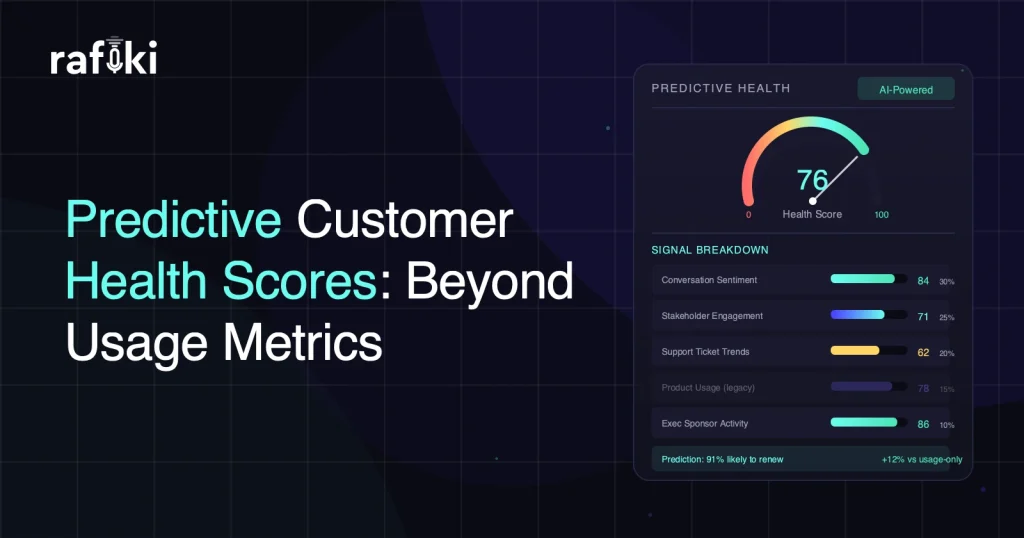
Once conversation signals are structured, health scoring becomes probabilistic.
Example weighted model:
Conversation intelligence significantly increases model accuracy.
Without it, models remain incomplete.
A mid-market SaaS company built a predictive health model combining:
They discovered:
By triggering proactive intervention when two conversation-based risk factors appeared, they reduced churn by 14% in two quarters.
The insight came from structured conversation intelligence — not product metrics alone.
Predictive health models only matter if they trigger action.
In 2026, AI agents for Customer Success trigger workflows such as:
If sentiment drift + blocker recurrence → Escalate to Senior CSM
If executive disengagement detected → Schedule executive alignment session
If competitive mention appears → Deploy value reinforcement campaign
If renewal timeline vague → Clarify procurement milestones
Rafiki provides the structured signals that power these automations.
Predictive health models also surface:
Conversation intelligence reveals upsell readiness before CSMs formally propose expansion.
Growth becomes predictive, not reactive.
Predictive health scoring changes:
Board decks include conversation-derived risk signals.
High-risk accounts surfaced automatically.
Recurring feature complaints quantified and routed.
Conversation-based renewal confidence scores improve NRR predictability.
Predictive health models fail without structured input.
Manual note-taking cannot scale.
Rafiki transforms CS conversations into:
This turns qualitative dialogue into quantitative risk inputs.
Without structured conversation analysis, predictive health scoring is incomplete.
The modern predictive stack includes:
Product Usage Data
+
Support Telemetry
+
Rafiki Conversation Intelligence
+
AI Health Modeling Engine
+
Automated Intervention Workflows
+
Human Strategic Oversight
This layered model increases churn predictability dramatically.
Companies adopting predictive customer health scores experience:
Reactive CS becomes obsolete.
Predictive CS becomes standard.
The future of Customer Success isn’t about prettier dashboards.
It’s about better signals.
Usage metrics are necessary — but insufficient.
Customers tell you they’re at risk long before usage drops.
They tell you in:
Predictive customer health scores combine quantitative telemetry with structured conversation intelligence.
Rafiki turns every CS call into actionable health signals.
In 2026, the CS teams that lead won’t just measure usage.
They’ll measure conversations.
And those who detect risk first — retain revenue first.
Start for free — no credit card, no seat minimums, no long contracts. Just better sales intelligence.