Product-Led

Outreach Conversation Intelligence + Rafiki: Sequences That Learn

Aruna Neervannan
Mar 31, 2026 11 min read
Outreach Conversation Intelligence + Rafiki: Sequences That Learn

Your outreach sequences are firing in the dark — and the calls that could light the way are sitting unreviewed in a folder no one opens.

Sales teams in 2026 run sophisticated multi-step sequences through platforms like Outreach. They A/B test subject lines, optimize send times, and measure open rates down to two decimal places. Yet the one asset that holds the richest buyer signal — the actual conversation — rarely feeds back into the sequencing engine. The result is a painful loop: reps execute sequences that never evolve, prospects receive messages disconnected from what they said on the last call, and pipeline stalls for reasons leadership discovers too late. This is the gap that Outreach conversation intelligence workflows are supposed to close, but most teams never get there because their tooling treats calls and sequences as separate worlds.

The cost is not abstract. When a prospect explicitly names a competitor on a discovery call, and the follow-up sequence ignores that objection entirely, you do not just lose the deal — you erode trust. When a champion mentions an internal budget review timeline, and the next cadence step fires a generic case-study email two weeks too early, you telegraph that nobody is listening. Multiply that across hundreds of active sequences and thousands of touches per quarter, and you start to understand why conversion rates plateau even as activity metrics climb.

The Broken Feedback Loop: Why Sequences Stop Learning

Outreach conversation intelligence is the practice of feeding real call and meeting insights back into automated sales sequences so that every subsequent touch reflects what the buyer actually said. In theory, this creates a self-improving system. In practice, the loop breaks at three predictable points.

  • Manual call review bottlenecks — Managers can review a fraction of calls each week. The insights that do surface are qualitative notes in Slack, not structured data that a sequencing engine can act on.
  • CRM field poverty — Even when reps log call outcomes, they reduce a thirty-minute discovery conversation to a single dropdown: "Demo Scheduled" or "Follow Up." The nuance — the specific pain, the buying committee dynamics, the objection pattern — vanishes.
  • Static sequence design — Most sequences are built once, cloned, and lightly edited. They do not adapt to the signals a prospect reveals across multiple interactions because those signals never reach the sequence builder in structured form.

The underlying problem is architectural. Legacy tools treat call recording, transcription, CRM updates, and sequencing as separate modules connected by brittle integrations and manual handoffs. Every handoff is a point of signal loss. By the time a useful insight travels from a recorded call to a sequence adjustment, the buying window has moved.

What "Sequences That Learn" Actually Means

A learning sequence is one that adapts its messaging, timing, and channel mix based on structured intelligence extracted from prior buyer interactions. This is not science fiction — it is a workflow design pattern that becomes possible when conversation intelligence is embedded, not bolted on.

  • Signal extraction — Every call produces structured outputs: objections raised, competitors mentioned, decision criteria stated, next steps committed, sentiment shifts detected. These are not summaries for a manager to skim; they are machine-readable fields.
  • Conditional branching — Sequence steps branch based on extracted signals. A prospect who mentioned budget constraints on a discovery call enters a value-ROI track. A prospect who named a specific competitor enters a competitive displacement track.
  • Timing adaptation — If a buyer says "we're reviewing vendors in Q3," the sequence pauses high-pressure steps and shifts to nurture content, then re-engages on a timeline aligned with the stated evaluation window.
  • Feedback scoring — Each sequence variant is scored not just on open and reply rates, but on downstream outcomes: meetings booked, pipeline generated, deals closed. The system learns which conversation-informed branches produce revenue, not just engagement.

This model flips the traditional relationship between sequences and conversations. Instead of sequences driving calls and calls being an afterthought, calls become the intelligence source that continuously reshapes sequences. The sequence becomes a living system, not a static playbook.

The Five Signals Your Sequences Should Consume

Not all conversation data is equally useful for sequence optimization. Teams that attempt to pipe "everything" into their outreach workflows drown in noise. The highest-leverage signals fall into five categories.

Objection Patterns

When a prospect raises a pricing objection, a security concern, or an integration question, the next sequence step should address that specific friction — not deliver a generic testimonial. Objection data, extracted and categorized automatically, is the single most actionable signal for sequence branching.

Competitive Mentions

Buyers who name a competitor are signaling an active evaluation. Your sequence needs to pivot immediately to differentiation content tailored to that specific competitor. Research on B2B buying dynamics consistently shows that buyers form vendor preferences earlier in the cycle than most sellers assume — which means competitive displacement content delivered late is content delivered never.

Decision Criteria and Process

When a buyer reveals their evaluation criteria — whether they map to MEDDIC, BANT, or a custom framework — those criteria should populate both the CRM and the sequence logic. If "time to value" is the stated priority, every subsequent touch should reinforce speed of deployment, not feature breadth.

Stakeholder Mapping

Calls frequently reveal names, roles, and influence levels of other stakeholders in the buying committee. Sequences that incorporate multi-threading — targeting newly identified stakeholders with role-specific messaging — outperform single-thread sequences consistently.

Timing and Urgency Cues

Buyers often state timelines explicitly: "We need to have something in place by end of Q2." They also drop implicit urgency cues: "Our current contract expires in ninety days." Both signal types should adjust sequence pacing.

  • Explicit timelines set sequence pause-and-resume windows
  • Urgency cues accelerate cadence and shift tone from educational to action-oriented
  • Absence of any timeline signal suggests a nurture track, not a close track

Designing the Closed-Loop Workflow: Outreach Conversation Intelligence in Practice

The operational model for Outreach conversation intelligence that actually works requires four layers, each feeding the next without manual intervention.

  • Layer 1: Capture — Every call, video meeting, and voicemail is recorded and transcribed automatically, across all participants and languages. Global teams need this in sixty-plus languages, not just English.
  • Layer 2: Extract — AI models parse transcripts for the five signal categories above, producing structured fields — not just summaries. These fields are tagged by deal, by contact, and by sequence enrollment.
  • Layer 3: Sync — Extracted fields push to the CRM and the sequencing platform in near-real time. No rep intervention. No copy-paste. No "I'll update it later."
  • Layer 4: Adapt — Sequence logic consumes synced fields and routes prospects into the appropriate branch, adjusts timing, and modifies content blocks. The rep sees a recommended next step; the prospect receives a message that feels like a direct response to what they said.

This four-layer model is where most teams stall — not because the concept is complex, but because their tooling was not built to operate this way. Traditional platforms handle Layer 1 reasonably well. Layers 2 through 4 require AI-native architecture: models that understand sales context, agents that act autonomously, and integrations that write to CRM fields without human triggers.

How Rafiki AI Powers Learning Sequences with Outreach

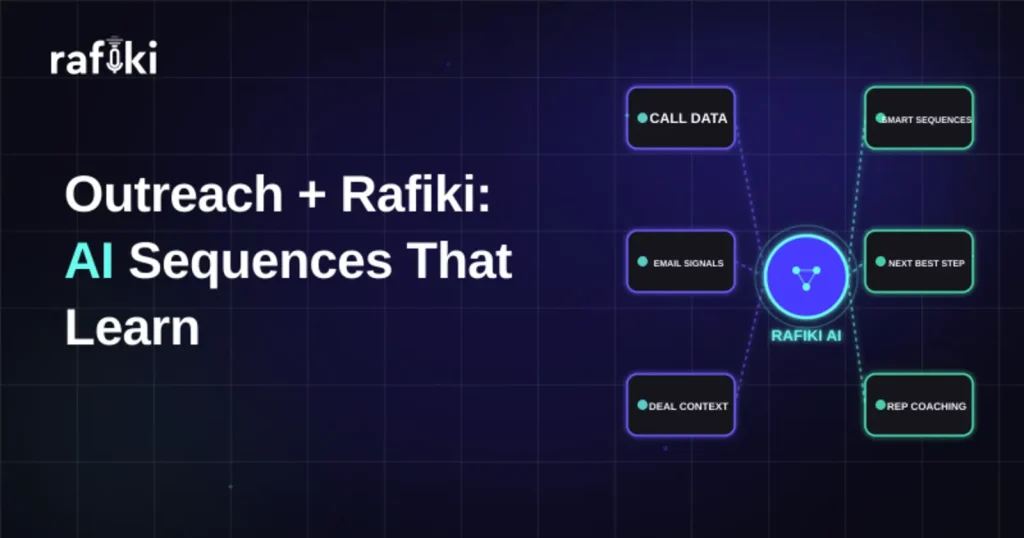
Rafiki AI is an AI-native revenue intelligence platform built from day one on multi-model AI architecture — not a call recorder with analytics bolted on after the fact. Its six autonomous AI agents map directly to the four-layer workflow described above, and they operate around the clock without seat minimums or annual contracts.

  • Smart Call Summary — Generates structured, multi-section summaries for every call. These are not generic transcripts; they extract objections, next steps, competitor mentions, and decision criteria as discrete fields that downstream systems can consume.
  • Smart CRM Sync — Auto-populates methodology-specific fields in Salesforce, HubSpot, Zoho, Pipedrive, or Freshworks. Whether your team runs MEDDIC, BANT, SPICED, SPIN, GAP, Challenger, Sandler, or a custom framework, Rafiki AI writes the extracted data to the correct CRM fields after every call — no rep input needed. This is the bridge between conversation intelligence and sequence logic.
  • Smart Call Scoring — Scores every call against your chosen methodology (including MEDDIC, BANT, SPIN, SPICED, GAP, Challenger, Sandler) or custom criteria, surfacing which conversations advanced deals and which introduced risk. Scoring data feeds back into sequence optimization: reps who consistently score high on competitive handling, for example, can have their talk tracks templated into sequence content blocks.
  • Smart Follow Up — Generates contextual follow-up drafts based on what was actually discussed, not what a template assumes. When integrated with Outreach sequences, this means every post-call touchpoint references specific buyer statements, objections, and commitments.
  • Ask Rafiki Anything — Query conversation data across your entire pipeline using natural language. Sales leaders and reps can ask targeted questions about deal risks, objection trends, and competitive patterns, getting instant answers grounded in actual call evidence.
  • Gen AI Reports — Leadership and RevOps teams generate AI-powered reports across the entire pipeline to identify which sequence branches correlate with closed-won outcomes, which objection patterns persist, and where coaching interventions will have the highest leverage. Paired with Gen AI Search, teams can surface specific conversation moments across thousands of calls in seconds.

Because Rafiki AI starts at $19 per seat per month with no minimums and no annual commitment, growing teams can deploy full Outreach conversation intelligence without the budget battles that enterprise incumbents demand. A five-rep SDR team pays the same per-seat rate as a two-hundred-rep organization — and gets the same AI agents, the same sixty-plus language support, and the same integration depth.

Implementation: A Phased Rollout for Outreach + Rafiki AI

Rolling out learning sequences does not require a six-month implementation project. The following phased approach gets teams operational in weeks, not quarters.

  1. Week 1: Connect and capture — Integrate Rafiki AI with your meeting platforms (Zoom, Teams, Google Meet) and your CRM. Rafiki AI's quick setup means this is a same-day task for most teams. Enable recording and transcription for all prospect-facing calls.
  2. Week 2: Map signal fields to CRM — Define which conversation signals matter for your sequence logic. Configure Smart CRM Sync to write those signals to the appropriate fields. If you run MEDDIC, map Metrics, Economic Buyer, Decision Criteria, Decision Process, Identified Pain, and Champion fields. If you use a custom framework, Rafiki AI supports custom field mapping.
  3. Week 3: Build branching logic in Outreach — Create sequence branches triggered by CRM field values that Rafiki AI populates. Start with two high-impact branches: competitive mention and pricing objection. Keep branching simple initially — you can add complexity as data accumulates.
  4. Week 4: Activate Smart Follow Up — Enable AI-generated follow-up drafts that pull from structured call summaries. Reps review and send rather than drafting from scratch. This alone compresses post-call admin time and ensures follow-ups reference actual buyer statements.
  5. Ongoing: Score, report, iterate — Use Smart Call Scoring to evaluate call quality across the team. Use Gen AI Reports to identify which conversation-informed sequence branches produce the highest conversion rates. Prune underperforming branches. Double down on what works. This is the "learning" in learning sequences — and it compounds over time.

The key principle is to start narrow and expand. Do not attempt to branch sequences on every possible signal in week one. Let the data show you which signals carry the most predictive weight for your specific buyer persona and deal cycle.

Measuring What Matters: Metrics for Conversation-Informed Sequences

Traditional sequence metrics — open rate, click rate, reply rate — remain useful but insufficient when sequences consume conversation intelligence. You need a second layer of metrics that connects conversation signals to revenue outcomes.

  • Signal-to-branch coverage — What percentage of calls produce structured signals that trigger a sequence branch? Low coverage means your extraction model needs tuning or your branching logic is too narrow.
  • Branch conversion differential — How do conversion rates differ between conversation-informed branches and generic sequences? This is the clearest measure of whether your learning loop is working.
  • Time-to-follow-up — How quickly after a call does the next sequence step fire with contextual content? The faster the better — anything over twenty-four hours and the context advantage begins to erode.
  • CRM field completeness — What percentage of opportunity records have auto-populated methodology fields after calls? This is a proxy for the health of your intelligence pipeline. Teams using auto-sync consistently see dramatic improvements over manual entry rates.
  • Rep coaching efficiency — Managers spend less time reviewing calls manually and more time coaching on specific, scored behaviors. Track coaching hours per rep per week and correlate with call-score improvement trends.

These metrics transform the conversation between sales leadership and the front line. Instead of asking "how many emails did you send," managers ask "how many sequences adapted based on what the buyer told us." The shift from activity measurement to intelligence measurement is where revenue acceleration lives.

The Compounding Advantage: Why AI-Native Architecture Matters

Bolted-on intelligence degrades. Integrations break. Manual steps get skipped under quota pressure. AI-native architecture — where intelligence extraction, CRM sync, scoring, and follow-up generation are built into the same platform from day one — compounds in the opposite direction. Every call makes the system smarter. Every sequence iteration sharpens the branching logic. Every coaching insight improves the next generation of talk tracks.

  • Multi-model AI adapts to your industry vocabulary, your product terminology, and your buyer language over time
  • Autonomous agents operate without rep intervention, eliminating the "I forgot to log it" failure mode
  • Global teams benefit from sixty-plus language transcription, meaning EMEA and APAC calls feed the same intelligence loop as North America
  • No seat minimums mean you scale the system as the team grows, without renegotiating contracts or hitting tier thresholds

Top-performing B2B organizations consistently differentiate on their ability to operationalize buyer signals at speed. The gap between knowing what a buyer said and acting on it in the next sequence step is the gap between winning and losing in 2026. AI-native platforms close that gap by design. Legacy stacks widen it by default.

The Path Forward: Sequences as Intelligent Systems

The era of static, fire-and-forget sequences is ending. Buyers expect every interaction to build on the last. Sellers who deliver that continuity earn trust, compress deal cycles, and win at higher rates. Sellers who do not get filtered into the "vendor spam" mental category — and no amount of A/B testing on subject lines recovers from that.

  • Outreach conversation intelligence is not a feature checkbox — it is an architectural decision about how your revenue engine processes and acts on buyer signals
  • The four-layer model (capture, extract, sync, adapt) is the minimum viable workflow for sequences that genuinely learn
  • AI-native platforms deliver this workflow out of the box; legacy stacks require duct tape and manual processes that erode under pressure
  • The compounding advantage goes to teams that start now — every week of unanalyzed calls is a week of lost signal

Your sequences should be the smartest part of your sales motion, not the most repetitive. The intelligence is already in your calls. The question is whether your stack is built to extract it, structure it, and feed it back before the next touchpoint fires.

Rafiki AI gives growing sales teams the AI-native revenue intelligence to make every sequence step informed by what the buyer actually said — across sixty-plus languages, starting at $19 per seat per month, with no seat minimums and no annual contracts. Explore the full platform, start free, or book a demo to see how your Outreach sequences start learning from day one.

Ready to see what
you've been missing?

Start for free — no credit card, no seat minimums, no long contracts. Just better sales intelligence.