Your sales team is losing revenue because the conversations that predict deal outcomes happen in calls nobody analyzes systematically.
Every day, your reps conduct dozens of sales conversations filled with buying signals, objection patterns, and competitive insights. Buyers reveal their true decision criteria, budget constraints, and internal politics. Prospects signal whether they're genuinely interested or just going through the motions. Yet most sales organizations treat these conversations as ephemeral events—captured in scattered notes, filed in CRM fields that nobody reads, and forgotten until the deal unexpectedly stalls or closes.
The result is a massive blind spot in your revenue operations. You're making forecasting decisions based on stage progression and activity metrics while the real predictive intelligence sits locked inside recorded calls. You're missing the early warning signs that could save at-risk deals and the positive indicators that could accelerate pipeline velocity. In 2026, this reactive approach to revenue intelligence isn't just inefficient—it's unsustainable.
Most revenue attribution models today operate like financial accounting from decades past—they track the final transaction but ignore the complex sequence of interactions that created it. Your CRM shows you when a deal closed and for how much, but it doesn't reveal why it closed or what specific conversations drove the buying decision.
Traditional attribution approaches suffer from fundamental limitations:
This approach leaves revenue teams flying blind. You can see the results of your sales process, but you can't identify the repeatable patterns that create success or the warning signs that predict failure. Every deal becomes a black box where you hope for the best but can't systematically improve what works.
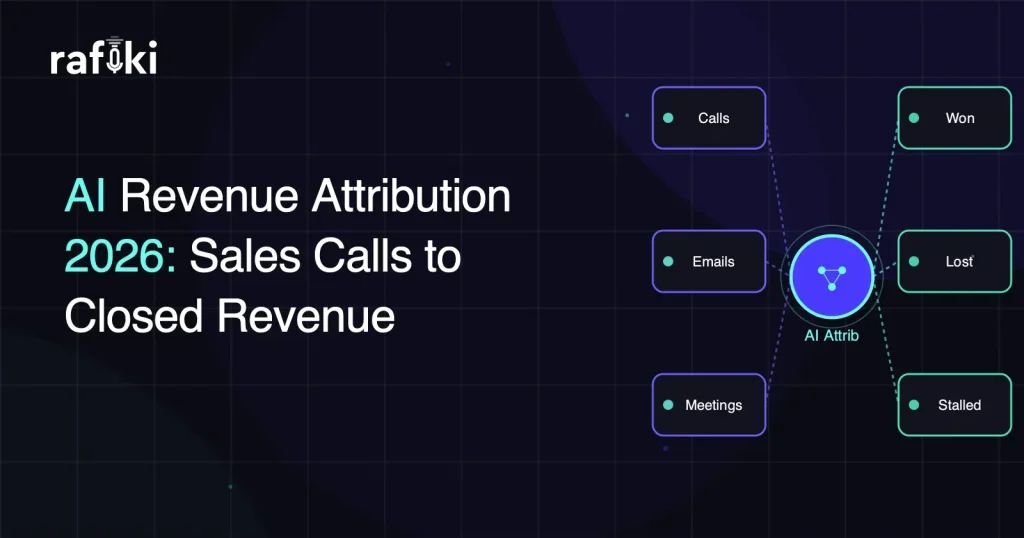
AI revenue attribution transforms this dynamic by treating every sales conversation as a structured data source. Instead of relying on subjective rep notes or basic activity tracking, intelligent systems analyze the actual content, tone, and progression of sales interactions to identify the specific moments and messages that drive revenue outcomes.
This shift represents a fundamental evolution in how we understand the buyer's journey:
The result is attribution that connects specific conversation elements to revenue outcomes. You can identify which discovery questions correlate with higher close rates, which demo approaches generate the most excitement, and which objection-handling techniques actually address buyer concerns effectively.
Modern AI revenue attribution operates on a multi-touch model that weighs each conversation's contribution to the final outcome. This approach recognizes that revenue generation is a cumulative process where early discovery calls set the foundation, middle-stage presentations build momentum, and closing conversations overcome final hesitations.
Effective conversation attribution tracks multiple dimensions simultaneously:
This multi-dimensional approach creates a comprehensive view of how conversations contribute to revenue. You can see which early-stage interactions set up successful closes, which mid-cycle conversations maintain momentum, and which final discussions push deals over the line.
Advanced systems apply sophisticated weighting to different conversation types and stages. A technical deep-dive with the end user might receive different attribution weight than a pricing discussion with procurement, based on historical correlation with closed revenue. Discovery calls that uncover compelling events get higher attribution than routine check-ins.
AI revenue attribution doesn't just analyze conversations after the fact—it identifies revenue-critical moments as they happen. Advanced systems monitor ongoing discussions for specific signals that correlate with deal progression or risk, enabling immediate response to capitalize on opportunities or address concerns.
Key signal categories that drive attribution insights include:
Real-time detection enables proactive revenue management. Instead of waiting for deals to stall or accelerate unexpectedly, teams can respond immediately to conversation signals that predict outcomes. This shift from reactive to proactive revenue operations creates significant competitive advantage.
Rafiki's AI-native revenue intelligence platform transforms sales conversations into structured attribution data through its autonomous agent architecture. Unlike traditional conversation intelligence tools that simply record and transcribe, Rafiki's AI agents analyze every interaction for revenue-predictive signals and automatically map conversation elements to deal outcomes.
The platform's attribution capabilities operate across multiple intelligence layers:
This automated approach eliminates the data quality issues that plague traditional attribution models. Every conversation contributes accurate, structured intelligence to your revenue attribution analysis, creating reliable insights that scale across your entire sales organization.
Rafiki's 60-language transcription capabilities also enable global attribution analysis, allowing multinational sales teams to identify revenue patterns across diverse markets and cultural contexts. The platform's AI-native architecture processes conversation nuances that traditional tools miss, from cultural communication styles to regional buying behavior patterns.
Sophisticated AI revenue attribution goes beyond identifying correlations between conversations and closed revenue—it begins to establish causal relationships that enable predictive insights. By analyzing thousands of similar deals and conversation patterns, advanced systems can identify which specific conversation elements actually drive outcomes versus which simply coincide with success.
Advanced attribution analytics reveal actionable insights:
This causal understanding enables prescriptive recommendations rather than just descriptive analytics. Instead of simply reporting which conversations correlated with success, intelligent systems can recommend specific conversation approaches that will increase deal probability for similar prospects.
Successful implementation of AI revenue attribution requires a structured approach that combines technology deployment with process evolution and team enablement. Organizations must shift from activity-based attribution to conversation-based intelligence while maintaining forecast accuracy during the transition.
Phase 1: Data Foundation and Integration
Phase 2: Signal Identification and Validation
Phase 3: Predictive Attribution and Optimization
AI revenue attribution in 2026 represents just the beginning of autonomous revenue intelligence. As conversation analysis becomes more sophisticated and attribution models more precise, we're moving toward systems that not only identify what drives revenue but actively optimize conversation approaches in real-time.
The competitive advantage belongs to organizations that embrace conversation-driven attribution now, while their competitors still rely on outdated activity-based models. Forward-thinking sales organizations are already building conversation intelligence capabilities that transform revenue operations.
These organizations capture competitive advantage by understanding exactly which conversation elements drive their revenue growth, while their competitors continue operating with attribution blind spots that leave potential revenue unrealized.
Ready to transform your revenue attribution with AI-native conversation intelligence? Rafiki's revenue intelligence platform starts at just $19 per seat with no minimums, no annual commitments, and setup in 15 minutes. Book a demo to see how conversation-driven attribution can unlock your hidden revenue potential, or start with Rafiki's free tier to experience autonomous revenue intelligence for your growing sales team.
Start for free — no credit card, no seat minimums, no long contracts. Just better sales intelligence.