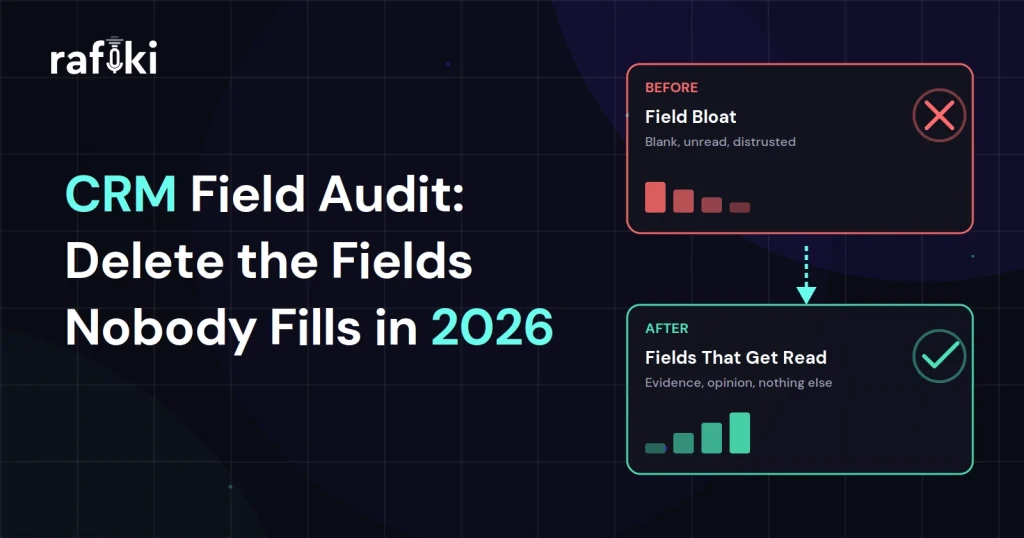
Open any opportunity record in a CRM that has run for more than three years and count the fields. You will find one that someone added for a 2022 campaign that no longer exists, plus "Competitor (Secondary)," which no rep has ever filled. Meanwhile, a picklist with fourteen options for "Buying Motivation" holds whatever a hurried rep last picked, usually the first option. A CRM field audit fixes this clutter by asking which fields deserve to stay.
Then there are three different fields that all mean "next step," each owned by a team that no longer remembers adding it. The record is enormous and mostly blank, and the clutter buries the few fields leadership reads, such as close date and amount. Reps no longer notice which fields matter, so they give every field the same hurried attention.
Every CRM collects fields the way an attic collects boxes. Someone added each one for a reason, but nobody knows if the reason still applies, so removing anything feels risky. Reps resent filling it in and managers stop reading it, which leaves RevOps with little it can report from. Worse, the fields that would make a report meaningful usually have the lowest fill rates on the record.
Data quality initiatives tend to respond by telling reps to fill more fields. That is the opposite of the fix, because the problem usually sits in the fields themselves.
This article walks through the CRM field audit, which tests whether reps fill each field, whether anyone reads it, and whether it changes a decision. The results sort fields into the types that actually exist. Each type then points to its own answer: delete it, fill it from conversations, or leave it with the rep.
RevOps should run the audit in the first week of Q4, before 2027 planning locks the reporting. Once planning starts, any report built on an unfilled field produces a number that nobody in the room can trust.
A CRM field audit is a structured review of every custom and standard field a revenue team uses, starting with the opportunity and account records. It checks whether each field earns its place by asking three questions: do reps fill it, does anyone read it, and does anyone decide anything based on it?
RevOps deletes the fields that fail all three questions. Fields that fail the first test but pass the others become candidates for automatic population, while the few that pass all three stay protected.
The audit differs from a data quality initiative in its direction. Data quality efforts assume the fields are right and the reps are wrong, so they push reps to fill more. A field audit starts from the opposite view: a persistently low fill rate tells you something about the field itself. It asks whether the field should exist at all, and whether a human needs to type information that already lives somewhere else.
The call recording is often that somewhere else, and it makes the audit different in 2026 than it was a few years ago. Many CRM fields exist to capture something a buyer said, and revenue teams now record and search those words. The field is then a manual, lossy copy of a source the team already has in full.
Why does every CRM drift toward bloat? The forces are structural, and they explain why a one-time "clean up the CRM" project never sticks.
Year after year the record gets heavier, and each new field gives reps and managers one more reason to distrust it. Time lost to non-selling work, data entry included, comes up again and again in Salesforce's State of Sales research. The same research points to disconnected data as another obstacle that keeps returning. A bloated record feeds both problems, so trimming it pays off on two fronts.
An unfilled field looks harmless because it is empty, and that emptiness is exactly what hides the cost. The cost shows up in three places that teams rarely trace back to the field.
First, reporting drifts into fiction when a field has a poor fill rate. The report treats the filled minority as if it were the whole pipeline. Leadership then sees a pattern that exists only among the reps who happened to fill the field.
Second, when a record has sixty fields and leadership reads six, reps cannot tell which is which. The fill rate on the important six then drops along with the rest. Third, rep trust in the CRM erodes, because a system that demands unused information feels like bureaucracy. Reps treat it accordingly, and that distrust is the root of the data quality problem the CRM team wants to solve.
Finance feels the reporting cost most directly. Deloitte's CFO guide to technology trends lays out the technology agenda finance leaders are taking on, and decision-grade data runs through all of it.
A CRM whose fields are mostly blank produces the opposite, and the company is about to build 2027 planning on it. Our guide to the revenue stack audit makes the broader consolidation case, and the field audit brings the same discipline inside the CRM.
The audit runs on three measures. RevOps can answer each one from the CRM's own data, plus a short survey of the people who consume it.
Across opportunities that reps opened in the last two quarters, what share have a real value in this field? Exclude defaults and the first picklist option, which usually mean a rep clicked through. A low fill rate on active deals can mean the field is unnecessary, or that it asks for typing no human should have to do.
Does anyone look at this field? The CRM's metadata shows which reports and dashboards reference it, and a quick survey tells you which fields managers and executives actually consult. When a field appears in no report and no consumer names it, reps are filling it into a void.
Does any decision change based on this field's value? Forecast category moves the number and close date moves the plan, while a fourteen-option "Buying Motivation" picklist rarely moves anything. Fields that inform no decision are documentation, and documentation belongs in the conversation record.
Once RevOps has the three measures, fields sort into three types, and the type decides what happens to each. When a conversation intelligence tool captures every buyer conversation, the first two types need entirely different handling.
Sorting this way tends to show that ritual fields make up much of the record's bulk. A handful of opinion fields, by contrast, hold most of its value. For evidence, the information that matters most, the sort reveals that the team has been asking the wrong source all along.
The audit ends in three actions, which RevOps applies field by field and writes down so that the next audit starts from a known state.
What comes out of the rebuild is a shorter, fuller record that reps and managers can trust. Unlike the old record, it lets anyone trace each evidence field back to the moment a buyer said it.
Evidence fields need a source, and Rafiki AI supplies one by capturing every buyer conversation across meetings and phone calls. Its transcription covers over 60 languages, and from each transcript it extracts the methodology elements those fields exist to hold.
Smart CRM Sync auto-populates methodology-specific fields for MEDDIC, BANT, SPICED, GAP, and other frameworks from the conversation. It fills custom CRM fields too, on Salesforce, HubSpot, Pipedrive, Zoho, and Freshworks. The call now fills the evidence fields that reps never filled, so the audit's automate step shrinks from a project to a configuration task.
For RevOps leaders running the audit, Gen AI Search shows whether the information a doubtful field wants actually appears in conversations at all. Knowing that settles many delete-or-automate decisions in seconds.
Smart Call Scoring supplies the accountability behind opinion fields by showing whether the rep established, on a call, the methodology elements that justify a forecast category. Gen AI Reports lets teams pull the reports they used to build on ritual fields directly from the conversation data. With Rafiki AI's agents handling the evidence on their own, people keep the fields that hold judgment.
| Dimension | Bloated CRM | Audited CRM |
|---|---|---|
| Field count | Grows every year | Shrinks to the fields reps fill and managers read and use |
| Evidence fields | Reps type them, and most stay blank | Conversations fill them, with citations |
| Opinion fields | Mixed in with everything else | Few, and they sit next to their evidence |
| Ritual fields | Stay because deleting is scary | RevOps deletes them after a claim window |
| What a low fill rate means | Rep discipline problem | Field design signal |
| Reporting | Rests on the filled minority | Rests on complete evidence |
| Rep experience | Bureaucracy | A record that fills itself |
The audit belongs in the first weeks of Q4 for a practical reason: teams are choosing the reports for 2027 planning right now. Every one of those reports depends on fields whose fill rates RevOps already knows. When RevOps runs the audit first, the planning reports rest on complete fields. The ones that would have produced fiction are gone before anyone builds on them.
The sequence takes a few weeks, starting in week one with RevOps exporting the field list and fill rates. During week two, the team surveys consumers and pulls report metadata. Week three is for sorting fields into evidence, opinion, and ritual, and for publishing the delete list.
In week four, the team connects the evidence fields to the conversation record and deletes the ritual fields before rebuilding the planning reports on what remains. A RevOps team that finishes by the end of October hands leadership a 2027 plan built on a complete record. That record stays complete because it fills itself.
CRM fields pile up because adding one is easy and deleting one feels risky, which leaves a record that is mostly blank. You can take the first step this week. Export every opportunity field with its fill rate for the last two quarters, then find the fields no report references.
That export becomes the draft delete list, and a short survey of managers and executives turns it into the list you announce with a claim window. Next, mark every field that summarizes something a buyer said. Rafiki AI's agents can populate those on their own from every buyer conversation, with a citation. With those pieces in place, RevOps goes into 2027 planning with a record that tells the truth.
It is a RevOps review that goes field by field through the opportunity and account records and asks whether each field earns its place. The audit judges this with three measures. Fill rate tracks whether reps enter real values, and read rate tracks whether any report, dashboard, or person consults the field. Decision rate covers the last question, whether the field's value changes any decision.
RevOps deletes the fields that fail all three. Fields that capture what buyers said connect to the conversation record, which populates them automatically. The few fields that hold human judgment stay, and RevOps places them next to their supporting evidence.
In most cases the problem starts with the field itself. Many fields ask a human to type a summary of something a buyer said in a conversation. That is exactly the after-call work reps skip under pressure. Someone added other fields for a campaign, a process, or a team that no longer exists, and fill rates fell as the purpose faded.
Still others duplicate fields that different teams own. A team that treats a low fill rate as a discipline problem responds with reminders or validation rules. Reps then produce compliant but meaningless data to satisfy them. Reading the fill rate as a design signal leads to a better fix, which is to automate the field from the conversation record or delete it.
Delete the ritual fields, meaning those that fail all three measures because nobody fills them and no report or decision depends on them. Typical examples include codes for campaigns that ended, legacy stage flags, and fields for teams that no longer exist. Duplicates such as multiple "next step" fields belong on the list too.
The safe process starts with publishing the deletion list and giving consumers a short window to claim any field they need. After the window closes, archive the data if governance requires it and remove whatever nobody claimed. Reps then have fewer fields competing for their attention.
It replaces the rep as the source for evidence fields. These often have the weakest fill rates, because they ask reps to summarize a conversation. Those fields cover pain, timeline, decision process, competitor, next step, and MEDDIC, SPICED, or BANT elements. Conversation intelligence captures the conversation itself and extracts those elements directly.
CRM sync then populates the fields directly from the call, with a citation to the moment. Fill rates on evidence fields stop depending on rep discipline, and managers can trust the reports that rest on them. For reps, the CRM also stops feeling like a data entry chore.
If your audit leaves a list of evidence fields that reps keep skipping, Rafiki AI's conversation intelligence can fill them from your recorded calls. Pricing is $19 per seat per month with no annual contract required, and a team of any size can sign up. Start a free trial before 2027 planning begins, or book a demo if you want to talk through your field list with our team first.
Start for free — no credit card, no seat minimums, no long contracts. Just better sales intelligence.