AI

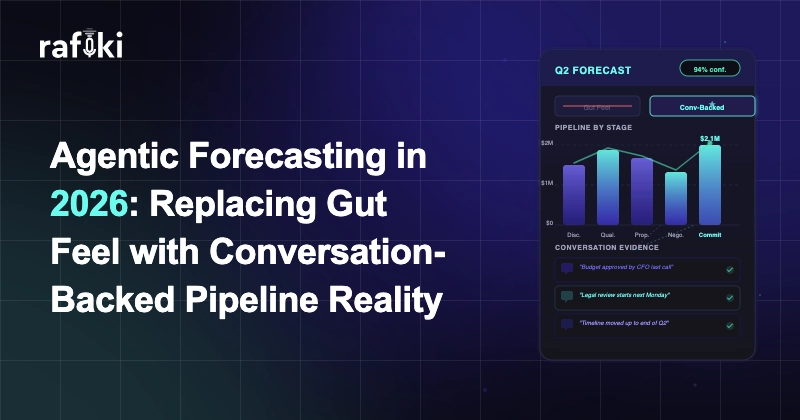
Agentic Forecasting in 2026: Replacing Gut Feel with Conversation-Backed Pipeline Reality
Feb 19, 2026
4 min read
The Forecast call is still a theater performance.
It’s Monday morning. Pipeline review.
A CRO asks:
“How confident are we in this deal?”
The rep replies:
“Very strong. They’re engaged.”
But what does “engaged” mean?
In most organizations, forecasting is still driven by rep confidence and CRM stage — not evidence.
In 2026, that model is no longer competitive.
Welcome to Agentic Forecasting — where AI continuously analyzes real customer conversations to determine pipeline health.
Agentic forecasting uses autonomous AI systems to:
Instead of asking reps what they think will close, agentic systems evaluate what the customer actually said.
That difference changes everything.
A deal in “Proposal Sent” tells you nothing about:
Stages show process progress — not buyer conviction.
Reps are:
Forecasts built on confidence are forecasts built on psychology — not reality.
Even the best managers can’t manually analyze hundreds of calls per quarter.
Which means:
The data exists.
It’s just not operationalized.
Agentic forecasting works because it analyzes patterns across meetings.
Here are the signals that matter most:
Are multiple decision-makers actively participating?
Deals that close typically show:
Single-threaded deals rarely convert.
If the same objection appears in three calls, it’s not “handled.”
It’s unresolved.
Agentic systems track objection frequency across meetings — not just whether it appeared once.
Compare:
“We’re aiming for Q3.”
vs.
“Procurement begins July 5th. Decision by August 20.”
Precision predicts progress.
Vagueness predicts delay.
Is the competitor:
Agentic systems differentiate between casual reference and real displacement risk.
Strong deals include:
Weak deals end with:
“We’ll follow up internally.”
That’s not momentum.
That’s drift.
Sentiment isn’t about positivity.
It’s about direction.
Conversation-backed sentiment trends are stronger predictors than stage probability.
Agentic forecasting only works if your AI understands conversations deeply.
This is where Rafiki becomes the intelligence engine behind the forecast.
Rafiki captures and analyzes every sales conversation — across discovery, demo, negotiation, and follow-ups.
But it doesn’t stop at transcription.
Rafiki:
All of this feeds structured deal intelligence.
Instead of “Stage 4 = 60% probability,” Rafiki enables:
Managers can see risk before quarter-end — not during the postmortem.
Imagine forecast calls like this:
Instead of:
“I feel good about it.”
You see:
That shifts forecasting from subjective debate to evidence-based discussion.
Agentic forecasting delivers measurable outcomes:
Risk is detected earlier.
Confidence is grounded in conversation data.
Managers can step into at-risk deals sooner.
Qualification gaps are surfaced automatically.
Forecasting stops being reactive.
It becomes proactive revenue management.
| Traditional | Agentic Forecasting with Rafiki |
|---|---|
| Rep confidence | Conversation-backed signals |
| Stage probability | Stakeholder + objection depth |
| Static CRM fields | Dynamic intelligence updates |
| Manual call reviews | AI-analyzed call patterns |
| Quarterly corrections | Continuous risk monitoring |
This is not just better reporting.
It’s better execution.
Three forces are accelerating this shift:
Companies that don’t operationalize conversation intelligence will rely on instinct.
Companies that use agentic forecasting will rely on evidence.
Only one of those scales.
CRM used to be the system of record.
In 2026, conversation intelligence becomes the system of truth.
Agentic forecasting turns that truth into action.
But without a structured conversation layer, agents operate blindly.
Rafiki provides that foundation.
It transforms every meeting into:
Which means your forecast is no longer based on what reps remember.
It’s based on what buyers actually said.
You can continue running forecast calls driven by optimism.
Or you can run them driven by evidence.
The best revenue teams in 2026 aren’t replacing humans with AI.
They’re augmenting human judgment with conversation-backed intelligence.
Agentic forecasting doesn’t eliminate leadership instinct.
It strengthens it.
With Rafiki powering structured conversation analysis, your forecast becomes:
In competitive markets, predictability is advantage.
Start for free — no credit card, no seat minimums, no long contracts. Just better sales intelligence.