Sales Forecasting

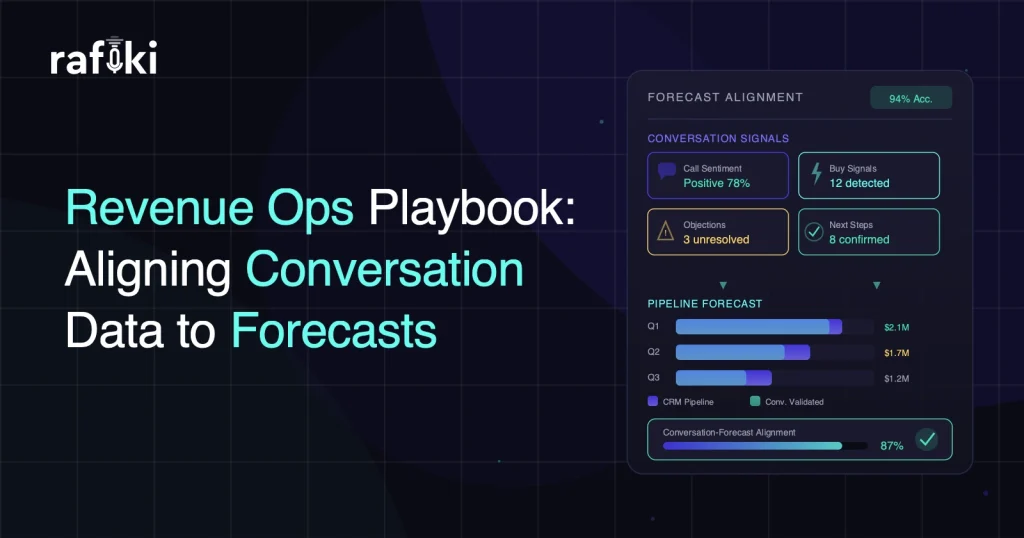
Revenue Ops Playbook: Aligning Conversation Data to Forecasts in 2026
Jan 8, 2026
5 min read
Forecasting Is No Longer a CRM Exercise — It’s a Conversation Exercise. Revenue leaders don’t miss forecasts because spreadsheets are wrong.
They miss forecasts because signals are invisible.
Pipeline reviews often depend on:
But those are lagging indicators.
The earliest signs of deal health — or decay — appear in conversations.
In 2026, modern RevOps teams are shifting from CRM-based forecasting to conversation-backed forecasting.
The playbook has changed.
Forecast accuracy now depends on how well you align conversation data to pipeline health.
And this is where conversation intelligence platforms like Rafiki become foundational to revenue operations.
Let’s diagnose the traditional forecasting gap.
Reps update CRM fields after calls.
Under pressure.
From memory.
With optimism bias.
That introduces:
Forecast models built on incomplete CRM data will always be fragile.
Deals don’t collapse overnight.
Warning signs appear early:
By the time CRM stage regresses, it’s already late.
Conversation data surfaces these risks sooner.
Modern revenue teams are connecting:
Conversation data → Deal health → Forecast probability → Pipeline accuracy
Instead of relying solely on CRM stage probability, they incorporate:
This isn’t theoretical.
It’s already becoming standard in advanced revenue organizations.
The question is no longer:
“Did the rep update the stage?”
It’s:
“What does the buyer’s language indicate?”
Conversation intelligence (CI) platforms capture meetings.
But in 2026, capture isn’t enough.
Structure is everything.
Rafiki transforms unstructured conversations into:
This structured intelligence becomes the raw material for forecasting models.
Here’s how modern RevOps teams operationalize this shift.
Not every call insight affects forecast accuracy.
RevOps must define which conversation signals correlate with deal outcomes.
Examples:
Rafiki structures these signals automatically across calls.
This removes manual tagging and inconsistency.
Once signals are defined, they must be operationalized.
RevOps teams build deal health models such as:
Green:
Yellow:
Red:
Rafiki feeds these structured signals into dashboards, enabling real-time deal health scoring.
The forecast meeting structure changes.
Instead of asking:
“How confident are we?”
Managers review:
This transforms forecast calls from narrative-based to evidence-based.
One of the biggest advantages of conversation-backed forecasting is early detection.
Example:
CRM Stage: Proposal Sent
Rep Confidence: 80%
Conversation signals:
Rafiki surfaces these patterns before stage regression.
RevOps can:
Forecast corrections become proactive.
Beyond individual deals, conversation data reveals systemic patterns:
Rafiki aggregates signals across accounts, enabling macro-level forecast refinement.
Forecasting becomes more predictive, not reactive.
In 2026, the revenue forecasting stack looks like this:
CRM → System of record
Rafiki → Conversation intelligence layer
Deal Health Model → Signal weighting
Forecast Dashboard → Executive visibility
Human Judgment → Strategic decision
The key is that CRM no longer operates alone.
Conversation intelligence feeds structured, real-time context into the forecast model.
Forecast accuracy depends on data integrity.
But not all CI platforms provide structured intelligence.
Many:
That’s insufficient.
RevOps requires:
Rafiki’s ability to structure topics, subtopics, and qualification frameworks enables forecasting workflows to operate on clean, consistent inputs.
Without structure, signal-to-noise ratio collapses.
Revenue teams adopting conversation-backed forecasting see:
Because forecasting shifts from being stage-driven to signal-driven.
The broader trend is clear.
Modern revenue teams are moving toward:
Pipeline health = Conversation signal density
Deals with:
Have higher win probability.
Deals with:
Have higher slippage probability.
Conversation data is becoming the leading indicator of revenue health.
Conversation intelligence isn’t just for enablement.
It’s forecast infrastructure.
Narratives aren’t structured signals.
Forecast accuracy improves when macro patterns inform micro decisions.
Signals must be validated against win/loss data.
Rafiki’s structured extraction makes calibration possible.
Work with Sales Leadership to define qualification and risk indicators.
Use Rafiki to map signals into CRM and dashboards.
Integrate deal health scoring into forecast meetings.
Refine probability weighting using historical data.
By mid-year, forecasting becomes evidence-backed.
Revenue Ops in 2026 is no longer just:
It is:
Signal orchestration.
Conversation intelligence is the highest-fidelity signal source in the revenue engine.
Rafiki enables RevOps to:
That alignment is competitive advantage.
For years, forecast accuracy depended on:
In 2026, it depends on structured conversation intelligence.
Aligning conversation data to forecasts means:
Rafiki turns meetings into structured pipeline intelligence.
That intelligence powers cleaner forecasting workflows.
And cleaner forecasting drives predictable revenue.
In modern revenue operations, conversation signals are no longer optional.
They are the foundation of pipeline health.
Start for free — no credit card, no seat minimums, no long contracts. Just better sales intelligence.