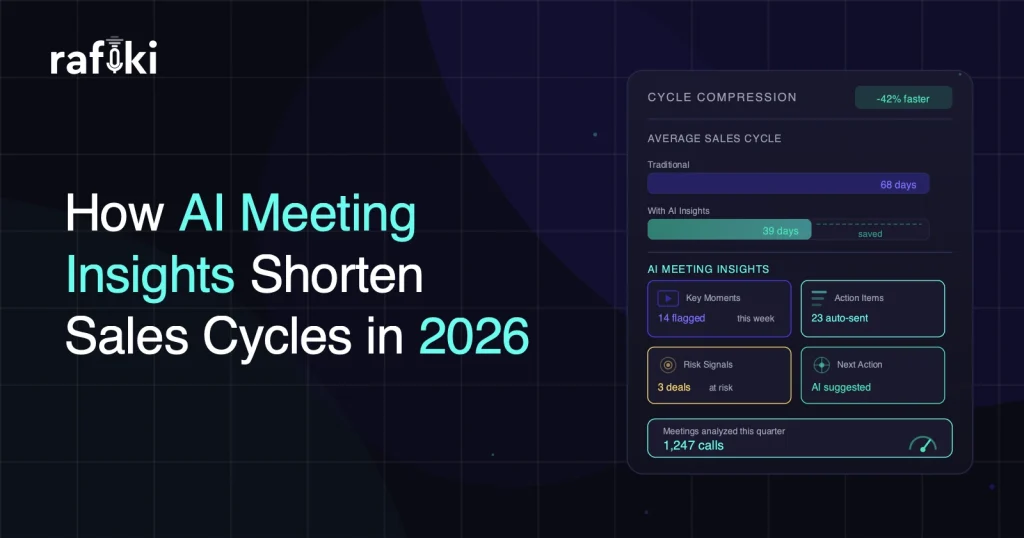
Sales Cycles Don’t Slow Down by Accident — They Drift. No deal ever starts with the intention of slipping.
Sales cycles stretch because of:
But here’s the reality:
These problems show up early — in conversations.
The issue isn’t that signals don’t exist.
It’s that most teams don’t systematically track them.
In 2026, high-performing GTM teams are reducing cycle time not by pushing harder — but by listening smarter.
AI meeting insights are becoming the lever that shortens cycles by identifying risk, misalignment, and opportunity before they compound.
And conversation intelligence platforms like Rafiki are at the center of that shift.
Before we talk tactics, let’s understand the root causes of slow deals.
Most elongated sales cycles stem from three invisible issues:
All three surface in meeting conversations.
If you can structure and act on those signals in real time, cycle compression becomes achievable.
AI meeting insights go beyond transcripts or summaries.
They involve structured extraction of:
Rafiki transforms every meeting into structured pipeline intelligence.
That intelligence becomes actionable — not archival.
One of the biggest causes of elongated cycles is discovery drift.
Deals stretch when:
Without structure, reps assume discovery is “good enough.”
AI meeting insights allow teams to track topic coverage across meetings.
Rafiki extracts:
A SaaS company noticed enterprise deals exceeding 120 days.
Using conversation topic tracking, they found:
By coaching reps to explicitly confirm decision process and timeline in first two meetings, average cycle time dropped by 18%.
Topic tracking exposed the bottleneck.
Most delays are emotional before they’re procedural.
Buyers rarely say:
“We’re losing confidence.”
Instead, hesitation appears subtly:
Sentiment drift is one of the strongest leading indicators of deal slippage.
Rafiki analyzes sentiment trends across meetings.
It can detect:
A mid-market fintech team noticed that deals slipping past 90 days often showed declining sentiment after the technical deep dive.
Rafiki surfaced a pattern:
By implementing a structured security reinforcement call immediately after demos, cycle time reduced by 22% in affected deals.
Sentiment tracking identified the emotional stall point.
Unresolved objections are silent cycle killers.
A pricing objection mentioned once is normal.
Mentioned three times across meetings? It’s a warning.
Traditional CRM fields don’t capture objection intensity or recurrence.
Rafiki categorizes objections and tracks them over time.
Reps and managers can see:
A B2B cybersecurity firm found that deals with recurring “integration complexity” objections extended 30% longer.
Rafiki data showed reps acknowledged objections but failed to quantify mitigation.
They implemented:
Objection recurrence dropped.
Cycle time shortened by 15%.
Tracking patterns shortened deals.
One of the biggest cycle extenders:
Late-stage stakeholder introduction.
Deals stall when:
AI meeting insights allow stakeholder participation tracking.
Rafiki detects:
This enables early multi-threading.
An enterprise HR software company found deals over 6 figures stalled when economic buyers weren’t engaged by meeting 3.
By enforcing “EB participation by call 3” and using Rafiki dashboards to track engagement, cycle length reduced by 25% in enterprise segment.
Multi-threading shortened cycle time dramatically.
Weak next steps create drift.
Meetings end with:
“We’ll reconnect soon.”
Strong deals end with:
“Calendar invite sent for procurement review on May 14th.”
Rafiki extracts next-step commitments and ownership clarity.
Teams can identify:
A vertical SaaS company found that deals without calendar-defined next steps after demos were 2.5x more likely to extend beyond 90 days.
Using AI insights, they mandated:
Cycle compression followed.
Competition elongates cycles when positioning is reactive.
Rafiki tracks:
Early competitive detection allows proactive framing.
A MarTech vendor discovered competitor mentions surged in late-stage deals over 60 days.
They adjusted:
Cycle length shortened by 12%.
Proactive positioning reduces indecision.
Cycle compression is not just about closing faster.
It’s about:
When conversation intelligence feeds forecasting workflows:
Rafiki connects structured meeting insights into pipeline dashboards, making cycle risk visible.
Many sales teams try to shorten cycles by:
But pressure doesn’t solve misalignment.
Alignment does.
AI meeting insights reveal misalignment clearly:
Addressing those directly shortens cycles naturally.
Reducing sales cycle by 15–25% leads to:
Cycle compression compounds growth.
AI meeting insights only matter if they are structured and actionable.
Surface-level summaries don’t shorten cycles.
Structured signal extraction does.
Rafiki enables:
Every meeting becomes pipeline intelligence.
That intelligence fuels cycle compression.
As we enter 2026, the teams that shorten cycles fastest are those that:
All of which depend on structured conversation intelligence.
Sales cycles don’t shrink because reps work harder.
They shrink because friction is removed earlier.
AI meeting insights transform conversations into early-warning systems.
They make invisible signals visible.
They turn hesitation into intervention.
They convert misalignment into action.
Rafiki turns every meeting into structured pipeline intelligence — enabling topic tracking, sentiment monitoring, objection detection, and stakeholder analysis.
In 2026, the fastest-growing GTM teams won’t just move faster.
They’ll move smarter.
And smarter execution shortens cycles naturally.
Start for free — no credit card, no seat minimums, no long contracts. Just better sales intelligence.