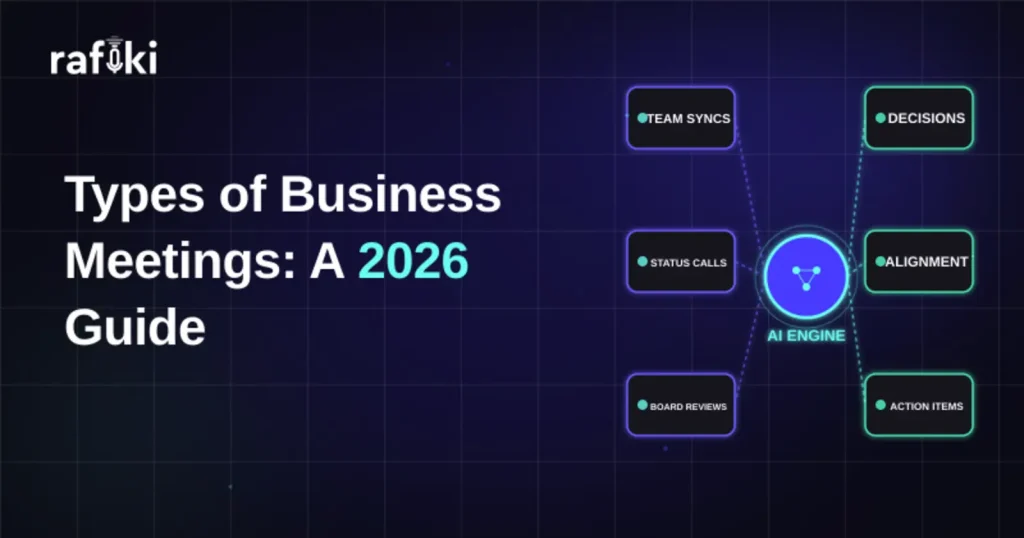
Most of your team's meeting time generates zero actionable insight for your pipeline.
That is not a scheduling problem. It is a revenue problem. When the average B2B sales cycle involves dozens of meetings across discovery, negotiation, QBRs, and internal strategy sessions, each conversation carries signals that determine whether a deal closes or dies. Yet most organizations treat all types of business meetings with the same low-fidelity approach: someone takes notes (or nobody does), action items vanish into chat threads, and leadership has no visibility into what was actually said on the calls that matter most. The result is a systematic loss of the intelligence your team generates every single day.
The cost compounds fast. Reps repeat discovery questions buyers already answered. Managers coach based on self-reported summaries instead of what happened on the call. Customer success teams miss escalation signals that surface weeks before churn. Deals slip because nobody caught the procurement blocker mentioned in passing during a technical review. Every unstructured meeting is a leak in your revenue engine — and in 2026, with buyers more informed and less patient than ever, those leaks determine who hits quota and who does not.
Why the Old Way of Categorizing Meetings Fails Revenue Teams
Traditional meeting taxonomies sort by format: "stand-up," "brainstorm," "all-hands," "one-on-one." That framing is operationally useless for a sales or CS organization. It tells you nothing about the revenue function a meeting serves, the intelligence it should produce, or how to measure its effectiveness. A discovery call and a renewal kickoff are both "video meetings" — but they require completely different preparation, scoring criteria, and follow-up workflows.
The core failure is treating meetings as calendar events instead of structured data sources. When you understand the distinct types of business meetings your revenue team runs, you can:
- Assign the right preparation framework (MEDDIC for discovery, SPICED for expansion, Challenger for competitive displacement)
- Score each meeting against methodology-specific criteria automatically
- Route follow-up actions to the correct stakeholders without manual triage
- Aggregate patterns across meeting types to identify systemic coaching gaps
- Connect upstream meeting quality to downstream conversion metrics
Without this structure, your CRM contains a graveyard of meeting records with no analytical value. Leadership makes pipeline decisions based on gut feel, and enablement programs target the wrong behaviors because nobody has granular visibility into what is happening inside each meeting category.
The Core Types of Business Meetings in a Modern Revenue Organization
A business meeting is any structured conversation between two or more participants with a defined commercial or operational objective. In a 2026 revenue context, these meetings fall into distinct categories based on their function in the buyer or customer lifecycle. Understanding each type is the foundation for building meeting-specific workflows, scorecards, and intelligence loops.
External Revenue Meetings
These are the meetings that directly generate, advance, or protect revenue. They face the buyer or customer and produce the highest-value signals in your organization.
- Discovery calls — the foundational meeting where reps qualify fit, uncover pain, map the decision-making unit, and identify metrics that matter. Discovery is where deals are won or lost before most reps realize it.
- Product demos and technical reviews — meetings that bridge discovery to evaluation, where prospects assess capability against requirements. These conversations surface competitive intelligence, integration concerns, and champion-level engagement signals.
- Negotiation and procurement calls — late-stage meetings where pricing, legal terms, security reviews, and timelines are discussed. Missed signals here cause deal slippage and last-minute discounting.
- Quarterly Business Reviews (QBRs) — structured reviews with existing customers that assess value delivery, usage trends, and expansion potential. QBRs are the highest-leverage meeting type for net revenue retention.
- Customer onboarding and kickoff calls — the post-sale handoff meetings that set the trajectory for adoption, time-to-value, and long-term retention. Poor onboarding meetings are the leading indicator of early churn.
- Renewal and expansion conversations — meetings where CSMs and AMs assess satisfaction, introduce new capabilities, and negotiate continued or increased commitments.
Internal Strategy and Alignment Meetings
These meetings do not face the customer, but they directly shape the quality of every external interaction. They are the connective tissue of your go-to-market operation.
- Pipeline reviews — recurring meetings where managers and reps assess deal health, validate stage progression, and prioritize coaching interventions. The quality of pipeline review conversations is one of the strongest predictors of forecast accuracy.
- Deal strategy sessions — deep-dive meetings on specific high-value opportunities, often involving cross-functional stakeholders (sales engineering, legal, executive sponsors). These meetings require context from every prior customer-facing interaction.
- Coaching and one-on-one meetings — manager-rep sessions focused on skill development, call review, and behavioral feedback. Effective coaching meetings are grounded in observed call performance, not anecdotal self-reporting.
- Cross-functional handoff meetings — the critical transitions between SDR and AE, AE and CS, or CS and AM. Fumbled handoffs destroy buyer trust and force customers to repeat context they already provided.
- Forecast and commit calls — leadership-level meetings where revenue commitments are finalized based on aggregated pipeline intelligence. Garbage in, garbage out — if the underlying meeting data is unstructured, the forecast is fiction.
What Each Meeting Type Should Produce: The Intelligence Framework
Recognizing the types of business meetings your team runs is step one. Step two is defining the specific intelligence outputs each meeting type should generate. Most organizations skip this entirely, which is why meeting volume increases while insight quality flatlines.
Every revenue-impacting meeting should produce three outputs:
- Structured summary — a standardized capture of key topics discussed, objections raised, commitments made, and next steps agreed. Not a transcript dump. A structured, queryable record.
- Methodology-aligned scoring — an objective assessment of how well the meeting advanced the relevant framework. Did the discovery call surface all MEDDIC fields? Did the QBR cover value realization metrics? Scoring must be consistent, automated, and tied to the meeting type.
- Follow-up actions with owners and deadlines — action items extracted from the conversation, assigned to the right person, and tracked to completion. The gap between "we discussed it" and "someone actually did it" is where revenue leaks.
When you layer these outputs across every meeting type, you create a revenue intelligence layer that compounds over time. Discovery signals inform demo customization. Demo feedback shapes negotiation strategy. QBR insights drive expansion plays. Coaching sessions reference specific call moments instead of vague generalizations. The entire revenue motion becomes interconnected rather than siloed by calendar invite.
The 2026 Shift: From Passive Attendance to Active Intelligence Capture
The fundamental change reshaping how organizations approach business meetings in 2026 is the shift from passive human note-taking to active AI-driven intelligence capture. This is not about recording calls — most teams already do that. It is about extracting structured, actionable intelligence from every conversation automatically, at a level of consistency and completeness that no human note-taker can match.
This shift matters for several reasons:
- Volume exceeds human capacity — even a modest sales team generates an enormous amount of meeting content each month. No manager can review even a fraction of those calls manually.
- Consistency eliminates bias — human summaries vary based on who writes them, what they remembered, and what they thought was important. AI-generated intelligence applies the same criteria every time.
- Speed determines competitive advantage — in fast-moving deals, the team that follows up within hours with a precise, personalized summary wins against the team that sends a generic "great meeting" email the next day.
- Global teams need global coverage — organizations selling across multiple geographies need intelligence capture that works across languages, time zones, and cultural communication styles.
The organizations that operationalize this shift — building meeting-type-specific intelligence workflows rather than treating every conversation the same — create a structural advantage that compounds with every interaction. Those that do not are still flying blind, relying on rep memory and CRM fields that were never filled in accurately.
How Rafiki AI Transforms Every Type of Business Meeting into Revenue Intelligence
Rafiki AI is an AI-native revenue intelligence platform built from day one on multi-model AI architecture — not a legacy call recorder with AI features bolted on. Its six autonomous AI agents work across every meeting type your team runs, extracting structured intelligence, scoring performance, syncing data to your CRM, and generating follow-up actions without manual intervention.
Here is how Rafiki AI maps to the meeting types that drive your revenue:
- Discovery and qualification calls — Smart Call Scoring evaluates every discovery call against your chosen methodology — MEDDIC, BANT, SPIN, SPICED, Challenger, Sandler, or any custom criteria your team defines. Reps get immediate, objective feedback on what they covered and what they missed.
- Demos and technical reviews — Smart Call Summary generates structured summaries that capture feature questions, competitive mentions, integration requirements, and stakeholder reactions — all queryable and searchable across your entire call library.
- Negotiation and procurement meetings — Smart Follow Up extracts every commitment, objection, and next step from late-stage calls and generates personalized follow-up content that references the exact language the buyer used.
- QBRs and renewal conversations — Smart CRM Sync auto-populates methodology-specific fields and custom CRM fields directly from call content, ensuring that customer health data is always current without manual entry from CSMs.
- Pipeline reviews and coaching sessions — Gen AI Reports surfaces aggregate patterns across meeting types, enabling managers to identify which reps consistently miss budget qualification in discovery or fail to establish next steps in demos.
- Cross-functional handoffs — Ask Rafiki Anything (Gen AI Search) allows any team member to query the full context of every prior conversation with an account, eliminating the information loss that plagues SDR-to-AE and AE-to-CS transitions.
Rafiki AI transcribes and analyzes conversations in over 60 languages, integrates natively with Salesforce, HubSpot, Zoho, Pipedrive, Freshworks, Zoom, Teams, and Google Meet, and sets up in minutes. There are no seat minimums, no annual contracts, and plans start at $19 per seat per month — enterprise-grade intelligence at a fraction of enterprise cost.
Mapping Meeting Types to Methodology: A Practical Guide
One of the most impactful decisions a revenue leader makes is aligning each meeting type with the right qualification or execution methodology. This alignment is what transforms a generic meeting cadence into a disciplined revenue process. Organizations with methodology-consistent sales processes consistently achieve higher win rates than those relying on ad-hoc approaches.
Here is a practical mapping framework:
- Discovery calls — MEDDIC or BANT for initial qualification; SPIN for complex consultative selling environments
- Product demos — Challenger for competitive displacement scenarios; GAP selling for pain-centric presentations
- Negotiation meetings — custom scoring criteria focused on commercial terms, legal blockers, and decision timeline confirmation
- QBRs — SPICED for value delivery assessment; custom health scoring for renewal risk indicators
- Onboarding kickoffs — milestone-based scoring tied to customer onboarding KPIs and time-to-value benchmarks
- Coaching one-on-ones — call-level scoring trends over time, isolating specific competency gaps like objection handling, multi-threading, or closing technique
The key insight is that no single methodology works for every meeting type. The teams that outperform in 2026 are the ones that treat methodology alignment as a configurable system — not a one-size-fits-all mandate. Rafiki AI enables this directly: Smart Call Scoring accepts any methodology or custom scoring criteria, so your meeting intelligence adapts to your process rather than forcing your process to adapt to the tool.
Implementation: Building a Meeting Intelligence System in 5 Steps
Moving from unstructured meetings to a full revenue intelligence system does not require a six-month transformation project. Here is a phased approach that most teams complete in under two weeks:
- Audit your meeting types — catalog every recurring meeting in your revenue org. Classify each by function (discovery, demo, QBR, pipeline review, coaching, handoff) and frequency. Identify which meetings generate the most revenue-critical signals and which are currently producing zero structured output.
- Define intelligence outputs per meeting type — for each category, specify what a "good" output looks like. What fields should a discovery summary populate? What score dimensions matter for a QBR? What follow-up actions should a negotiation call trigger? Document these as your meeting intelligence standards.
- Connect your meeting infrastructure — integrate your video conferencing, CRM, and communication tools. Rafiki AI connects to all major platforms in minutes, ensuring every meeting is captured without requiring reps to change their workflow.
- Configure methodology-specific scoring — set up scoring criteria for each meeting type. Use standard frameworks as starting points and customize based on your team's specific process. Train managers on how to interpret scores and use them in coaching conversations rather than as punitive metrics.
- Establish feedback loops — create a weekly cadence where meeting intelligence informs pipeline reviews, coaching sessions, and forecast calls. Use Gen AI Reports to surface trends across meeting types — rising objection themes, declining discovery depth, improving demo conversion. Let the data drive your enablement priorities.
The organizations that execute this framework do not just improve meeting quality. They create a self-reinforcing system where every conversation makes the next one better — because every signal is captured, scored, and routed to the person who needs it.
The Meetings That Define Your Revenue Trajectory
The types of business meetings your team runs in 2026 are not administrative overhead — they are the primary surface area where revenue is created, advanced, and protected. Every discovery call contains qualification signals that predict close rates. Every QBR contains retention signals that predict churn. Every pipeline review contains forecast signals that determine whether leadership makes accurate commitments to the board.
The question is not whether your team holds these meetings. Every team does. The question is whether you are extracting the intelligence these meetings produce — or letting it evaporate the moment the call ends.
- Teams that treat meetings as unstructured events lose winnable deals to competitors who move faster and follow up better
- Teams that capture meeting intelligence manually lose consistency, accuracy, and hours of productive selling time every week
- Teams that deploy AI-native meeting intelligence create a compound advantage that grows with every conversation across every deal
The gap between these approaches widens every quarter. In a market where buyers expect sellers to remember what was discussed, act on what was promised, and never ask the same question twice, meeting intelligence is not a nice-to-have. It is the infrastructure that separates growing teams from stagnating ones.
Rafiki AI gives your team AI-native revenue intelligence across every type of business meeting — discovery to QBR, coaching to forecast — with six autonomous AI agents working around the clock. No seat minimums. No annual contracts. Enterprise-grade insight starting at $19 per seat per month. Start free or book a demo and turn every meeting into a revenue advantage.