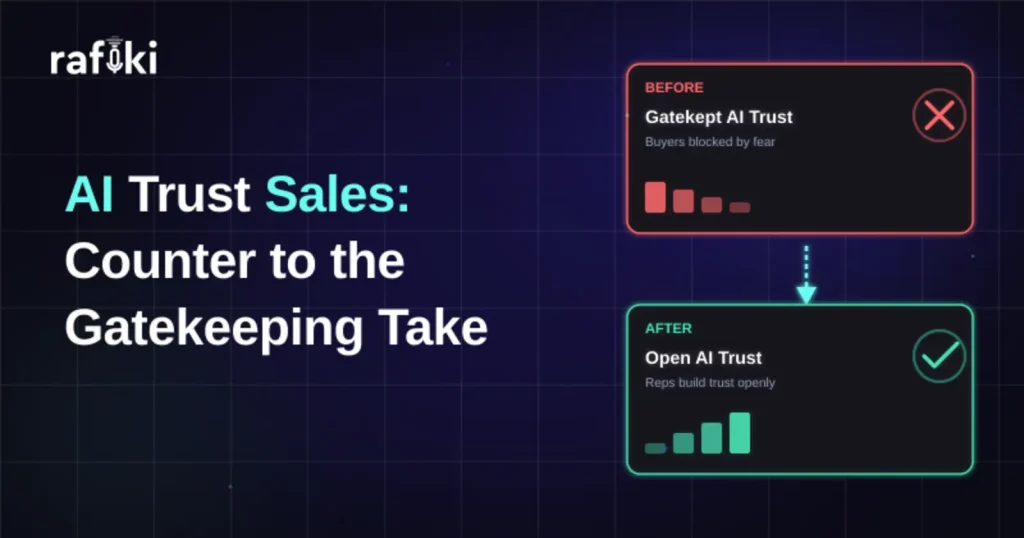
The biggest threat to your pipeline right now isn't a missed quota — it's a sales team that has quietly stopped trusting the AI you bought to help them close.
There's a comfortable narrative circulating in the revenue intelligence space: that AI in sales is a privilege earned only by enterprises with massive data lakes, dedicated AI ops teams, and seven-figure platform budgets. The implication is that smaller, faster-growing teams should wait their turn — that ai trust sales outcomes are a function of scale, not architecture. That take is wrong, and it's costing growing teams real revenue.
The truth is messier and more interesting. Trust in AI for sales has nothing to do with company size and everything to do with how the AI was built, what it sees, what it does with what it sees, and whether your reps can verify it in seconds. If you accept the gatekeeping framing, you'll keep paying enterprise prices for legacy tooling that your reps secretly ignore. If you reject it, you'll build a faster, leaner revenue engine that wins deals your larger competitors fumble.
The dominant take from legacy revenue intelligence vendors is that AI trust comes from "enterprise-grade" data volumes and years of model tuning on captive customer datasets. This conveniently positions large incumbents as the only safe choice and frames growing teams as too small, too noisy, or too immature to benefit. It's a gatekeeping argument dressed up as a technical one.
The actual trust barrier looks nothing like that. It looks like this:
Trust collapses the moment AI output diverges from what the rep remembers — and once collapsed, it almost never returns. The barrier isn't model size. It's transparency, traceability, and the speed at which a human can verify the machine.
The argument that meaningful AI in sales requires enterprise scale has three quiet assumptions, and all three fail under examination. First, it assumes AI quality is purely a function of training data volume. Second, it assumes that growing teams have less complex selling motions. Third, it assumes that trust is built by brand reputation rather than by what reps experience in their daily workflow.
What this gatekeeping framing actually produces:
Growing teams don't have less complex deals — they have less margin for error. A small sales team losing a handful of winnable deals a quarter feels that loss harder than a large enterprise org. The case for AI trust in growing sales teams is stronger, not weaker. The gatekeeping take has it backwards.
AI trust in sales refers to the rep's, manager's, and executive's confidence that the system's outputs reflect reality, can be traced to source evidence, and consistently drive correct actions. It is not a brand feeling. It is a behavioral pattern measured in usage, override rates, and field accuracy.
Four conditions have to be true simultaneously:
If any one of those conditions fails, adoption stalls. Reps revert to manual notes, managers revert to gut-feel reviews, and the AI investment becomes shelfware. According to McKinsey's research on AI adoption, the gap between AI experimentation and AI value capture is overwhelmingly driven by workflow integration and trust, not by model sophistication.
There's a meaningful technical distinction the gatekeeping take obscures. Legacy revenue intelligence platforms were built in a pre-LLM era to record calls, transcribe them, and surface keyword-based insights. AI was added later, layered on top of an architecture that wasn't designed for it. The result is brittle: summaries that hallucinate, scoring that ignores methodology nuance, and search that can't reason across accounts.
AI-native platforms are different in three concrete ways:
This architectural difference is the actual reason some AI surfaces trust and other AI surfaces noise. It has nothing to do with how many years a vendor has been collecting calls and everything to do with whether the system was designed from day one to reason, ground, and act.
Trust in AI sales tools is built or destroyed in the verification loop — the time and friction between an AI output and the human's ability to confirm or correct it. Long loops kill trust. Short loops compound it.
A healthy verification loop looks like this:
Contrast this with the legacy pattern: AI surfaces a "deal at risk" flag, the rep has no idea why, opens the call recording, scrubs through the audio, finds nothing conclusive, dismisses the flag, and stops looking at risk scores entirely. The model could be state-of-the-art. The verification loop killed it.
This is also why methodology-specific scoring matters so much. Generic "deal health" scores force reps to do translation work in their heads. Scoring that maps directly to MEDDIC fields, SPICED stages, or Challenger commercial teaching points lets a rep verify the AI against the exact framework they were trained on. Harvard Business Review's analysis of generative AI risk makes this point clearly: AI systems earn trust through traceability and contextual fit, not through opacity and scale.
Rafiki AI is built as an AI-native revenue intelligence platform from day one — not a call recorder with AI features bolted on later. That architectural difference shows up in how the platform handles every condition of ai trust sales outcomes depend on.
The six autonomous AI agents work as a coordinated revenue team that runs 24/7 across 60+ languages, integrating natively with Salesforce, HubSpot, Zoho, Pipedrive, Freshworks, Zoom, Teams, and Google Meet. The platform starts at $19/seat/month with no seat minimums and no annual commitment — the opposite of the gatekept enterprise model. Trust isn't gated behind a procurement cycle. You can validate it in minutes of setup.
Building durable AI trust is a sequence, not a switch. Skipping steps is the most common reason adoption stalls. Here's the rollout that works for growing teams.
This sequence works because it treats trust as an earned outcome of repeated verified accuracy, not as something a vendor brand confers. For deeper tactical guidance on how this pattern plays out in coaching, see our writeup on AI skill scoring and closing the loop on sales coaching, and our analysis of why modular coaching wins over monolithic enterprise stacks.
When you stop accepting the framing that real AI is reserved for enterprise buyers with seven-figure budgets, several concrete advantages open up — advantages that compound as the AI landscape continues to consolidate around AI-native architectures.
The gatekeeping take wants you to believe AI trust is bought with budget. It isn't. It's built with architecture, methodology fit, and verification speed — all of which are now available to teams of any size. The vendors who benefit from the old framing have every incentive to keep promoting it. You have every incentive to ignore them.
Looking ahead through 2026 and beyond, the gap between teams that trust their AI and teams that don't will become a major predictor of revenue efficiency. Not headcount. Not pipeline coverage. Not even win rate as a standalone metric. Trust, because trust is what determines whether AI output actually changes rep behavior, manager coaching, and executive decisions.
Teams that win this gap will look different:
The vendors who built their platforms before the AI-native era will keep trying to bolt new models onto old foundations. Some will succeed partially. Most will produce the kind of brittle, low-trust output that drives the adoption crisis we see today. The platforms built AI-native from day one — with multi-model orchestration, agentic workflows, and source-grounded outputs — will define the next decade of revenue intelligence. The teams who adopt them early, regardless of size, will be the ones quietly taking market share from larger competitors stuck in legacy contracts.
Stop letting anyone tell you that meaningful AI is gated behind enterprise scale. It isn't. It's gated behind architecture and adoption — and both are available to your team right now.
See what AI-native revenue intelligence looks like when it's actually built for growing sales teams. Explore the Rafiki AI platform, start free with no seat minimums and no annual contracts at $19/seat/month, or book a demo to see how Smart Call Scoring, Smart CRM Sync, and the full team of six autonomous AI agents can be running in your workflow quickly. The trust barrier is real. The gatekeeping framing isn't.
Start for free — no credit card, no seat minimums, no long contracts. Just better sales intelligence.