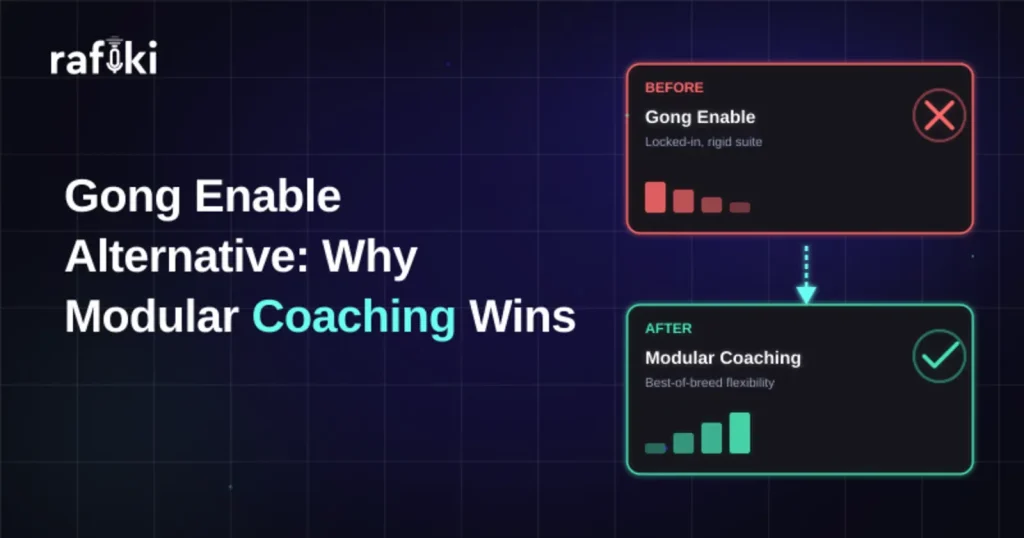
Your sales coaching program is only as strong as the weakest link in your enablement stack — and if that stack is a single vendor's walled garden, the weakest link is everywhere.
Revenue leaders in 2026 face a paradox. They have more enablement technology at their disposal than ever, yet reps still stumble through discovery calls, fumble objection handling, and lose winnable deals because coaching never reaches them at the moment it matters. The root cause is not a shortage of tools. It is an architecture problem. Many organizations locked themselves into monolithic enablement suites years ago, expecting a single platform to handle call recording, coaching workflows, content management, and analytics under one roof. What they got instead was a rigid, expensive system that forces every team — from SDRs to customer success — into the same mold, regardless of how they actually sell.
If you are evaluating a Gong Enable alternative, you are likely feeling this tension firsthand. The promise of an all-in-one coaching module inside a conversation intelligence platform sounds elegant on a vendor slide deck. In practice, it creates dependencies that slow down iteration, inflate costs, and leave frontline managers without the flexibility to coach the way their specific team needs. The question is no longer "which single platform does everything?" It is "which combination of best-in-class, modular tools lets my team coach faster, cheaper, and more precisely?"
A monolithic coaching platform is one where coaching, scoring, content delivery, and analytics are tightly coupled inside a single vendor's ecosystem. On paper, integration is seamless. In reality, you inherit every limitation the vendor builds into its roadmap, pricing model, and data architecture.
The consequence is predictable. Frontline managers stop using the coaching module because it takes too long to configure. Reps receive generic scorecards that do not reflect the selling motion they actually run. And leadership loses visibility into whether coaching is moving pipeline — because the analytics are trapped inside the same system that created the problem. If you have searched for a Gong Enable alternative, these frustrations likely sound familiar.
A modular coaching stack is an intentionally assembled set of specialized tools — each best-in-class at its function — connected through integrations rather than bundled by a single vendor. Instead of buying a platform that does everything adequately, you compose a stack where each layer excels at one job.
The advantage is structural. When one layer underperforms, you swap it without rebuilding your entire enablement workflow. When a new AI capability emerges — and in 2026, they emerge monthly — you plug it in without waiting for your monolithic vendor's next quarterly release. McKinsey's research on composable architecture makes a compelling case that modular technology strategies give organizations greater adaptability compared to monolithic approaches.
Not every modular tool qualifies as a genuine alternative. When evaluating options, apply these five criteria to separate real coaching enablers from rebadged call recorders.
Apply these five filters and the field narrows quickly. Most legacy enablement platforms fail on at least two — typically methodology flexibility and pricing. The platforms that pass all five tend to be purpose-built, AI-native, and modular by design.
The distinction between AI-native and AI-augmented matters more in coaching than almost any other revenue function. Coaching depends on nuance — detecting when a rep's discovery questions are surface-level, identifying the moment a prospect's tone shifts from curious to skeptical, recognizing that a competitor was mentioned obliquely rather than by name. Legacy platforms that bolted AI onto existing call recording infrastructure struggle with this nuance because their data models were designed for keyword spotting, not contextual understanding.
This architectural difference is why the best Gong Enable alternative in 2026 is not another monolithic suite. It is an AI-native intelligence layer that integrates into your existing stack, handles the heavy analytical work autonomously, and delivers coaching-ready insights where your managers already work.
Even the best coaching tool fails if frontline managers cannot operationalize it. Harvard Business Review research highlights that manager effectiveness is one of the most powerful levers for team performance — yet most managers spend their coaching time on administrative tasks rather than actual skill development. Monolithic platforms exacerbate this by adding another interface managers must log into, another dashboard to interpret, another workflow to learn.
The net effect is a coaching motion that scales with headcount without requiring a proportional increase in manager hours. This is the operational advantage that makes modular stacks outperform bundled alternatives — not any single feature, but the compounding efficiency of each specialized layer working in concert.
Rafiki AI is an AI-native revenue intelligence platform built from day one on a multi-model architecture, designed to serve as the intelligence and coaching backbone of a modular stack. It is not a monolithic suite. It is the engine that makes every other tool in your stack smarter — and it starts at $19/seat/month with no seat minimums and no annual contracts.
Here is how Rafiki AI's six autonomous AI agents map to the modular coaching stack framework:
Beyond the six agents, Rafiki AI includes AI Role Play with customizable buyer personas — giving reps a practice environment calibrated to the objections, personas, and scenarios they actually face. And with 60+ language transcription, teams selling across EMEA, APAC, or LATAM get the same coaching depth as English-speaking reps. This global coverage is a capability most legacy platforms cannot match, and it is a decisive factor for any organization evaluating a Gong Enable alternative for international teams.
Rafiki AI integrates natively with Zoom, Teams, and Google Meet, and getting started is fast and straightforward. The result is an AI revenue team that works 24/7, catching the signals buried in calls that no human manager could review manually.
Transitioning from a monolithic enablement platform to a modular stack does not require a rip-and-replace. The most successful teams phase the rollout to minimize disruption and build internal buy-in.
This phased approach de-risks the transition. At each stage, you have a clear comparison point. And because modular tools like Rafiki AI have no annual contracts, you are never locked in — you continue only as long as the value is evident.
One of the sharpest criticisms of monolithic enablement platforms is that coaching ROI stays opaque. The platform reports activity metrics — calls reviewed, scorecards completed, content consumed — but connecting those activities to pipeline velocity or win rates requires manual analysis that rarely gets done.
The advantage of a modular stack is that each layer produces its own metrics, and an AI-native analytics layer can correlate them automatically. When your call scoring tool shows a rep improving on discovery depth and your CRM shows that same rep's deals progressing faster through pipeline, you have a causal chain that justifies continued investment — or reveals where the stack needs adjustment.
The shift from monolithic to modular coaching is not a technology preference. It is a competitive strategy. In 2026, the teams that win are the ones that iterate fastest — testing new coaching frameworks, adopting new AI capabilities, and adapting their selling motion quarter by quarter. Monolithic platforms, by design, resist this speed. Their value proposition is stability, not agility. That was an advantage in a slower market. It is a liability now.
The organizations searching for a Gong Enable alternative are recognizing this structural advantage. They do not need a different monolith. They need a fundamentally different architecture — one that treats coaching as a composable workflow, not a bundled feature inside a platform you chose three years ago for a different reason.
The enablement market has reached an inflection point. The monolithic model that dominated the last decade is giving way to composable stacks where each tool earns its place through performance, not lock-in. For revenue leaders evaluating a Gong Enable alternative in 2026, the decision framework is clear: choose tools that are AI-native by architecture, methodology-agnostic by design, globally capable by default, and priced for growth rather than extraction.
The monolithic era rewarded vendor consolidation. The modular era rewards buyer intelligence. Choose accordingly.
Rafiki AI gives your team enterprise-grade revenue intelligence — six autonomous AI agents, Smart Call Scoring against any methodology, 60+ language support, and AI-native architecture — starting at $19/seat/month with no seat minimums and no annual contracts. Explore the full platform or book a demo to see how a modular coaching stack built on Rafiki AI replaces monolithic enablement with something that actually scales.
Start for free — no credit card, no seat minimums, no long contracts. Just better sales intelligence.