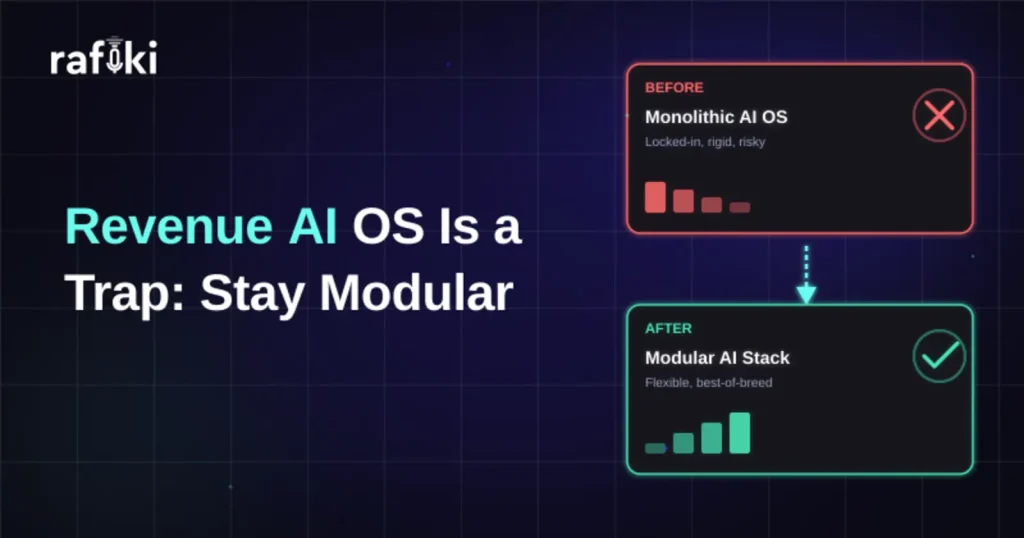
The fastest way to cripple your revenue stack in 2026 is to hand everything to a single vendor that promises an all-in-one "Revenue AI Operating System."
It sounds seductive. One platform to rule every stage of the pipeline — prospecting, call intelligence, deal execution, forecasting, coaching, renewals. One login, one contract, one throat to choke. Vendors pitching the Revenue AI OS narrative want you to believe that consolidation equals simplicity, and simplicity equals speed. But what you actually get is a monolithic revenue AI platform that locks you into somebody else's roadmap, somebody else's data model, and somebody else's pace of innovation — right when the AI landscape is shifting faster than any single vendor can keep up with.
If you are a revenue leader at a growing sales team, this matters more to you than it does to an enterprise with an army of admins. You cannot afford an 18-month migration if the platform stagnates. You cannot absorb a steep price hike when the vendor decides to monetize the module you actually need. And you cannot wait two quarters for a feature that a best-of-breed tool already ships today. The OS trap is not a theoretical risk. It is already playing out across the market, and the teams that stay modular are pulling ahead.
The All-in-One Revenue AI Platform Fallacy
The Revenue AI OS pitch relies on a simple logical shortcut: fewer tools means less friction. In practice, the opposite is true. A monolithic revenue AI platform concentrates risk instead of distributing it. When one module underperforms — and one always does — you cannot swap it out without destabilizing the entire system.
- Feature breadth masks feature depth. All-in-one platforms spread engineering resources across dozens of modules. The call intelligence layer is adequate; the forecasting layer is adequate; none of them are best-in-class. You settle for "good enough" at every stage of the funnel.
- Innovation bottlenecks compound. Large-model AI evolves quarterly. A monolithic vendor must validate every model update against every module before shipping. That means you get last year's models while modular competitors run the latest architectures.
- Switching costs are the real product. Once your pipeline data, call recordings, CRM mappings, and coaching workflows live inside one system, leaving costs more than staying — even when staying is expensive. The vendor knows this, and prices accordingly.
- Customization ceilings appear fast. Your sales methodology, your ICP definitions, your scoring rubrics are unique. OS-style platforms offer configuration. Modular tools built on open architectures offer true flexibility.
The pattern is familiar. It mirrors what happened with legacy marketing automation suites a decade ago: promise the world, deliver a walled garden, then raise prices once migration pain exceeds the budget for alternatives. Revenue teams that recognize the pattern early have a structural advantage.
Why Modularity Wins: The Architecture Argument
Modularity in a revenue stack refers to selecting purpose-built tools for distinct jobs — call intelligence, CRM, outbound sequencing, forecasting — and connecting them through native integrations or lightweight middleware. It is the opposite of buying a suite and hoping every module is world-class.
Organizations that adopt composable, modular technology architectures generally find it easier to ship capabilities faster and adapt to changing market conditions. The same logic applies to your revenue AI platform decisions.
- Swap without disruption. If your outbound sequencer falls behind, replace it. Your call intelligence, CRM sync, and coaching layers remain untouched. Zero migration tax on the modules that work.
- Best model, best task. Different AI tasks — transcription, summarization, scoring, forecasting — benefit from different model architectures. A modular stack lets each tool use the optimal model. An OS forces a single model layer across all tasks.
- Pricing stays competitive. When every vendor knows you can leave, they keep prices honest. When one vendor owns everything, you lose leverage at renewal.
- Speed of deployment. Purpose-built tools ship in days, not quarters. You do not need a platform admin to configure 14 modules before value starts flowing.
Modularity does not mean chaos. It means intentional composition. The connective tissue is your CRM and a thin integration layer — not another mega-platform sitting on top.
The Real Cost of the OS Trap: What You Lose
Revenue leaders evaluating an all-in-one OS rarely calculate the hidden costs until they are already locked in. The sticker price is only the beginning.
- Opportunity cost of slow iteration. When the OS vendor takes six months to ship a coaching feature, your managers keep running blind. Meanwhile, a modular tool with smart call scoring is already scoring every call against MEDDIC, BANT, SPIN, or your custom rubric — today.
- Data portability risk. Monolithic platforms store data in proprietary schemas. Exporting call-level insights, deal signals, and rep performance histories into a new system is a project measured in months, not hours.
- Team adoption drag. Reps adopt tools that are fast and focused. Force them into a bloated platform where they only use a fraction of the surface area, and adoption drops. Low adoption means low signal capture, which means low intelligence value.
- Vendor dependency at the board level. When your forecasting, pipeline analytics, and rep coaching all run through one vendor, a contract dispute or service outage does not create an inconvenience — it creates a board-level crisis.
The teams losing the most are mid-market and growth-stage companies. They lack the admin headcount to manage a complex OS, but they face the same pressure to modernize with AI. For them, the modular path is not just better — it is the only viable one.
Designing a Modular Revenue AI Stack: Core Principles
Building a modular stack is not about buying the most tools. It is about buying the right tools and connecting them deliberately. Here are the principles that separate a high-performing modular stack from a disjointed mess.
Principle 1: Let the CRM Be the Spine, Not the Brain
Your CRM — Salesforce, HubSpot, Zoho, Pipedrive — should be the system of record, not the system of intelligence. The brain of your stack is the AI layer that captures signals, scores interactions, and surfaces risk. The CRM stores the output. Trying to make the CRM do both creates bloated workflows and stale data.
- Use native integrations that push structured insights into CRM fields automatically.
- Avoid platforms that require manual data entry to populate intelligence — that defeats the purpose.
- Ensure bi-directional sync so your AI layer reads deal context and your CRM reflects call-level signals.
Principle 2: Optimize for Signal Density, Not Feature Count
Every tool in your stack should increase the density of actionable signals per rep, per deal, per quarter. If a module adds dashboards but not insights, cut it.
- Prioritize tools that extract structured data from unstructured conversations — competitor mentions, objection patterns, decision-maker sentiment, next steps.
- Evaluate whether the tool reduces the time between signal detection and rep action.
- Reject tools that require managers to hunt for insights. The tool should surface them proactively.
Principle 3: Demand AI-Native, Not AI-Augmented
There is a critical difference. AI-native means the product was built from day one on machine learning and multi-model architectures. AI-augmented means a legacy tool bolted on a GPT wrapper and called it innovation. The distinction shows up in transcription accuracy, summarization quality, scoring reliability, and — most importantly — the speed at which the vendor ships improvements as foundation models evolve.
- Ask vendors: what models power each capability, and how often do you update them?
- Test multi-language transcription. If it only works well in English, the architecture is shallow.
- Check whether AI features require separate pricing tiers or are embedded in the core product.
The Call Intelligence Layer: Where Modularity Matters Most
Of all the modules in a revenue stack, call intelligence is the one where the gap between best-of-breed and bundled-in-an-OS is widest. The reason is straightforward: call intelligence sits at the intersection of transcription, NLP, scoring, summarization, CRM sync, and coaching — each of which benefits from different model optimizations. A dedicated call intelligence tool can run the best model for each task. An OS bundles a generic model across all of them.
- Transcription quality determines everything downstream. If the transcript is wrong, the summary is wrong, the score is wrong, and the CRM field is wrong. Purpose-built tools invest disproportionately in transcription accuracy across accents, languages, and audio conditions.
- Methodology-specific scoring requires deep configurability. Your team runs MEDDIC. Your partner team runs Challenger. Your CS org uses SPICED. A modular call intelligence layer scores each team against its own framework without compromise.
- Follow-up automation must be contextual. Generic follow-up emails generated from shallow summaries waste rep time and annoy prospects. Deep follow-ups — ones that reference specific objections, map next steps to stakeholders, and flag missing information — require a tool built for that job.
- Coaching at scale depends on call scoring that managers trust. If the scoring model is a black box inside a larger OS, managers default to manual review, which does not scale.
This is the layer where the revenue AI platform decision has the highest leverage. Get it right, and every downstream process — forecasting, pipeline review, QBR prep — improves. Get it wrong, and you are building on unreliable data.
How Rafiki AI Powers the Modular Revenue Stack
Rafiki AI is an AI-native revenue intelligence platform built from day one on multi-model AI architecture — not a legacy recorder with a GPT wrapper. It is designed to be the call intelligence layer in a modular stack, integrating cleanly with your existing CRM, dialer, and video conferencing tools while delivering enterprise-grade insights at a fraction of enterprise cost.
Here is how Rafiki AI maps to the modular principles outlined above:
- Autonomous AI agents — Notetaking Agent, Follow Up Agent, CRM Sync Agent, Coaching Agent, Revenue Agent — each purpose-built for a distinct revenue workflow. They run 24/7, requiring no manual input from reps.
- Smart CRM Sync auto-populates methodology-specific fields — MEDDIC, BANT, SPIN, SPICED, GAP, Challenger, Sandler — and custom CRM fields directly from call content. Your CRM stays the spine; Rafiki AI provides the intelligence.
- Smart Call Scoring scores every call against any standard methodology or your own custom scoring criteria, giving managers a reliable, scalable coaching signal they can act on the same day.
- 60+ language transcription means global teams run on a single platform without bolting on regional transcription vendors — a modularity advantage that most competitors cannot match.
- Native integrations with Salesforce, HubSpot, Zoho, Pipedrive, Freshworks, Zoom, Teams, and Google Meet ensure Rafiki AI slots into your existing stack without forcing you to rip and replace anything.
- Ask Rafiki Anything lets RevOps leaders and managers run natural-language queries across every conversation in the system — surfacing patterns, risks, and opportunities that no dashboard can anticipate.
Critically, Rafiki AI starts at $19 per seat per month with no seat minimums, no annual contracts, and no hidden fees. That pricing model is itself a modular advantage: you can deploy it for a single team, prove value, and expand — without the six-figure annual contract an OS vendor demands upfront.
Implementation: Rolling Out a Modular Revenue AI Stack in Four Steps
Shifting from a monolithic mindset to a modular stack does not require a rip-and-replace. It requires a phased approach that builds confidence with each step.
- Audit your current stack for depth versus breadth. List every module in your revenue toolset. For each, rate whether it is best-in-class or merely adequate. Flag the "adequate" modules as replacement candidates. Common weak spots: call intelligence, coaching, and CRM data hygiene.
- Deploy a purpose-built call intelligence layer first. Call data is the richest source of revenue signal in your org. Start here because the ROI is immediate and measurable — in rep time saved, CRM field accuracy, and coaching quality. Rafiki AI deploys quickly with minimal setup, so the deployment risk is near zero.
- Establish integration contracts between tools. Define what data flows where. Call summaries and deal signals should push to CRM fields. Scoring data should feed into your coaching dashboards. Follow-up drafts should land in your sequencer. Map these flows explicitly so nothing falls between tools.
- Review and swap quarterly. The advantage of modularity is that you can upgrade any layer without disrupting the others. Set a quarterly review cadence to evaluate whether each tool still earns its place. If a better option emerges, the switch costs days — not months.
This approach respects your team's bandwidth. There is no big-bang migration, no months-long implementation project, and no period where the old system is off but the new system is not quite on.
The Competitive Edge: Why Modular Teams Outperform in 2026
The revenue teams winning in 2026 share a common trait: they treat their tech stack as a portfolio, not a monolith. They optimize for flexibility, signal quality, and speed of iteration — not for vendor consolidation.
- They adopt AI capabilities faster because swapping in a new best-of-breed tool is a tactical decision, not a strategic overhaul.
- They retain talent more effectively because reps and managers use tools that are focused and intuitive, not bloated platforms that slow them down.
- They forecast more accurately because their call intelligence layer captures real buyer signals — not self-reported rep data — and syncs them into the CRM automatically.
- They control costs because every vendor knows it can be replaced, keeping pricing competitive at renewal. Treating vendor relationships as composable — rather than locked-in — reduces long-term total cost of ownership.
- They scale globally without friction because modular tools with broad language support — like Rafiki AI's 60+ language capability — eliminate the need for regional point solutions.
The OS trap promises simplicity but delivers rigidity. The modular path demands slightly more architectural thinking upfront but delivers compounding advantages over every quarter that follows.
Conclusion: Build for Flexibility, Not for a Vendor's Roadmap
The revenue AI platform market in 2026 is noisy with vendors promising to be your everything. Resist the pitch. The teams that thrive are the ones that choose tools based on depth, integrate them deliberately, and reserve the right to swap any layer at any time. Modularity is not a compromise — it is a strategy.
- Choose AI-native over AI-augmented.
- Choose depth of insight over breadth of feature checkboxes.
- Choose tools that integrate openly rather than platforms that trap your data.
- Choose pricing that scales with your team, not contracts that scale with your vendor's revenue targets.
The all-in-one Revenue AI OS will keep getting pitched. And it will keep underdelivering for the same reason every monolith does — the world moves too fast for one vendor to be best at everything. Stay modular. Stay fast. Stay in control.
Rafiki AI is built for exactly this approach — an AI-native revenue intelligence platform that serves as the high-signal call intelligence layer in your modular stack. Six autonomous AI agents, 60+ languages, native CRM integrations, and pricing that starts at $19 per seat with no minimums and no annual contracts. Start free or book a demo and see what modular, purpose-built revenue intelligence looks like in practice.