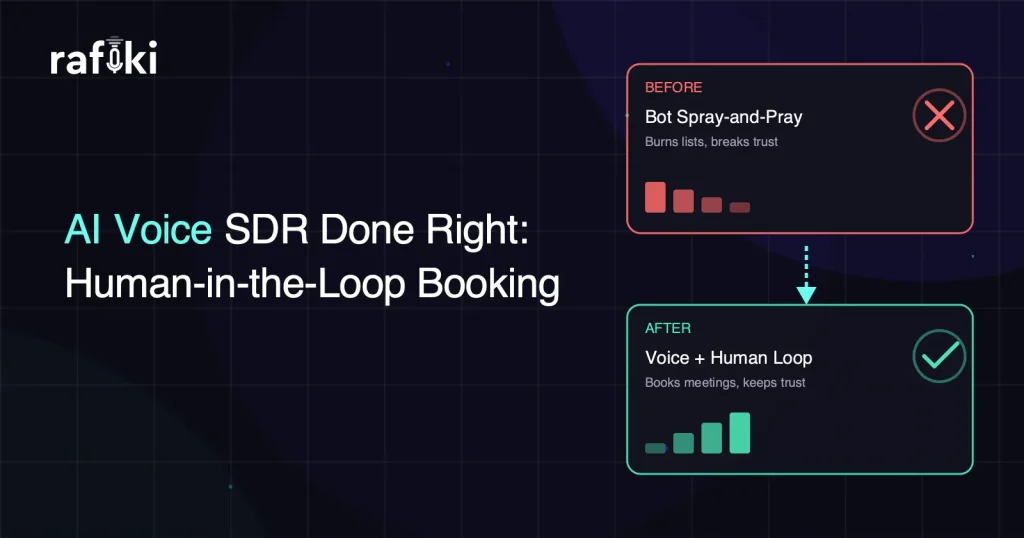
Buyers can usually tell within the first few seconds when a "rep" on the phone is actually a bot pretending not to be one — and the moment they catch it, your brand loses a deal you never even knew existed.
The race to deploy autonomous AI voice agents for outbound calling has created a strange new failure mode in B2B sales. Teams chase the dream of infinite dials and zero payroll, then quietly discover that fully autonomous voice bots are booking meetings with the wrong people, mishandling objections, agreeing to commitments no human can keep, and burning lists that took months to build. The damage doesn't show up in a dashboard. It shows up in unsubscribe rates, in LinkedIn screenshots of awkward transcripts, and in the slow erosion of reply rates across every channel.
The opportunity is real. Voice is still the highest-intent surface in outbound. But the way most teams are deploying an AI voice SDR today — fully autonomous, no oversight, optimized for booked meetings rather than qualified pipeline — is destroying the very trust that makes voice work. There is a better way, and it starts with putting humans back in the loop at the exact moments that matter.
The pitch sounds irresistible. Point an AI voice agent at a list of contacts, let it dial around the clock, and wake up to a calendar full of meetings. In practice, the meetings that land on your AEs' calendars from unsupervised voice bots tend to fall into a few painful categories: wrong persona, wrong company size, wrong problem, or — worst of all — a prospect who agreed to "a quick call" just to end the conversation.
The damage compounds across the funnel:
The root cause isn't the voice technology. Synthetic voices have improved dramatically — in short conversational moments they can be hard to distinguish from human voices, and large language models can handle objection branches that scripted IVR systems never could. The root cause is governance. Teams are giving voice agents authority they haven't earned, with no checkpoints, no escalation paths, and no humans reviewing what was promised on the call.
The economics of fully autonomous dialing look great in a spreadsheet and terrible in a CRM. The reason is that booked meetings are a vanity metric. Qualified, attended, advancing meetings are the metric that matters, and that ratio collapses the moment a voice bot is rewarded for "agreement" rather than "fit."
Consider what a hands-off voice agent is actually optimizing for:
The trust cost is what spreadsheets miss. Research from Salesforce on the connected customer consistently shows that buyers expect personalization and context from the first interaction — not generic discovery questions delivered in a synthetic voice. When a prospect realizes mid-call that the "rep" doesn't actually know what their company does, the conversation is over, and so is the relationship.
The fix is not to abandon voice AI. The fix is to redesign the workflow so the AI does what it's genuinely good at — dialing, transcribing, qualifying against a script, capturing signals — while humans handle what they're uniquely good at: judgment, nuance, and the final commitment.
Human-in-the-loop (HITL) booking is a workflow design where an AI voice agent runs the top of the conversation — opener, permission, light discovery, qualification questions — and then hands the live caller to a human SDR at the precise moment a meeting commitment is about to be made. The AI does the volume. The human does the close.
The model rests on a simple principle: the AI should never make a promise a human will have to honor. That includes scheduling, pricing references, product capabilities, and any statement that could be quoted back in a deal review three months later.
A well-designed HITL voice workflow includes:
The result is a voice motion that scales like AI and converts like a human. Your SDR team stops spending hours a day dialing voicemails and starts spending those hours having the high-intent conversations the AI surfaced for them. Pipeline quality goes up. Rep burnout goes down. And the buyer — the only person whose opinion ultimately matters — never has the unsettling experience of realizing they were talking to a machine that committed their calendar without them noticing.
Drawing the line between AI authority and human authority is the most important design decision in a voice SDR program. Get it wrong and you either neuter the AI's leverage or hand it too much rope. The right line moves with maturity, but the starting point should always lean conservative.
Tasks the AI voice agent should own:
Tasks the AI voice agent should never own:
The escalation trigger is where the design earns its money. The moment a prospect says "tell me more," asks a substantive question, or signals decision authority, the AI should warm-transfer to a live SDR with the transcript, the qualification scores, and the account context already loaded on the rep's screen. The handoff should feel to the prospect like a natural transition — "let me bring in my colleague who specializes in this" — not a jarring switch.
The handoff moment is the entire ballgame. A clumsy transfer — dead air, the human asking questions the AI already asked, mismatched context — confirms every fear the prospect had about being processed by a machine. A clean transfer makes the AI invisible and the human prepared.
Five elements separate a trust-building handoff from a trust-destroying one:
Reps need training for this motion. The instinct of a traditional SDR is to "start from the top" because they don't trust the data they were handed. That instinct kills the workflow. Reps must learn to trust the AI's qualification work and pick up the conversation mid-flow, the same way a senior AE picks up a call from an SDR mid-discovery. The cultural shift takes a few weeks. The productivity unlock that follows is durable.
Regulators across multiple jurisdictions have made their position clear: AI-generated voices used in outbound communication require disclosure. Beyond the legal layer, there is a reputational layer that matters even more. Buyers who feel deceived by a voice bot don't just file complaints — they post screenshots, warn peers, and remember your brand for the wrong reasons.
A defensible disclosure and compliance posture includes:
The counterintuitive finding from teams running disclosed AI voice programs is that disclosure rarely tanks conversion. Prospects who are going to engage will engage regardless. Prospects who would have hung up on a human will hang up on a bot too. What disclosure does eliminate is the worst outcome of all: the prospect who books the meeting, shows up, realizes they were misled, and walks away from the brand entirely.
Rafiki AI is built for exactly this kind of hybrid workflow — AI doing the volume, humans doing the judgment, with a unified revenue intelligence layer connecting both. As an AI-native platform built from day one on multi-model AI rather than bolted on, Rafiki AI gives SDR leaders the intelligence layer to govern voice automation responsibly — scoring conversations, summarizing context, syncing CRM, and surfacing the right moments to route to a human.
The pieces that make HITL voice booking work:
For SDR leaders running hybrid voice motions, the platform's autonomous AI agents — act as a full revenue team working alongside human reps, scoring conversations, summarizing context, syncing data, drafting follow-ups, and answering ad-hoc questions. The forthcoming Voice Agent will close the loop for fully autonomous outbound that still respects the human-in-the-loop guardrails described above. Rafiki AI integrates natively with Salesforce, HubSpot, Zoho, Pipedrive, Freshworks, and Monday.com on the CRM side, plus Zoom, Microsoft Teams, and Google Meet on the conferencing side, and Slack, Aircall, and OpenPhone for messaging and dialing — so the hybrid voice workflow plugs into the stack your SDR team already runs. The point isn't to replace SDRs. It's to make every SDR conversation count, and to make sure the AI layer never makes a promise the human team can't keep. Pricing starts at $19/seat with no seat minimums, which means hybrid voice teams can scale headcount and AI coverage independently, without enterprise contract friction.
Teams that succeed with voice AI treat it as a multi-quarter program, not a weekend pilot. The phasing matters because trust, once burned, takes far longer to rebuild than the program took to launch.
Two metrics matter more than booking count during rollout:
If those numbers move in the right direction, expand. If they don't, pull back. The teams that get this right resist the temptation to celebrate booking volume in week two and instead earn the right to scale by proving quality in month two.
The teams winning with voice AI in 2026 aren't the ones running the loudest, most autonomous bots. They're the ones who figured out that voice AI is a leverage tool, not a labor replacement. Their SDRs handle fewer dials but more real conversations. Their AEs receive cleaner pipeline with richer context. Their RevOps leaders see forecast accuracy improve because the qualification work happened in real time, not in retroactive data entry.
The competitive gap between "AI-first SDR team with HITL discipline" and "AI-first SDR team without it" will widen quickly. Both will claim to use voice AI. Only one will be building a trustworthy pipeline. Buyers will notice. AEs will notice. Boards will notice when the booked-to-closed-won ratio either holds or collapses.
Voice will remain the highest-bandwidth channel in outbound, and AI will remain the highest-leverage way to scale it. The teams that pair those two truths with human judgment at the moments that matter will own the next era of outbound. The teams that don't will spend the next year explaining to their boards why their reply rates keep dropping.
If you're rethinking how voice AI should fit into your outbound motion without sacrificing buyer trust, see how Rafiki AI's autonomous AI sales agents power human-in-the-loop workflows across qualification, handoff, CRM sync, and follow-up. Start free with no seat minimums at $19/seat, or book a demo to see how 60+ language coverage and methodology-aware call scoring give growing SDR teams enterprise-grade revenue intelligence without enterprise-grade cost.
Start for free — no credit card, no seat minimums, no long contracts. Just better sales intelligence.