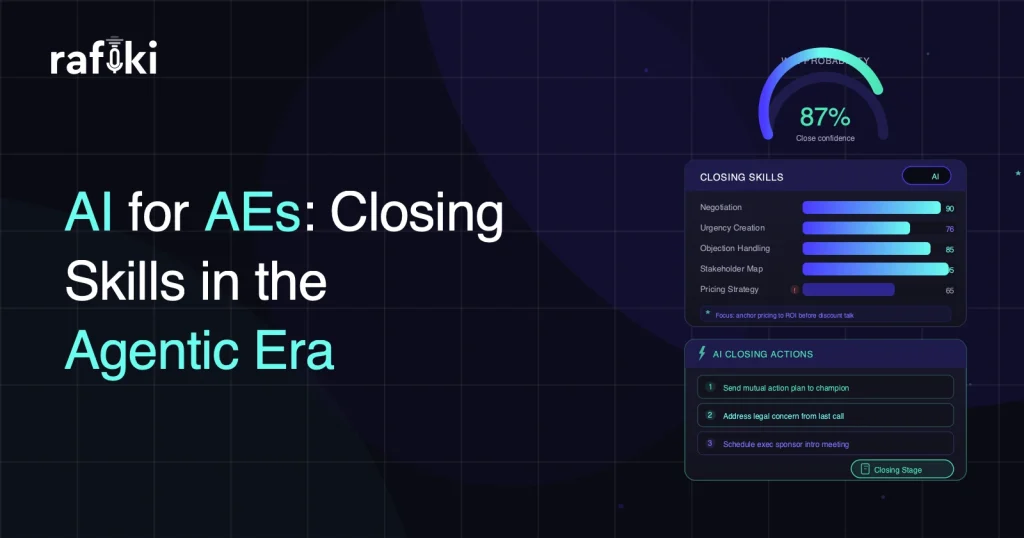
The Closing Role Is Changing, But Not Disappearing. For years, headlines predicted that AI would replace sales reps.
That prediction missed something fundamental.
Complex B2B deals are not closed by automation.
They’re closed by:
In 2026, AI hasn’t replaced AEs.
It has redefined what great AEs focus on.
The agentic era doesn’t eliminate closers.
It elevates them.
But only if they use AI correctly.
This is where AI for AEs becomes less about productivity — and more about precision.
And where platforms like Rafiki act as the intelligence layer that sharpens closing strategy.
In earlier sales tech waves, AEs were supported by:
Helpful, but surface-level.
In the agentic era, AI can:
The AE’s job changes from:
“Track and remember everything”
to:
“Interpret intelligence and act strategically”
That’s a powerful shift.
AI is not redefining all skills equally.
The agentic era amplifies five specific AE competencies.
Complex B2B deals involve:
Traditional CRM shows who’s listed.
AI shows who’s engaged.
Rafiki detects:
Instead of assuming “we’re multi-threaded,” AEs can see structured evidence.
This allows targeted outreach before late-stage collapse.
Multi-threading becomes proactive — not reactive.
A single objection isn’t dangerous.
Recurring objections are.
In the past, AEs relied on memory.
Now, AI surfaces patterns across meetings:
Rafiki categorizes objections across calls and tracks recurrence.
This enables AEs to:
Closing becomes strategic anticipation — not reactive defense.
Deals rarely die because the product fails.
They die because:
AI can detect signals like:
Rafiki structures these signals into qualification intelligence (MEDDIC, SPICED, GAP, etc.).
AEs gain clarity on:
This precision reduces false optimism.
Most AEs think they handle competition well.
Few do it consistently.
AI can surface:
Rafiki aggregates competitive insights across accounts.
This gives AEs:
Closing improves when positioning is informed by real conversation data — not anecdote.
Sentiment drift is subtle.
Enthusiasm rarely collapses suddenly.
It fades.
AI can detect:
Rafiki’s conversation analysis highlights these shifts.
This allows AEs to:
Closing becomes calibrated.
Rafiki performs these automatically, reducing admin burden and increasing clarity.
AI enhances awareness.
Humans execute judgment.
Let’s compare old vs new.
The AE reviews structured intelligence — not raw transcripts.
Strategic time increases.
Administrative time decreases.
One of the biggest stressors for AEs is forecast scrutiny.
Instead of:
“I feel confident.”
You can say:
Rafiki provides structured deal intelligence that strengthens AE credibility.
Confidence becomes defensible.
When AEs operate with structured conversation intelligence:
This is not because AI closes deals.
It’s because AI removes blind spots.
Blind spots cost revenue.
Historically, great AEs were those who:
In 2026, greatness shifts to:
Rafiki acts as the memory layer for every deal.
It ensures no signal is lost.
As buying committees expand and cycles lengthen:
Structured conversation intelligence does not.
Rafiki transforms:
The AE is no longer drowning in information.
They are guided by intelligence.
AI for AEs does not diminish the art of closing.
It sharpens it.
In the agentic era:
AEs focus on:
The best closers in 2026 are not the ones who resist AI.
They are the ones who leverage it deeply.
Rafiki ensures every conversation becomes structured revenue intelligence.
And when intelligence compounds across meetings, deals close with greater precision.
The future of closing isn’t automation.
It’s augmentation.
And AEs who embrace the agentic stack will outperform those still relying on instinct alone.
Start for free — no credit card, no seat minimums, no long contracts. Just better sales intelligence.