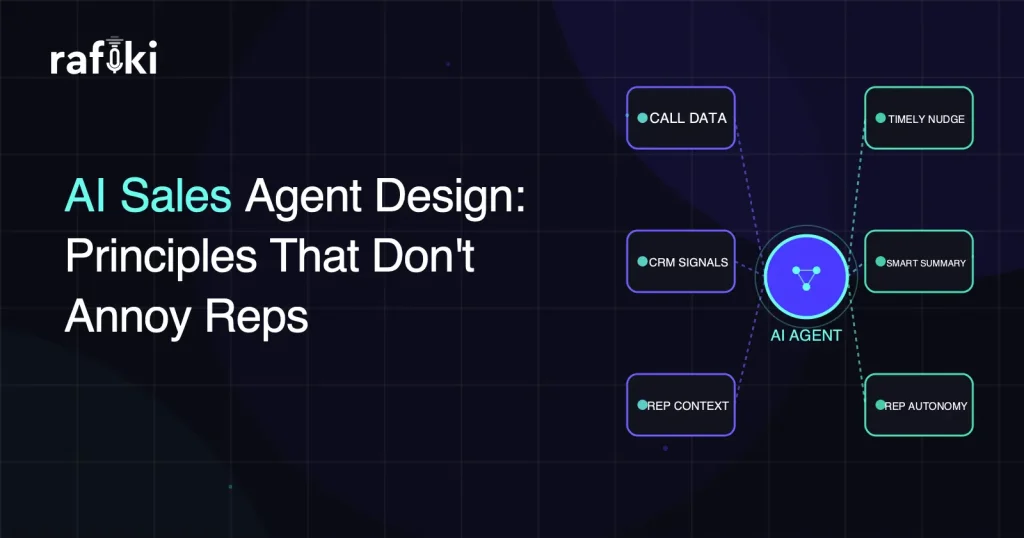
Your sales reps don't hate AI, they hate AI that wastes their time, second-guesses their instincts, and adds friction to a workflow that was already grinding them down.
The promise of autonomous AI agents in sales has never been louder. Every vendor deck in 2026 features some version of an AI copilot, assistant, or agent. Yet adoption tells a different story. Reps disable notifications, ignore AI-generated summaries, and route around systems that feel more like surveillance than support. The gap between what AI agents can do and what reps actually use reveals a fundamental ai sales agent design problem, not a technology problem.
When ai sales agent design gets it wrong, the consequences cascade fast. Reps revert to gut instinct, managers lose visibility, and the revenue signals buried in hundreds of weekly conversations go unanalyzed. Deals slip. Forecasts drift. The expensive AI tooling your team purchased becomes shelfware with a monthly invoice. The teams that win in 2026 are not the ones with the most AI features — they are the ones whose AI agents are designed so well that reps forget they are there, until they surface the insight that saves a deal.
The root cause is straightforward. Most AI agents in sales were designed by product teams optimizing for demo impressions, not daily workflow. They interrupt. They over-notify. They produce outputs that require more effort to parse than the original task. A Harvard Business Review piece on human-AI collaboration reinforces a broader industry finding: AI tools succeed only when they reduce cognitive load rather than add to it.
The failure modes are predictable and repeatable:
The net result is a vicious cycle. Leadership invests in AI tooling. Reps resist. Leadership mandates usage. Reps comply minimally and game the metrics. The intelligence layer that was supposed to improve win rates becomes another tax on the selling day.
Workflow-native design is the single most important principle in ai sales agent design. An agent that requires a rep to change how they sell is an agent that will be abandoned. The agent must meet the rep where they already work — inside the CRM, within the calendar, embedded in the communication tools they use daily.
The design question is never "what can the agent do?" It is "where does the rep already look, and how do we put the right insight there at the right moment?"
Signal surfacing refers to the practice of presenting relevant, contextual data points to a rep without dictating what they should do with them. This distinction is the difference between an agent that earns trust and one that feels patronizing.
Sales is a craft. Experienced reps have pattern recognition honed over thousands of conversations. The best AI agents amplify that instinct rather than override it. They say, "the economic buyer has not been mentioned in the last three calls" — they do not say, "you must schedule a meeting with the CFO by Friday."
Agents that prescribe erode autonomy. Agents that surface signals enhance judgment. The latter builds the kind of trust that drives voluntary, sustained adoption.
Transparent AI reasoning is non-negotiable in sales environments where compensation, career progression, and deal outcomes are at stake. An agent that scores a call at 62 out of 100 without explaining why is worse than no scoring at all — it breeds resentment and distrust.
Trust is asymmetric in sales organizations. It takes months to build and one bad output to lose. Every design decision in ai sales agent design should be evaluated through this lens: does this make the rep trust the agent more, or less?
Time-to-value is the metric that separates agents reps love from agents reps tolerate. Every interaction with the agent should save more time than it consumes. This sounds obvious. In practice, most AI tools violate it constantly.
The math is simple. If an agent saves each rep 30 minutes a day, a 10-person team reclaims 25 hours of selling time weekly. That is not a marginal improvement. It is a structural advantage. The design implication: ruthlessly eliminate every unnecessary interaction between the rep and the agent.
Contextual adaptation means the agent understands the organizational layer — team structure, deal stage conventions, methodology, and coaching cadence — not just individual call data. An AI agent that analyzes calls in isolation misses the broader revenue picture.
The best agents function as a shared intelligence layer across the revenue organization — connecting signals from SDR calls to AE negotiations to CS renewals. This is where design moves from individual productivity to organizational revenue intelligence.
These five principles are not theoretical. They describe the design philosophy behind Rafiki AI's six autonomous AI agents, built from day one on an AI-native, multi-model architecture rather than bolted onto a legacy call recording tool.
Rafiki AI delivers on workflow-native design through agents that work where your team already operates:
Critically, Rafiki AI supports transcription and analysis in 60+ languages, making it the operational backbone for global teams whose conversations span markets and geographies. The platform integrates with Zoom, Microsoft Teams, and Google Meet, and starts at $19 per seat per month with no seat minimums and no annual contracts. This is enterprise-grade revenue intelligence priced for growing teams — not enterprise budgets.
Where legacy tools treat AI as a feature layer on top of call recording, Rafiki AI's architecture enables its agents to cross-reference signals across every conversation in the pipeline. A competitor mention in an SDR discovery call connects to a pricing objection in an AE negotiation, which surfaces as a risk signal in a manager's Gen AI Report. This is the organizational intelligence layer that Principle 5 demands.
Rolling out AI agents effectively requires deliberate sequencing. Teams that activate every feature on day one overwhelm reps and guarantee the adoption failures described earlier. The following phased approach aligns agent capabilities with rep readiness:
Each phase should be accompanied by feedback loops. Ask reps what is useful, what is noisy, and what is missing. Agents that improve based on team input compound adoption over time. Research on AI deployment, including McKinsey's ongoing State of AI surveys, supports the finding that user-centric rollout strategies tend to outperform top-down mandates in driving sustained adoption.
The conversation about AI in sales has shifted. In 2026, the question is no longer whether to deploy AI agents — it is whether your agents are designed well enough to actually change outcomes. The teams that treat ai sales agent design as a core competency, not an afterthought, gain a compounding advantage.
This is not about replacing reps. It is about designing AI agents that make experienced reps measurably better and new reps ramp measurably faster. The design principles outlined here — workflow-native delivery, signal surfacing over prescription, transparent reasoning, aggressive time-to-value, and contextual adaptation — are the blueprint for building that advantage.
The failure of AI agents in sales is never a technology failure. It is a design failure. The models are powerful enough. The data is abundant enough. What separates agents that reps rely on from agents that reps resent is the design philosophy behind them — whether the agent was built to impress a buyer in a demo, or to earn a rep's trust on the fifteenth consecutive Tuesday of real-world use.
These principles are not aspirational. They are operational. And the teams that internalize them will close more deals, forecast more accurately, and retain more reps than those still wrestling with tools their people refuse to use.
Rafiki AI was built from day one on these principles — an AI-native revenue intelligence platform with six autonomous agents, 60+ language support, and enterprise-grade capabilities starting at $19 per seat with no seat minimums and no annual contracts. If your team is losing winnable deals because nobody catches the signals buried in their calls, start free or book a demo and see what happens when AI agents are designed to be used, not endured.
Start for free — no credit card, no seat minimums, no long contracts. Just better sales intelligence.