Your sales team is drowning in point solutions that don't talk to each other, creating data silos that hide the revenue insights they need most.
The typical sales organization in 2026 runs on multiple different tools: conversation intelligence here, sales engagement there, forecasting in another corner, and coaching scattered across multiple platforms. Each vendor promised to solve a specific problem. Instead, you've created a bigger one: fragmented data, duplicate workflows, and blind spots where deals slip through the cracks.
This fragmentation isn't just inefficient—it's actively undermining your revenue potential. When your conversation intelligence tool can't inform your forecasting model, when your coaching insights don't flow into your CRM, when your deal risk signals live in isolation from your pipeline reviews, you're making critical decisions with incomplete information. Meanwhile, your competitors who've unified their AI sales stack 2026 approach are capturing deals you're losing to preventable oversights.
Sales teams adopted point solutions because each tool promised to excel in its narrow domain. The reality has proven more complex. Conversation intelligence platforms record calls but don't automatically update deal health scores. Sales engagement tools track outreach sequences but don't incorporate conversation insights to personalize messaging. Forecasting systems rely on CRM data while ignoring the rich signals buried in customer conversations.
This fragmented approach creates several critical problems:
The cumulative effect goes beyond inefficiency. When your sales technology fights against itself, deals that should close don't. Opportunities that could expand remain unexplored. Revenue that belongs in your pipeline flows to competitors with better unified intelligence.
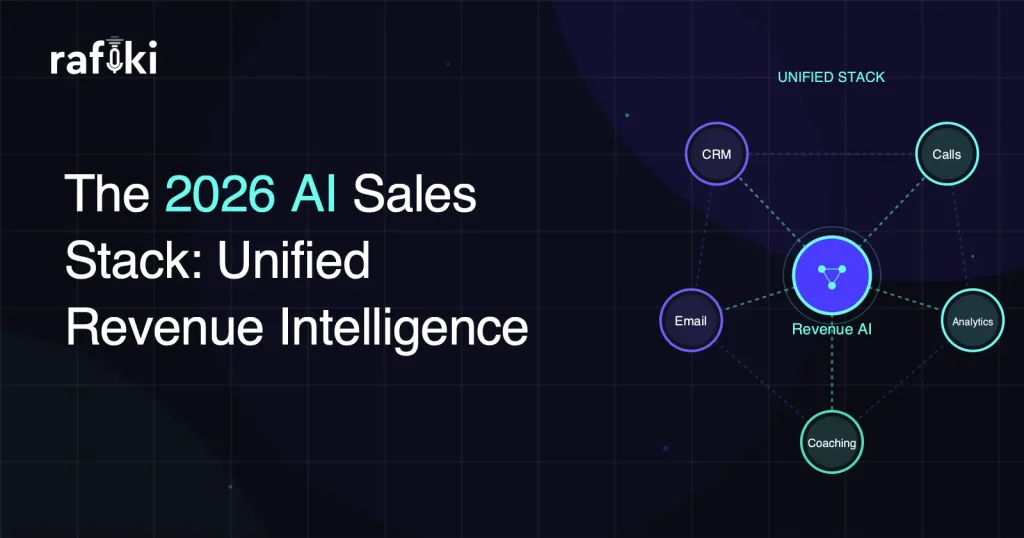
The most successful sales organizations have moved beyond the point solution approach. They're consolidating their AI sales stack 2026 around unified revenue intelligence platforms that combine multiple capabilities under a single AI-native architecture. This isn't simply bundling separate tools—it's rebuilding sales technology from the ground up with integration as the foundation.
Unified revenue intelligence platforms operate on several key principles:
This architectural shift enables capabilities that fragmented point solutions cannot deliver. When conversation insights automatically inform deal scoring, when coaching recommendations emerge from actual customer feedback patterns, when forecasting models incorporate real-time sentiment analysis—your sales process becomes genuinely intelligent rather than just digitized.
The breakthrough that makes unified revenue intelligence possible is multi-agent AI architecture. Instead of single-purpose AI models that excel in narrow domains, modern platforms deploy multiple specialized AI agents that collaborate to handle complex revenue operations. Each agent focuses on specific capabilities while sharing context and insights with the broader system.
Effective multi-agent revenue intelligence systems typically include:
These agents don't operate in isolation. They share a unified understanding of each customer relationship, enabling sophisticated analysis that no single-purpose tool can match. When a conversation reveals budget concerns, the deal scoring agent immediately adjusts risk assessment while the follow-up agent recommends specific value-building activities. This coordination happens automatically, in real-time, without requiring sales reps to manage multiple systems.
Traditional sales tools operate reactively—they report on what happened after deals close or conversations end. Unified revenue intelligence platforms process signals in real-time, enabling predictive insights that help sales teams get ahead of problems and opportunities. This shift from historical reporting to predictive intelligence transforms how sales teams operate.
Real-time revenue signal processing captures and analyzes:
This continuous analysis enables proactive intervention. When conversation patterns indicate a deal is at risk, the system doesn't just flag the problem—it recommends specific actions based on what has worked in similar situations. When expansion opportunities emerge in customer success calls, the intelligence flows immediately to account management teams with context about timing and approach.
Rafiki represents the next generation of unified revenue intelligence platforms, built from day one with multi-agent AI architecture rather than bolting artificial intelligence onto legacy systems. The platform deploys six autonomous AI agents that work together to provide comprehensive revenue intelligence without the fragmentation of traditional point solutions.
Rafiki's unified approach addresses the core problems of fragmented sales stacks:
The platform's AI sales agents architecture ensures these capabilities work together seamlessly. When Smart Call Summary identifies a customer concern, Smart Follow-Up automatically suggests specific remediation strategies while Smart CRM Sync updates deal risk scores across all connected systems. This coordination happens instantly, without requiring sales teams to manage multiple tools or manual workflows.
Unlike enterprise solutions that require significant implementation overhead and seat minimums, Rafiki's revenue intelligence platform delivers enterprise-grade capabilities starting at $19 per seat with no minimum commitments. The platform supports 60+ languages and integrates with existing sales technology stacks through 15-minute setup processes.
Transitioning from fragmented point solutions to unified revenue intelligence requires strategic planning. Organizations that succeed follow a structured approach that minimizes disruption while maximizing adoption. The key is replacing tools gradually while immediately demonstrating value through improved insights and efficiency.
A successful implementation typically follows these phases:
Throughout this transition, focus on demonstrating immediate value rather than replacing everything simultaneously. Teams should see improved insights and reduced manual work from day one, building confidence in the unified approach before retiring familiar tools.
Modern sales organizations operate across languages, time zones, and cultural contexts. Fragmented point solutions typically handle multilingual requirements poorly, forcing global teams to use different tools in different regions or accept reduced functionality. Unified revenue intelligence platforms must provide consistent capabilities regardless of language or cultural context.
Effective global revenue intelligence requires:
This global capability becomes increasingly critical as businesses expand internationally. Teams need revenue intelligence that works as effectively for Mandarin conversations as English, that understands Japanese business etiquette as well as American directness, that processes German technical discussions with the same sophistication as Spanish relationship-building calls.
Traditional enterprise revenue intelligence platforms come with enterprise pricing, implementation complexity, and ongoing maintenance overhead. This pricing model forces smaller organizations to accept fragmented point solutions or limits enterprise platform access to the largest deals and biggest teams. The result is uneven capability distribution that handicaps growth-stage organizations.
Modern unified revenue intelligence platforms break this pattern by delivering enterprise-grade capabilities through cloud-native architectures that eliminate traditional cost drivers:
This cost optimization enables broader access to advanced revenue intelligence capabilities. Growing sales teams can access the same AI-powered insights and automation that previously required enterprise budgets, leveling the competitive playing field and accelerating growth trajectories.
Organizations that successfully unify their AI sales stack 2026 around intelligent platforms gain sustainable competitive advantages across three dimensions. Speed advantages emerge from eliminating manual data transfer and system switching. Accuracy improvements come from AI models trained on complete customer interaction history rather than fragmented data points. Scale benefits result from automation that grows capability without proportional headcount increases.
These advantages compound over time. Teams operating with unified revenue intelligence make faster decisions based on more complete information. They identify opportunities and risks earlier in the sales cycle. They provide more personalized and relevant customer experiences. They scale successful patterns more effectively across larger territories and teams.
Perhaps most importantly, unified revenue intelligence creates organizational learning advantages. When all revenue activities feed into a single intelligent system, the platform becomes smarter with each interaction. Sales methodologies improve based on comprehensive outcome analysis. Coaching becomes more targeted and effective. Forecasting accuracy increases as AI models access richer training data.
Organizations still operating fragmented point solutions face an increasingly significant disadvantage. Their data remains siloed, their insights remain incomplete, their responses remain slower than competitors with unified intelligence. This gap will only widen as AI models become more sophisticated and training data becomes more comprehensive.
The shift toward unified revenue intelligence platforms represents more than a technology upgrade—it's an architectural foundation for future sales capabilities. As AI models become more sophisticated and business requirements evolve, organizations with unified platforms can adapt quickly by upgrading their underlying intelligence rather than replacing multiple point solutions.
Future revenue intelligence capabilities will likely include predictive customer lifetime value modeling, automated competitive intelligence, real-time market condition adjustment, and autonomous deal negotiation support. These advances become possible when AI systems have access to complete customer interaction history and unified business context.
Organizations building their revenue operations on fragmented point solutions will struggle to integrate these future capabilities. Each new advancement will require additional tools, more complex integrations, and further fragmentation. Meanwhile, teams operating unified platforms will benefit from continuous intelligence improvements without architectural disruption.
The time to consolidate your AI sales stack 2026 around unified revenue intelligence is now, before competitive gaps become insurmountable. The question isn't whether to make this transition—it's whether to lead the shift or follow it.
Ready to unify your revenue intelligence? Explore Rafiki's AI-native platform that delivers enterprise-grade insights starting at $19 per seat with no minimums, no annual commitments, and 15-minute setup. Start your free trial today or book a personalized demo to see how six autonomous AI agents can transform your fragmented sales stack into unified revenue intelligence.
Start for free — no credit card, no seat minimums, no long contracts. Just better sales intelligence.