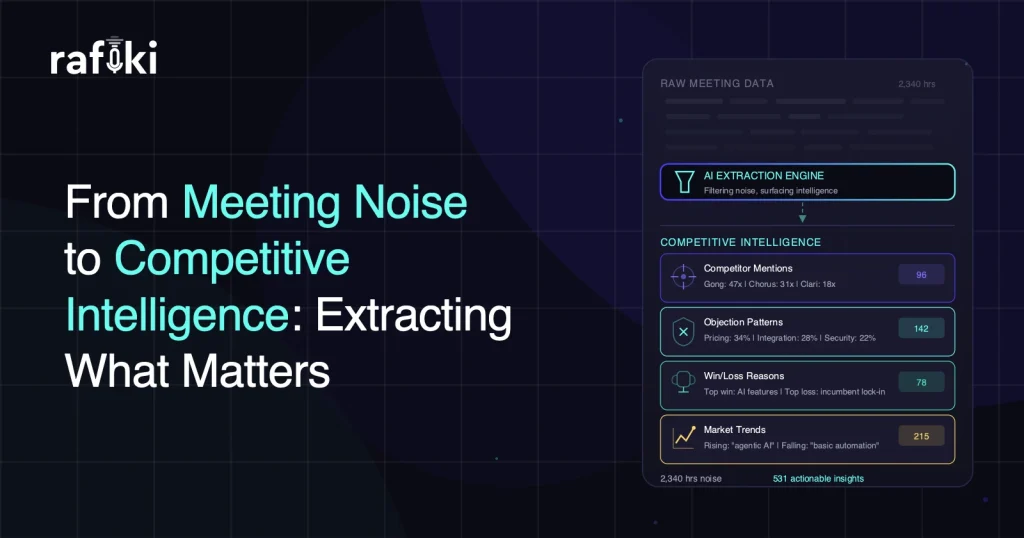
Your Competitive Intelligence Is Already in Your Meetings. Most companies think competitive intelligence comes from:
But the most accurate competitive insights don’t live in reports.
They live in conversations.
Every discovery call.
Every demo.
Every pricing objection.
Every renewal discussion.
Every QBR.
Customers tell you:
The problem?
It’s buried in meeting noise.
In 2026, the companies that win aren’t the ones with more meetings.
They’re the ones who can extract what matters from those meetings — systematically.
This is where structured conversation intelligence platforms like Rafiki transform raw dialogue into strategic advantage.
Modern revenue teams generate:
Without structure, this becomes:
Competitive intelligence becomes reactive.
You only update battlecards after a major lost deal.
But by then, it’s too late.
Competitive intelligence isn’t just:
“Competitor X was mentioned.”
It should answer:
These are pattern-level questions.
They require structured analysis across meetings.
Not individual call summaries.
You cannot extract insight from chaos.
The first practical step is turning unstructured meeting data into structured signals.
Rafiki helps by extracting:
This creates analyzable inputs.
Without structured extraction, pattern detection becomes impossible.
Frequency alone is misleading.
Example:
Competitor mentioned 40 times last month.
But:
Rafiki categorizes mentions by context.
This allows teams to distinguish between:
Now competitive intelligence becomes nuanced.
One lost deal is anecdotal.
Twenty similar objections across accounts is strategy.
AI-driven conversation analysis can surface:
Rafiki aggregates objection categories across deals.
This enables leadership to answer:
Now you can respond proactively.
Competitors evolve messaging constantly.
Buyers repeat what they hear.
AI meeting insights allow you to detect:
Example:
If multiple buyers suddenly say:
“Competitor X now includes this feature by default.”
That’s not random.
That’s narrative shift.
Rafiki surfaces these recurring claims across accounts.
Your product marketing team can respond before it becomes market consensus.
Competitive pressure doesn’t impact every stage equally.
AI analysis can reveal:
By mapping mentions to pipeline stage, you isolate the strategic gap.
This shortens sales cycles and improves win rates.
Not all competitor mentions are dangerous.
Tone matters.
AI sentiment analysis can detect:
Rafiki tracks sentiment trajectory across meetings.
If sentiment dips after competitor introduction, that’s an escalation signal.
This allows immediate repositioning.
Competitive intelligence should influence forecasting.
If:
Then forecast probabilities should adjust accordingly.
Conversation intelligence feeds structured signals into forecasting workflows.
Rafiki enables this connection by aligning competitive signals to deal health dashboards.
Forecast becomes signal-driven, not intuition-driven.
Conversation-derived competitive intelligence should not stay in Sales.
It should inform:
Example:
If AI detects recurring dissatisfaction with integration speed compared to competitors, product leadership can prioritize improvement.
Without structured conversation tracking, this insight arrives too late.
A mid-market SaaS company competing in HR tech faced increasing losses in enterprise segment.
Initial assumption: pricing too high.
After analyzing structured conversation data using AI:
They discovered:
Root issue: security positioning and compliance narrative.
They responded by:
Win rate improved by 17% in enterprise segment within two quarters.
The insight came from structured meeting intelligence — not post-mortem guesswork.
Here’s a practical system to operationalize this approach.
Define:
Rafiki’s structured extraction supports consistent tagging across meetings.
Track:
Monthly competitive intelligence reviews should include:
This prevents quarterly surprise losses.
For each identified pattern:
Competitive intelligence must drive change.
Markets are moving faster.
Competitors iterate messaging weekly.
Manual win/loss analysis cannot keep up.
AI-powered conversation analysis allows real-time market listening.
Rafiki turns every meeting into competitive intelligence infrastructure.
Instead of waiting for lost deals to learn, you learn from every call.
Meetings are noisy because humans are nuanced.
Competitive intelligence is powerful because patterns are predictable.
The challenge is extracting those patterns at scale.
Without structure:
With structured conversation intelligence:
The future of competitive advantage is not more research.
It’s better listening.
In 2026, the companies that win will:
Rafiki transforms meeting noise into competitive intelligence.
It structures objections, tracks competitive mentions, monitors sentiment, and feeds insights into dashboards.
When conversation intelligence becomes systematic, strategy becomes proactive.
Because the most important market data isn’t external.
It’s already in your calls.
And the companies that extract what matters will always move first.
Start for free — no credit card, no seat minimums, no long contracts. Just better sales intelligence.