AI

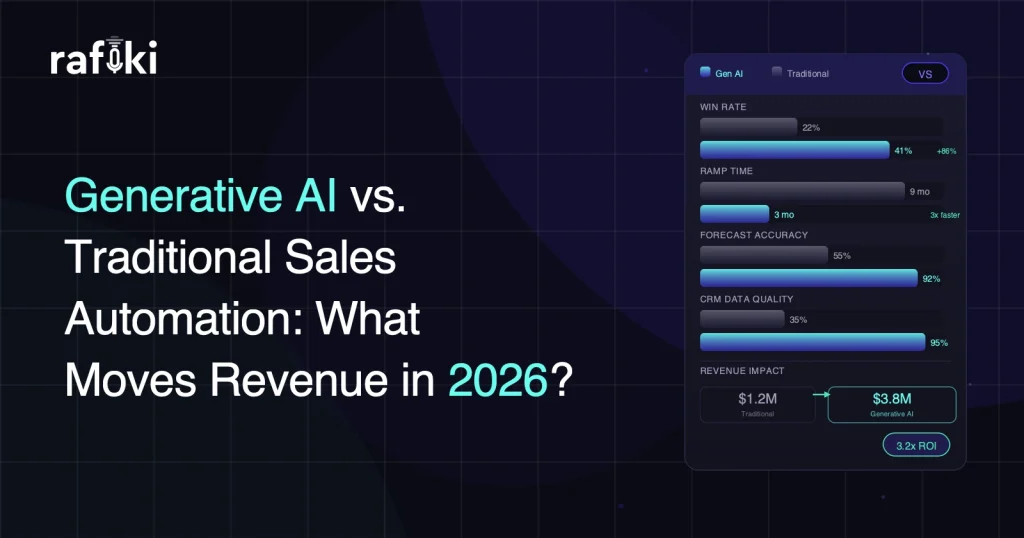
Generative AI vs. Traditional Sales Automation: What Actually Moves Revenue in 2026?
Jan 27, 2026
5 min read
Sales Automation Promised Efficiency. Generative AI Promises Intelligence.
For the past decade, sales teams have invested heavily in automation.
Email sequences.
CRM workflows.
Task reminders.
Lead routing rules.
Auto-dialers.
The promise was simple:
Automate repetitive tasks and revenue will increase.
Automation did improve productivity.
But it didn’t fundamentally improve decision-making.
Deals still slip.
Forecasts still miss.
Coaching is still inconsistent.
Objections still repeat.
Why?
Because traditional sales automation is rule-based.
Revenue is not.
In 2026, the conversation has shifted from automation to intelligence.
This is where generative AI fundamentally changes the sales operating model.
And it’s where platforms like Rafiki redefine what AI in sales actually means.
Traditional sales automation relies on predefined rules.
If X happens → do Y.
Examples:
These workflows are static.
They don’t adapt based on context.
They don’t understand nuance.
They don’t interpret what happened inside a sales conversation.
Automation executes tasks.
It doesn’t interpret reality.
Let’s examine where traditional automation falls short.
An automated sequence doesn’t know:
It just sends the next scheduled message.
Revenue risk isn’t visible in rules.
It’s visible in conversations.
Automation relies on CRM fields.
But CRM fields are:
If the CRM says “Stage 4,” automation assumes forward progress.
But what if:
Automation doesn’t detect that.
Generative AI can.
Traditional systems operate at the individual record level.
They don’t see:
They execute workflows.
They don’t synthesize patterns.
Revenue movement requires synthesis.
Generative AI in sales is not just automation with better language.
It’s contextual reasoning applied to revenue execution.
Instead of asking:
“What task should run next?”
Generative AI asks:
“What does this conversation signal about the deal?”
This is a fundamentally different question.
Let’s compare directly.
| Traditional Automation | Generative AI |
|---|---|
| Rule-based workflows | Context-aware reasoning |
| Triggered by CRM fields | Triggered by conversation signals |
| Executes predefined steps | Adapts based on buyer language |
| Cannot detect nuance | Interprets sentiment and intent |
| Works at single-record level | Detects patterns across accounts |
The shift is from execution to interpretation.
Every revenue outcome is shaped in conversation:
Inside those conversations are signals that matter:
Traditional automation never sees these signals.
Generative AI can — if it’s built correctly.
This is where Rafiki differentiates.
Rafiki doesn’t just automate tasks.
It understands context across meetings.
It analyzes conversations and extracts structured intelligence such as:
This intelligence becomes the foundation for adaptive action.
Not static automation.
Let’s look at real revenue scenarios.
Stage hasn’t changed.
Close date still set.
No alerts triggered.
System flags deal risk.
Manager intervenes early.
Revenue saved.
Manager reviews random calls.
Coaching becomes precise and targeted.
Behavior improves.
Win rates increase.
Competitor field updated manually.
Leadership adjusts positioning before losses compound.
Automation cannot generate that insight.
Conversation-aware AI can.
Generative AI influences revenue at multiple layers:
Auto-generated summaries and structured CRM updates.
Real-time risk detection and next-step clarity.
Systematic identification of skill gaps.
Conversation-backed pipeline evaluation.
Cross-account pattern recognition.
Traditional automation only affects layer one.
Generative AI impacts all five.
The modern sales architecture looks like this:
CRM → System of Record
Rafiki → Conversation Intelligence Layer
AI Agents → Adaptive Execution Layer
Orchestration → Governance + Escalation
Humans → Strategic Decision Layer
Without structured conversation intelligence, AI agents operate blindly.
With Rafiki, agents operate on verified customer reality.
That difference determines whether AI drives revenue — or just sends emails faster.
Markets in 2026 are:
Buyers expect personalization, insight, and strategic guidance.
Static automation cannot:
Context-aware AI can.
Revenue doesn’t move because:
Revenue moves because:
Generative AI enables those outcomes by interpreting what customers actually say.
Automation cannot.
Traditional sales automation made sales operations more efficient.
Generative AI makes sales execution more intelligent.
In 2026, efficiency alone is not enough.
Revenue growth depends on:
Rafiki represents the shift from automation to intelligence.
It doesn’t just trigger workflows.
It understands conversations across meetings and adapts insights dynamically.
Every call becomes:
The companies that continue relying solely on static automation will operate faster — but not smarter.
The companies that embed generative AI grounded in conversation intelligence will operate smarter — and faster.
In modern revenue teams, intelligence moves revenue.
Automation simply supports it.
Start for free — no credit card, no seat minimums, no long contracts. Just better sales intelligence.