Your reps are running the Miller Heiman playbook on paper while their buyers are running circles around them in real time.
Strategic Selling has been the gold standard for complex B2B deals since the 1980s. The Blue Sheet, the Buying Influence model, the concept of a Win-Win — these frameworks still hold up because the underlying psychology of enterprise buying committees has not fundamentally changed. What has changed is the velocity, volume, and complexity of the conversations where those frameworks are supposed to live. Your team closes dozens of calls a week across multiple stakeholders, and the strategic intelligence captured in those interactions evaporates the moment the call ends. Notes are partial. CRM entries are aspirational. The Blue Sheet gets filled out retroactively from memory — or not at all.
The cost of this gap is not theoretical. Deals stall because nobody identified the Economic Buyer's real concern. Competitors gain traction because a User Buyer's objection went unlogged. Forecasts miss because the Coach's enthusiasm was mistaken for organizational commitment. Miller Heiman gives your team the map. But without a system that captures, structures, and scores what actually happens in every conversation, the map stays in the glove compartment while your reps drive by feel. The emergence of miller heiman ai sales tools changes this equation entirely — and the teams that move first gain a compounding advantage every quarter.
Why Traditional Miller Heiman Execution Breaks Down at Scale
Miller Heiman Strategic Selling is a methodology built on discipline: identify every Buying Influence, map their stance, assess your position relative to competition, and build a strategy for each stakeholder. The problem is not the methodology. The problem is that discipline requires data, and the data lives in conversations your team is not systematically analyzing.
Here is where execution breaks down for most organizations:
- Blue Sheets are retrospective, not real-time. Reps fill them out after the fact, introducing recency bias and omitting details that felt minor at the time but prove decisive later.
- Buying Influence identification is incomplete. The average B2B deal now involves multiple decision-makers — Gartner's research on the B2B buying journey highlights the growing complexity of buying groups. Reps rarely map all of them, and almost never update the map as new stakeholders surface mid-cycle.
- Coaching is anecdotal. Managers review a handful of calls per week at best. They coach on what they happen to hear, not on systematic patterns across the pipeline.
- Win-Results analysis is skipped entirely. The Miller Heiman concept of matching your solution's results to each stakeholder's personal wins requires deep conversational data. Without it, reps default to feature-selling.
- Red Flags go undetected. Strategic Selling's Red Flag system only works if someone notices the flag. When deal intelligence is scattered across calendars, email threads, and partial notes, the signals drown in noise.
The net effect is that your organization pays for Miller Heiman training, invests weeks in workshops, and then watches the methodology atrophy within a quarter because the infrastructure to sustain it does not exist. This is not a training problem. It is an intelligence capture problem.
The Buying Influence Gap: What Your Calls Reveal That Your CRM Does Not
Buying Influences are the cornerstone of Strategic Selling. Every deal has an Economic Buyer, User Buyers, Technical Buyers, and ideally a Coach. Mapping them correctly determines strategy. Mapping them incorrectly — or incompletely — is the single biggest predictor of a stalled or lost deal.
The intelligence needed to map Buying Influences accurately already exists. It lives in the language your prospects use on calls:
- The stakeholder who asks about budget approval timelines is signaling Economic Buyer authority — or proximity to it.
- The person focused on integration requirements and security compliance is behaving as a Technical Buyer, even if their title suggests otherwise.
- The champion who volunteers internal politics and offers to "set up a meeting with my VP" is acting as a Coach.
- The User Buyer reveals themselves through workflow-specific questions: "How would my team actually use this day-to-day?"
These signals are not subtle. They are explicit. But they are buried in 30- to 60-minute recordings that nobody re-listens to. The gap between what your conversations contain and what your CRM reflects is where deals go to die. Miller Heiman ai sales tools close this gap by extracting Buying Influence signals automatically, tagging them to the correct contacts, and surfacing them before the next interaction — not after the deal is lost.
Red Flags and the Concept of Ideal Customer: AI-Powered Strategic Analysis
Red Flags in Miller Heiman refer to any element of the sale where information is missing, where your position is at risk, or where a Buying Influence's stance has shifted against you. The methodology asks reps to proactively identify these flags and address them before they compound. In practice, most teams identify Red Flags only during pipeline reviews — if they identify them at all.
AI conversation intelligence transforms Red Flag detection from a periodic exercise into a continuous system:
- Sentiment shifts. A Technical Buyer who was enthusiastic in the demo call but turns neutral in the security review is a Red Flag. AI detects this shift across calls automatically.
- Stakeholder disappearance. When a previously engaged Buying Influence stops attending calls or goes silent in threads, that absence is a signal. AI tracks multi-threading density across every opportunity.
- Competitive mentions. A prospect who starts referencing a competitor's capabilities by name mid-cycle is raising a flag that demands immediate response. AI captures and categorizes every competitive mention across your entire pipeline.
- Timeline erosion. When a prospect's language around timing shifts from "this quarter" to "sometime this year," the deal is slipping. AI quantifies timeline language changes across conversations.
- Missing Win-Results alignment. If three calls pass without any discussion of the Economic Buyer's personal win, the deal lacks executive sponsorship. AI flags this absence as readily as it flags a presence.
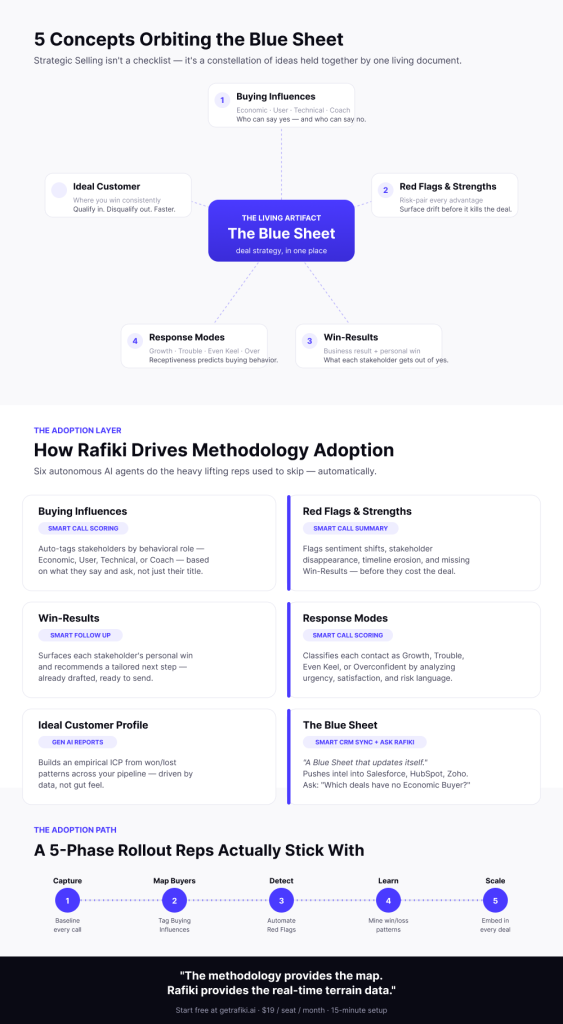
The Ideal Customer concept in Miller Heiman asks teams to define the profile of accounts where they win consistently, then measure every new opportunity against that profile. When AI analyzes patterns across hundreds of won and lost deals — the topics discussed, the stakeholders involved, the objections raised, the timeline progression — it generates an empirical Ideal Customer profile far more accurate than any manually constructed one.
From Blue Sheets to Living Deal Intelligence: Miller Heiman AI Sales Tools in Action
The Blue Sheet is Miller Heiman's deal strategy worksheet. It is meant to be a living document, updated as new information emerges. In reality, it is a static artifact. Reps complete it during training, update it before QBRs, and abandon it in between. The reason is simple: maintaining a Blue Sheet manually requires re-listening to calls, cross-referencing notes, and synthesizing information from multiple stakeholders. The effort exceeds the perceived value, so it does not happen.
Miller heiman ai sales tools fundamentally change this dynamic by auto-populating the strategic elements that a Blue Sheet is designed to capture:
- Single Sales Objective. AI extracts the stated business outcome the prospect is trying to achieve, tracking whether it evolves or remains consistent across calls.
- Buying Influence mapping. Every call participant is tagged by their behavioral role — Economic Buyer, User Buyer, Technical Buyer, Coach — based on what they say and ask, not just their title.
- Response Modes. Miller Heiman categorizes buyer receptivity as Growth, Trouble, Even Keel, or Overconfident. AI classifies these modes by analyzing the urgency, satisfaction, and risk language each stakeholder uses.
- Degree of Influence. Not all Buying Influences carry equal weight. AI assesses influence by tracking who other stakeholders reference, defer to, or align with during conversations.
- Red Flags and Strengths. Auto-generated and updated after every call, not reconstructed from memory days later.
The result is a Blue Sheet that updates itself. For teams that have invested in the Miller Heiman sales process, this is the difference between a methodology and a system. If your team also uses the Blue Sheet template, AI transforms it from a periodic exercise into a continuously current strategic dashboard.
How Rafiki AI Powers Miller Heiman Strategic Selling at Scale
Rafiki AI is an AI-native revenue intelligence platform built from day one on multi-model AI architecture — not a call recorder with AI features bolted on. For sales organizations running Miller Heiman, Rafiki AI's six autonomous AI agents operationalize every element of Strategic Selling without adding manual work to your reps' day.
Here is how the platform maps directly to Miller Heiman execution:
- Smart Call Scoring evaluates every conversation against structured frameworks including MEDDIC, BANT, and SPIN — giving managers a methodology-aligned view of call quality. This scoring directly identifies whether reps are uncovering Buying Influences, probing for Win-Results, and addressing Red Flags.
- Smart Call Summary extracts key topics, stakeholder concerns, action items, and competitive mentions from every call. These summaries feed the living Blue Sheet, ensuring no strategic detail is lost between conversations.
- Smart Follow Up generates contextual next-step recommendations after every call, aligned to where the deal stands strategically. If a Technical Buyer raised a security concern, the follow-up reflects it. If the Economic Buyer's timeline shifted, the follow-up addresses it.
- Smart CRM Sync pushes structured deal intelligence directly into Salesforce, HubSpot, Zoho, Pipedrive, or Freshworks — eliminating the gap between what happens on calls and what the CRM reflects.
- Ask Rafiki Anything lets managers and reps query their entire conversation library in natural language. "Which deals have an unidentified Economic Buyer?" "Where did a competitor get mentioned in the last two weeks?" "Which opportunities have not multi-threaded beyond a single contact?" These are Miller Heiman questions answered in seconds.
- Gen AI Reports surface pipeline-wide patterns: which Buying Influence roles are consistently under-engaged, which Red Flags correlate with losses, and where coaching intervention will have the highest impact.
Rafiki AI transcribes in over 60 languages, sets up in 15 minutes, and starts at $19 per seat per month with no seat minimums and no annual contracts. For growing sales teams running Miller Heiman, this delivers enterprise-grade strategic selling intelligence at a fraction of enterprise cost.
Implementation: A Phased Approach to AI-Augmented Strategic Selling
Rolling out AI conversation intelligence alongside Miller Heiman does not require a rip-and-replace. The highest-performing teams implement in phases, validating value at each stage before expanding.
- Phase 1: Capture and baseline (Weeks 1-2). Connect Rafiki AI to your conferencing platform — Zoom, Teams, or Google Meet. Record and transcribe all customer-facing calls. Establish a baseline of current call quality, stakeholder coverage, and CRM data completeness. Use Smart Call Scoring to grade existing calls against your chosen methodology framework.
- Phase 2: Buying Influence mapping (Weeks 3-4). Review AI-generated call summaries to identify which Buying Influences are present in each active opportunity. Use Ask Rafiki Anything to find deals with missing roles — especially Economic Buyers and Coaches. Update your Blue Sheets (or CRM opportunity records) with AI-extracted data.
- Phase 3: Red Flag automation (Weeks 5-6). Configure Gen AI Reports to surface weekly Red Flag summaries across the pipeline. Train managers to use these reports in coaching sessions and pipeline reviews. Establish a cadence: every deal review starts with AI-identified Red Flags, not rep self-reporting.
- Phase 4: Win-loss pattern analysis (Weeks 7-8). Analyze closed-won and closed-lost deals to identify conversational patterns that predict outcomes. Refine your Ideal Customer profile based on empirical conversation data. Feed these patterns back into scoring criteria and coaching priorities.
- Phase 5: Scale and embed (Ongoing). Expand to all customer-facing teams including customer success and SDR organizations. Use AI-generated intelligence to inform quarterly business reviews and strategic account plans. Continuously refine scoring models as your methodology evolves.
Each phase builds on the previous one. Teams that follow this approach report that the methodology "sticks" far longer than traditional training-only implementations because the system reinforces the behavior daily, not just during workshops.
Strategic Selling Metrics That Miller Heiman AI Sales Tools Make Measurable
Miller Heiman has always been strong on concepts and relatively weak on quantification. AI changes this by making previously qualitative elements measurable and trackable:
- Multi-threading depth. The number of distinct Buying Influences engaged per opportunity, tracked over time. AI measures this automatically from call participant data and conversational references to absent stakeholders.
- Red Flag resolution rate. What percentage of AI-identified Red Flags are addressed in subsequent calls? This is a direct measure of strategic selling discipline.
- Win-Results coverage. Across all opportunities, how often are reps connecting their solution's results to individual stakeholder wins? AI scores this from conversational content.
- Response Mode accuracy. When reps categorize a buyer as "Growth mode," does the conversational evidence support it? AI provides a check on subjective assessments.
- Coaching leverage. Which specific Miller Heiman skills — Buying Influence identification, competitive positioning, Win-Results articulation — have the strongest correlation with closed deals in your pipeline? AI reveals this from pattern analysis across your full conversation dataset.
These metrics transform Miller Heiman from a qualitative framework into a data-driven operating system. They give RevOps leaders the evidence base to justify continued methodology investment and the specificity to direct coaching resources where they generate the highest return.
The Competitive Reality: Why 2026 Is the Inflection Point
The adoption curve for AI in B2B sales has reached the point where non-adoption is a competitive disadvantage, not a neutral position. McKinsey's research on AI in sales highlights that organizations deploying AI across the commercial function are seeing meaningful gains in growth, efficiency, and customer satisfaction. The teams still relying on manual note-taking, self-reported CRM data, and periodic pipeline reviews are competing with one hand tied behind their back.
For organizations invested in Miller Heiman, the calculus is especially clear:
- You have already committed to a rigorous methodology. AI is the infrastructure that makes the methodology self-sustaining.
- Your competitors who use the same methodology but add AI execution gain asymmetric advantage — they see every Red Flag, engage every Buying Influence, and coach to empirical data.
- Legacy conversation intelligence tools — the ones that require annual contracts, large seat commitments, and weeks of implementation — created a false binary between "enterprise AI" and "no AI." That binary no longer exists.
- The cost of inaction compounds quarterly. Every deal reviewed without conversational data is a deal reviewed with incomplete information. Every coaching session based on anecdote is a coaching session half-wasted.
The question is not whether AI augments Miller Heiman Strategic Selling. The question is how many more quarters your team runs the methodology without the intelligence layer that makes it work.
Conclusion: Miller Heiman Deserves Better Than Manual Execution
Miller Heiman Strategic Selling remains one of the most rigorous and effective methodologies for complex B2B sales. Its concepts — Buying Influences, Red Flags, Win-Results, Response Modes, Ideal Customer — are as relevant in 2026 as they were when Robert Miller and Stephen Heiman first codified them. What is no longer acceptable is executing these concepts with the same manual processes that existed before AI.
The shift from static Blue Sheets to living deal intelligence is not incremental. It is transformational. When every conversation is captured, every Buying Influence is mapped from actual language, every Red Flag is surfaced in real time, and every coaching session is grounded in data, the methodology stops being something your team learned in a workshop and starts being something your team lives in every deal.
- Miller heiman ai sales tools make the methodology self-reinforcing rather than self-decaying.
- AI-native platforms provide the intelligence capture layer that Strategic Selling always needed but never had.
- Growing teams no longer have to choose between enterprise-grade methodology execution and realistic budgets.
The organizations that win complex deals in 2026 and beyond will be the ones that pair proven strategic frameworks with AI systems purpose-built to operationalize them. The methodology provides the map. AI provides the real-time terrain data. Together, they are unbeatable.
Rafiki AI gives your team enterprise-grade revenue intelligence starting at $19 per seat per month — no seat minimums, no annual contracts, setup in 15 minutes. If your organization runs Miller Heiman and your reps are still filling out Blue Sheets from memory, it is time to close that gap. Explore Rafiki AI's product overview or book a demo to see how AI-native conversation intelligence turns Strategic Selling from a training event into a daily operating system.