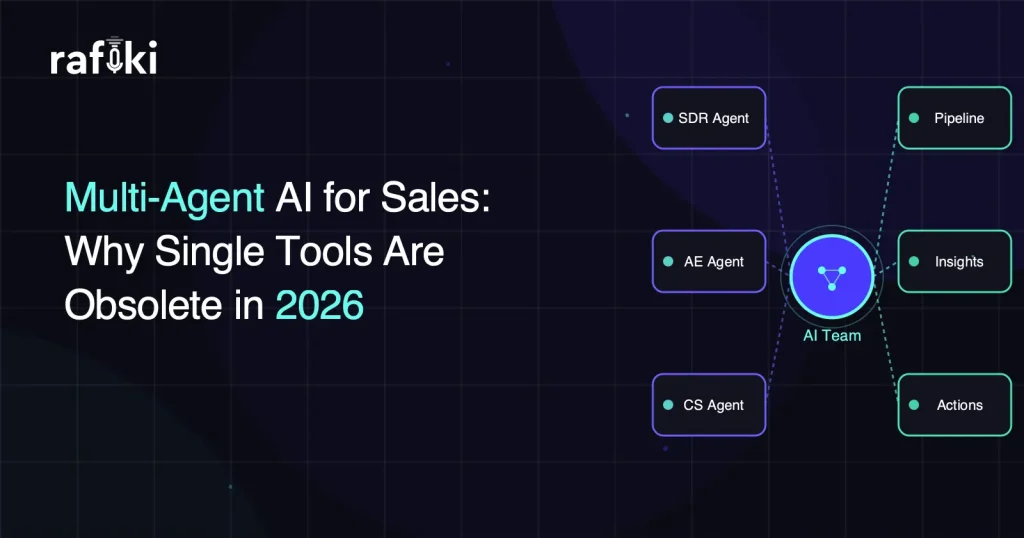
Your sales team is drowning in a sea of disconnected AI tools, each promising to solve one piece of the puzzle while your revenue opportunities slip through the cracks.
Look at your current tech stack. You've got one tool for call recording, another for email sequencing, a third for lead scoring, and a fourth for CRM updates. Each requires separate logins, different training, and manual stitching together of insights. Your reps spend more time jumping between platforms than actually selling, and critical buyer signals get lost in the handoffs between systems.
This piecemeal approach worked when AI was nascent and each tool solved a distinct problem. But in 2026, maintaining multiple single-purpose AI tools isn't just inefficient—it's actively hurting your revenue performance. The future belongs to multi-agent AI sales platforms that coordinate autonomous agents to work together seamlessly, creating a unified intelligence layer across your entire revenue operation.
The current landscape of sales AI tools resembles the early days of software development—fragmented, siloed, and requiring extensive integration work to achieve basic functionality. Most sales teams are running multiple different AI-powered tools, each optimized for a narrow use case.
This fragmentation creates several critical problems:
The real cost isn't just operational inefficiency. When your AI tools can't communicate with each other, you lose the compound intelligence that comes from connecting data points across the entire customer lifecycle. A pricing objection in a discovery call should inform your proposal strategy, competitive mentions should trigger specific follow-up sequences, and buyer sentiment should automatically adjust your outreach cadence. Single-purpose tools can't make these connections.
Multi-agent AI sales systems represent a fundamental shift from isolated tools to coordinated intelligence networks. Instead of managing multiple separate AI applications, you deploy a unified platform where specialized agents collaborate to handle different aspects of your revenue process.
Think of it like the difference between hiring individual freelancers for each project versus building an integrated team that shares knowledge and coordinates their efforts. Multi-agent systems create exponential value through agent cooperation:
This coordinated approach transforms how sales teams operate. Instead of your reps being the integration layer between different tools, the AI system handles coordination automatically while presenting unified insights and actions through a single interface.
The most effective multi-agent AI sales platforms deploy six core agents, each handling a specific domain while contributing to the collective intelligence of the system. This framework covers the complete revenue lifecycle from initial contact through deal closure and expansion.
Here's how the six agents work together:
The power comes from agent interconnection. When the Conversation Analysis Agent detects a competitive threat, it automatically triggers the Follow-Up Agent to craft appropriate messaging, updates the Deal Scoring Agent to adjust risk assessment, and informs the Knowledge Retrieval Agent to surface relevant competitive battle cards. This coordination happens in real-time without any manual intervention from your team.
The six-agent framework strikes the optimal balance between specialization and coordination complexity. Fewer agents mean individual agents become too generalized to excel at specific tasks. More agents create coordination overhead that reduces system efficiency and increases potential failure points.
Traditional single-purpose AI tools operate in batch mode—they process data at set intervals and provide insights hours or days after interactions occur. Multi-agent systems enable real-time intelligence that adapts to customer conversations as they happen.
This real-time capability transforms several critical sales scenarios:
The speed advantage compounds over time. Teams using real-time multi-agent systems respond to buyer signals within minutes instead of days, dramatically improving their conversion rates and deal velocity. Your competitors using batch-processing tools are always operating with stale intelligence.
Single-purpose AI tools typically support limited languages well, forcing global sales teams to use different tools for different regions. This creates inconsistent experiences and makes it impossible to track customer journeys across language boundaries.
Multi-agent AI sales platforms built for global operation provide consistent intelligence across all major languages:
This global capability becomes increasingly critical as selling becomes more international. Your buyers expect native-language interactions, but your sales operations need unified intelligence. Multi-agent systems deliver both without compromise.
Rafiki represents the next generation of revenue intelligence platforms, built from day one as a multi-agent AI sales system rather than a collection of bolted-together features. The platform deploys six specialized AI agents that work together to provide comprehensive coverage of your revenue operations.
The six autonomous AI agents handle every aspect of your sales process:
What sets Rafiki apart is the seamless coordination between agents. When Smart Call Summary identifies a pricing concern, it automatically triggers Smart Follow Up to address the objection, updates Smart Call Scoring to reflect the new risk factors, and ensures Smart CRM Sync captures the intelligence in your system of record. This coordination happens without any manual intervention from your team.
The platform also supports over 60 languages with the same quality of intelligence, making it the only truly global revenue intelligence solution available. Whether your customers are in Tokyo, São Paulo, or Stockholm, you get consistent insights and recommendations.
Transitioning from multiple single-purpose AI tools to a unified multi-agent platform requires careful planning to avoid disrupting active deals and team productivity. The most successful migrations follow a phased approach that gradually consolidates functionality while proving value.
Here's the proven migration pathway:
The key is running systems in parallel during transition periods. Your team needs confidence that the multi-agent system can handle their complete workflow before they abandon familiar tools. This approach maintains full productivity throughout the process.
Multi-agent systems actually reduce training overhead because teams learn a single interface instead of multiple tools. Focus your change management on helping teams understand how agent coordination eliminates manual work they're currently doing between systems.
The economics of multi-agent AI sales platforms fundamentally differ from traditional enterprise software. Instead of paying for multiple point solutions plus integration costs, you get comprehensive functionality at a significantly reduced total cost.
Consider the typical cost structure for single-purpose tools:
Multi-agent platforms eliminate most of these costs by providing integrated functionality through a single system. Teams see substantial cost reduction compared to their previous tool stack, while getting superior capabilities and no integration headaches.
The pricing model also aligns better with growing teams. Instead of high minimums and annual commitments, modern platforms offer flexible pricing that scales with your team size and doesn't penalize rapid growth or seasonal fluctuations.
The shift to multi-agent AI sales systems is accelerating rapidly. Teams that make the transition early gain compounding advantages that become harder for competitors to match over time.
These advantages include:
The window for easy migration is narrowing as well. As more teams adopt multi-agent systems, the competitive pressure to match their capabilities increases while the relative advantage of switching decreases. Teams that move in 2026 establish themselves as technology leaders in their markets.
The evolution from single-purpose AI tools to coordinated multi-agent systems represents more than just technological advancement—it's a fundamental shift in how revenue teams operate. Instead of humans being the integration layer between disconnected tools, AI agents handle coordination while humans focus on relationship building and strategic decision making.
This transformation enables sales teams to operate at unprecedented scale and efficiency. Conversations automatically generate insights, insights trigger appropriate actions, and actions update all relevant systems without any manual intervention. The entire revenue operation becomes more intelligent and responsive to customer needs.
The teams that embrace this shift early will establish lasting competitive advantages built on superior customer intelligence and operational efficiency. Those that cling to fragmented tool stacks will find themselves increasingly outmatched by competitors operating with coordinated AI systems.
Ready to experience how multi-agent AI transforms your revenue operations? Rafiki's AI-native platform starts at just $19 per seat with no minimums or annual commitments required. Get started with Rafiki today and see how six coordinated AI agents can eliminate the chaos of managing multiple single-purpose tools while delivering enterprise-grade intelligence at a fraction of the cost.
Start for free — no credit card, no seat minimums, no long contracts. Just better sales intelligence.