The Real Problem Isn’t AI. It’s Coordination. By 2026, most B2B revenue teams have adopted AI in some form:
- AI email drafting
- AI research assistants
- AI call summaries
- AI forecasting models
- AI chatbots
- AI CRM automation
But here’s what leadership is discovering:
Adding agents doesn’t automatically create leverage.
It often creates chaos.
Multiple AI systems act independently.
Data conflicts across platforms.
Forecast models disagree with rep updates.
Customer Success sees risk Sales never flagged.
Marketing optimizes messaging without real call feedback.
AI didn’t break the revenue engine.
Lack of orchestration did.
Welcome to the next frontier: Multi-Agent Revenue Orchestration.
What Is Multi-Agent Revenue Orchestration?
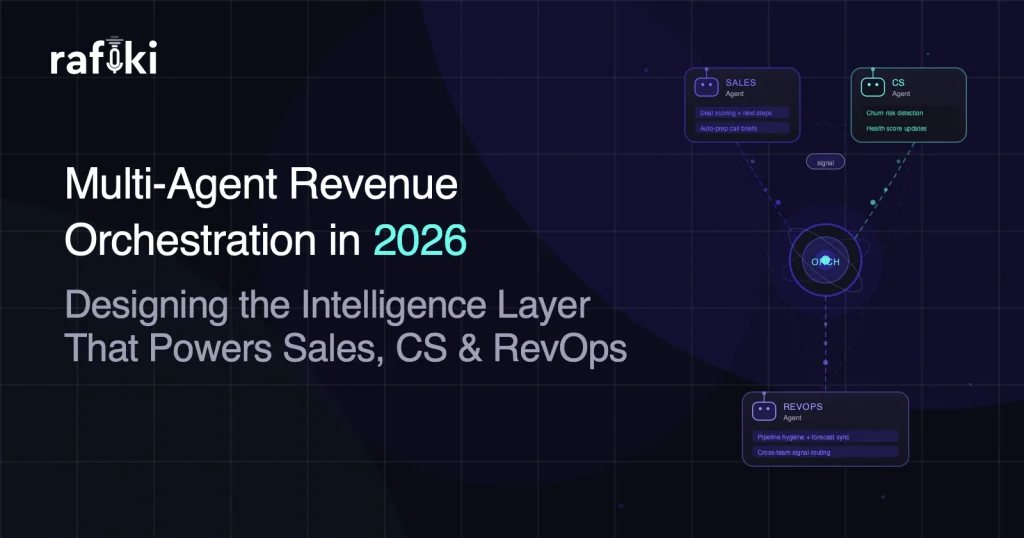
Multi-agent revenue orchestration is the coordination layer that ensures:
- AI systems act on shared intelligence
- Sales, CS, and RevOps operate from the same customer truth
- Autonomous actions align with pipeline reality
- Human oversight remains intentional
In simple terms:
It’s not about having more agents.
It’s about ensuring they act from the same source of truth.
And in 2026, that source of truth is not CRM.
It’s customer conversations.
Why CRM Alone Cannot Power Agentic Revenue
For decades, CRM has been considered the “system of record.”
But CRM suffers from three limitations:
1. It’s Manually Updated
Even with automation, most CRM data originates from rep input.
That introduces:
- Bias
- Inconsistency
- Optimism
- Gaps
2. It’s Lagging
CRM reflects what was recorded — not what is happening now.
Conversations evolve faster than stage changes.
3. It Lacks Context
CRM fields don’t capture:
- Emotional tone
- Objection intensity
- Stakeholder dynamics
- Competitive positioning nuance
- Language shifts over time
Without contextual grounding, AI agents make decisions on incomplete data.
That’s dangerous.
The Intelligence Layer: Why Conversation Data Is Foundational
Every revenue motion flows through conversations:
- Discovery calls
- Demos
- Negotiations
- QBRs
- Renewal conversations
- Escalation meetings
These conversations contain:
- Budget confirmation
- Authority signals
- Objection patterns
- Competitive threats
- Urgency indicators
- Adoption blockers
- Expansion signals
If agents act without understanding these signals, they operate blind.
This is where Rafiki becomes central to the 2026 revenue stack.
Rafiki as the Revenue Intelligence Foundation
Rafiki captures and analyzes every revenue conversation across:
- Sales
- Customer Success
- Product
- Support
But more importantly, it structures those conversations into:
- Stakeholder intelligence
- Objection tracking
- Qualification mapping (MEDDIC, SPICED, GAP, BANT, Challenger, Sandler)
- Sentiment trends
- Competitive heatmaps
- Next-step commitments
- Risk indicators
This structured conversation intelligence becomes the grounding layer for every downstream AI agent.
Without this layer, agents hallucinate.
With Rafiki, agents act on verified context.
The Five-Agent Orchestration Model
To understand multi-agent orchestration, consider five core agent categories:
1. Execution Agents (Sales Reps’ Assistants)
These agents:
- Draft follow-ups
- Update CRM
- Suggest next-best actions
- Generate account briefs
Rafiki feeds them:
- Real objections raised
- Stakeholder mapping
- Contextual summaries
- Qualification gaps
2. Forecast Agents (RevOps Intelligence)
These agents:
- Score deal health
- Detect risk patterns
- Flag slipping timelines
- Evaluate stakeholder coverage
Rafiki provides:
- Objection recurrence data
- Sentiment shifts
- Multi-threading analysis
- Timeline specificity tracking
3. Coaching Agents (Enablement)
These agents:
- Score calls
- Identify discovery gaps
- Recommend practice drills
- Track performance trends
Rafiki structures:
- Methodology compliance
- Objection handling quality
- Next-step clarity
- Positioning strength
4. Customer Success Agents
These agents:
- Detect churn risk
- Identify adoption blockers
- Surface expansion signals
- Flag sentiment deterioration
Rafiki captures:
- Repeated dissatisfaction themes
- Feature usage confusion
- Stakeholder turnover signals
- Competitive re-evaluation language
5. Governance & Compliance Agents
These agents:
- Monitor sensitive language
- Track contract discussions
- Ensure data permissions
- Audit CRM changes
Rafiki links every insight back to the original conversation — creating traceability.
The Orchestration Challenge: Avoiding Agent Conflict
Without coordination, agents may:
- Overwrite CRM data inconsistently
- Trigger duplicate alerts
- Misinterpret outdated context
- Escalate unnecessarily
Multi-agent orchestration requires:
Shared Context Memory
Every agent must operate from the same conversation-derived intelligence.
Rafiki serves as this memory layer.
Event-Driven Triggers
For example:
- If Rafiki detects repeated pricing objections → alert forecast agent
- If Rafiki detects no economic buyer mentioned → notify coaching agent
- If Rafiki detects churn language in QBR → trigger CS agent
The system becomes event-driven, not reactive.
Human Escalation Rules
High-risk signals must:
- Escalate to managers
- Request confirmation
- Allow override
This preserves accountability.
The Revenue Impact of Proper Orchestration
Companies that design orchestration correctly see:
Higher Forecast Accuracy
Because deal health reflects real buyer language.
Faster Deal Intervention
Because risk is detected before stage slippage.
Better Coaching ROI
Because performance gaps are systematic, not anecdotal.
Lower Churn
Because CS agents act on real sentiment and adoption signals.
Reduced Admin Burden
Because structured conversation data auto-updates systems.
Why 2026 Demands Orchestration
Three macro shifts make orchestration essential:
- Buying committees are larger
- Sales cycles are longer
- Revenue efficiency pressure is higher
Fragmented AI creates noise.
Orchestrated AI creates leverage.
The Bigger Shift: From Tool Stack to Intelligence Stack
In 2023:
Revenue teams stacked tools.
In 2026:
Revenue teams stack intelligence layers.
At the center of that stack is conversation-derived truth.
Rafiki provides:
- The contextual grounding layer
- The structured methodology mapping
- The stakeholder intelligence
- The objection tracking
- The sentiment analysis
- The CRM synchronization
- The competitive insight engine
It doesn’t replace your CRM.
It powers every agent that depends on it.
Conclusion: The Future Belongs to Coordinated Intelligence
The next decade of revenue growth won’t be defined by who has the most AI tools.
It will be defined by who orchestrates them correctly.
Multi-agent revenue orchestration ensures:
- Sales, CS, and RevOps operate from shared truth
- Autonomous systems act intelligently
- Humans intervene strategically
- Revenue becomes predictable
Without conversation intelligence, orchestration collapses.
With Rafiki, every agent in your stack operates on grounded, structured customer reality.
And in competitive markets, clarity compounds.