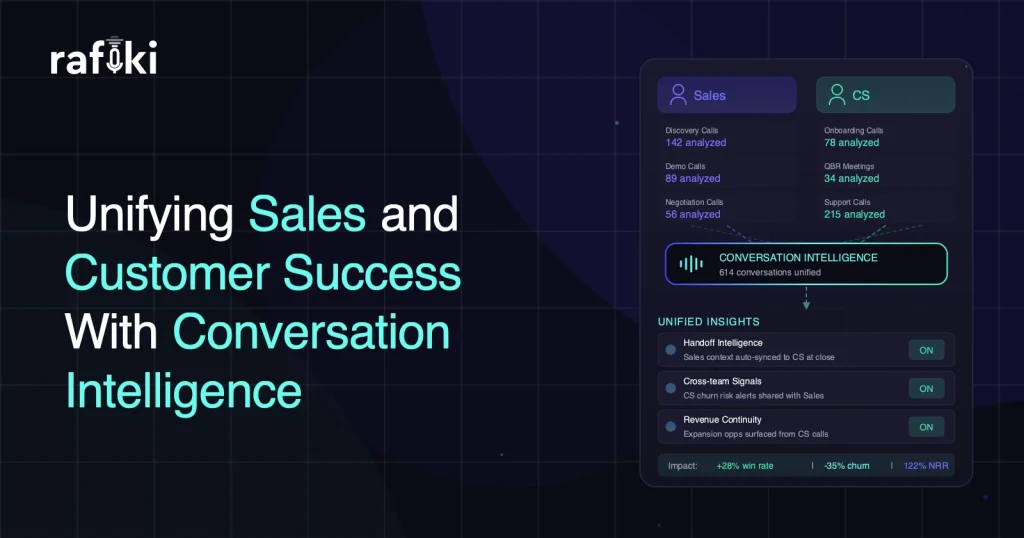
The revenue lifecycle is broken in the handoffs, not the functions. Most companies don’t lose revenue because Sales is bad or Customer Success is weak.
They lose revenue because the lifecycle is fragmented.
Sales collects context in discovery calls.
That context rarely reaches onboarding.
Customer Success learns what’s working and what’s at risk in QBRs.
That reality rarely reaches forecasting or expansion planning.
Support hears the blunt truth.
Product gets a filtered version, weeks later.
The biggest revenue leaks don’t happen inside a stage.
They happen between stages.
As of 2026, the highest-performing teams are fixing this with Revenue Lifecycle AI: an intelligence layer that connects Sales and CS with shared, structured signals—so everyone operates from the same customer truth.
That “truth” isn’t in the CRM.
It’s in the conversations.
And this is where platforms like Rafiki become foundational—because they turn conversations across the lifecycle into structured revenue intelligence.
What is Revenue Lifecycle AI?
Revenue lifecycle AI is the coordinated use of AI across the full customer journey—from first meeting to renewal and expansion—so signals and actions don’t reset at each handoff.
It does three things well:
- Captures and structures customer context continuously (not just in Sales)
- Detects patterns and predicts risk/opportunity using real signals, not lagging fields
- Orchestrates actions across teams so Sales, CS, RevOps, Support, and Product stay aligned
The key shift is this:
The lifecycle becomes one intelligence system—not separate tool stacks.
Why the old Revenue stack fails: CRM is a destination, not the source of truth
CRMs are necessary. They are not sufficient.
CRM limitations in the modern lifecycle
- Lagging: updated after calls, after decisions shift
- Inconsistent: rep-to-rep subjectivity, CSM-to-CSM variability
- Context-poor: doesn’t capture nuance, sentiment, objection intensity, stakeholder politics
- Siloed: Sales fields don’t translate cleanly to onboarding needs; CS insights don’t flow back upstream
Revenue Lifecycle AI doesn’t replace the CRM.
It replaces the CRM’s role as “truth.”
The truth lives where customers speak.
Conversations are the highest-fidelity revenue data
Every critical revenue outcome is shaped in conversation:
- Discovery: what the real pain is, and whether it’s urgent
- Demo: whether value clicks, and where friction appears
- Negotiation: how risk is perceived and who holds authority
- Onboarding: whether adoption is feasible and resourced
- QBRs: whether outcomes are being realized and expanded
- Renewals: whether value is defensible against budget pressure and competition
If you can structure conversation signals across these moments, you can:
- qualify better
- forecast smarter
- reduce churn earlier
- expand more predictably
That is the core of Revenue Lifecycle AI.
Rafiki’s role: the conversation intelligence layer across Sales and CS
Rafiki sits at the center of the revenue lifecycle by capturing and analyzing conversations across teams and turning them into structured signals such as:
- Topics and subtopics discussed (what actually mattered)
- Objections categorized and tracked over time
- Qualification signals mapped to frameworks (MEDDIC, SPICED, GAP, BANT, Challenger, Sandler, custom)
- Stakeholder signals (who has authority, who’s missing, who’s engaged)
- Sentiment trends across meetings (drift matters more than a single score)
- Next-step commitments (owner + date + deliverable)
- Competitive mentions and framing patterns
This is what enables AI to operate reliably—because it’s grounded in customer dialogue, not memory.
The Revenue Lifecycle AI Operating Model
Below is a practical model: what “AI across Sales + CS” looks like when it’s done right.
Layer 1: Capture and structure every customer conversation
Revenue Lifecycle AI starts by ensuring conversations are:
- captured consistently across Sales + CS
- structured into signals (not just transcripts)
- linked to accounts/opportunities and lifecycle stage
Rafiki’s structured extraction (topics, objections, next steps) is key here—because lifecycle intelligence requires standardized, analyzable outputs.
Layer 2: Convert structured signals into lifecycle scores
Modern teams move beyond static health scores and stage probabilities.
They compute lifecycle scores such as:
Sales-side scores
- Qualification completeness score (e.g., MEDDIC/SPICED coverage)
- Deal momentum score (next-step clarity + stakeholder engagement)
- Risk score (objection recurrence + sentiment drift + missing EB)
- Competitive pressure score (frequency + intensity of mentions)
CS-side scores
- Adoption confidence score (blockers + resourcing language + milestones)
- Churn risk score (sentiment drift + repeated pain + exec disengagement)
- Expansion readiness score (future-state language + advanced feature curiosity + exec engagement)
Rafiki provides the conversation-derived inputs that make these scores meaningful.
Layer 3: Orchestrate actions across teams
Scores alone don’t move revenue.
Actions do.
Revenue Lifecycle AI triggers workflows like:
- If Sales risk score spikes → manager intervention + multi-thread plan
- If onboarding risk detected → implementation escalation + adjusted success plan
- If churn risk signals rise → exec alignment + blocker strike-team
- If expansion readiness rises → value review + tailored upsell path
The lifecycle becomes proactive rather than reactive.
Sales in the lifecycle AI era: the deal is a signal stream, not a stage
AI-enhanced discovery: no more “good call” ambiguity
Revenue Lifecycle AI improves early-stage execution by making discovery measurable:
- Did the rep establish current vs future state (GAP)?
- Did they quantify impact (SPICED)?
- Did they identify decision criteria/process (MEDDIC)?
- Did they confirm budget/authority (BANT/MEDDIC)?
Rafiki helps by structuring these signals directly from the call, enabling:
- better coaching
- cleaner qualification
- fewer late-stage surprises
Agentic forecasting: conversation-backed pipeline reality
In 2026, forecasting is increasingly driven by:
- stakeholder depth
- objection recurrence
- timeline specificity
- sentiment drift
- competitive pressure
Rafiki’s deal intelligence and call signal tracking feed these inputs into the forecast conversation—making pipeline reviews evidence-based.
Sales-to-CS handoff: the most expensive blind spot
The classic failure: Sales promises outcomes; onboarding discovers constraints.
Revenue Lifecycle AI fixes handoff by passing structured truth:
- pains and desired outcomes
- stakeholders and politics
- objections and risks
- commitments made verbally
- success metrics discussed
Rafiki’s structured meeting intelligence makes this handoff consistent—so CS doesn’t start from scratch.
Customer Success in the lifecycle AI era: churn is detected in language before usage drops
Predictive health: beyond usage metrics
Usage tells you “what happened.”
Conversations tell you “what it means.”
Leading indicators include:
- repeated blockers (“we’re still stuck on…”)
- sentiment drift (enthusiasm → caution)
- exec disengagement (attendance drop)
- competitive curiosity (“what are alternatives?”)
- renewal uncertainty language (budget tightening, procurement delays)
Rafiki turns CS calls into structured health signals that can be scored and actioned.
Proactive churn prevention: escalation risk detection
Escalations don’t start with tickets. They start with tone.
Revenue Lifecycle AI monitors:
- rising frustration language
- repeated unresolved blockers
- “we’ve raised this before” phrases
- value skepticism
Then it triggers interventions earlier (exec alignment, product escalation, enablement).
Expansion: growth signals appear months before renewal
Customers don’t request expansion neatly.
They signal it:
- “we’re rolling out to another team”
- “can this do X?”
- “we’re scaling this process”
- “we need more visibility/controls”
Rafiki identifies and structures these signals so CS can time expansion correctly—making upsells feel natural.
The lifecycle flywheel: how Sales and CS strengthen each other with shared signals
Revenue Lifecycle AI creates a compounding loop:
CS → Sales feedback loop
CS conversations reveal:
- messaging gaps
- onboarding friction patterns
- competitor displacement drivers
- product fit issues by segment
These insights should flow back into:
- qualification criteria
- sales playbooks
- pricing/packaging narratives
- marketing positioning
Rafiki’s cross-meeting topic and objection analysis makes those patterns visible.
Sales → CS context loop
Sales conversations contain:
- expectations set
- deal risks accepted
- stakeholders promised outcomes
- success metrics discussed
These should flow into onboarding and success plans—so CS can deliver what was sold.
Revenue Lifecycle AI ensures this loop stays closed.
A practical 90-day rollout plan for Revenue Lifecycle AI
Phase 1: Foundation (Weeks 1–3)
- Ensure calls are captured across Sales + CS
- Define standard signal taxonomy: topics, objections, stakeholders, next steps
- Choose 8–12 “core lifecycle signals” that predict outcomes
Phase 2: Structured dashboards (Weeks 4–6)
- Build stage-aligned signal views:
- Sales: qualification gaps, risk indicators, competitive heat
- CS: adoption blockers, churn risk signals, expansion readiness
- Establish thresholds for alerts and escalation
Phase 3: Orchestrated actions (Weeks 7–10)
- Implement triggers (risk alerts, escalation routing, success plan auto-creation)
- Calibrate with manager/CS leader review
- Start measuring intervention outcomes
Phase 4: Optimization (Weeks 11–12)
- Correlate signals with:
- win rate
- sales cycle length
- renewal rate
- expansion rate
- Refine weighting and playbooks
Rafiki’s structured conversation intelligence accelerates each phase because your signals are already extractable and consistent.
Common mistakes when teams “do AI across the lifecycle”
Mistake 1: Treating AI as summaries, not structure
Summaries don’t drive operational decisions.
Signals do.
Mistake 2: Siloed AI deployments
Sales and CS adopt separate tools and models.
Signals don’t connect.
The lifecycle stays broken.
Mistake 3: No governance or trust layer
If teams can’t trace insights back to conversation evidence, adoption collapses.
Mistake 4: No action layer
Insights without triggers become dashboards nobody checks.
Revenue Lifecycle AI must be operational—not informational.
Why this matters in 2026: the efficiency era is over
Budgets are scrutinized.
Buying committees are larger.
Renewals are harder.
Competition is everywhere.
In this environment, revenue teams need:
- better qualification
- higher forecast accuracy
- earlier churn detection
- predictable expansion
Those outcomes require shared truth across the lifecycle.
And the only scalable shared truth is structured conversation intelligence.
Conclusion: Revenue Lifecycle AI turns scattered conversations into a unified growth engine
The future of revenue isn’t a better CRM workflow.
It’s a better intelligence system.
Revenue Lifecycle AI connects Sales and CS by turning every meeting—discovery, demo, QBR, escalation, renewal—into structured signals that drive action.
Rafiki helps power this shift by extracting topics, subtopics, objections, stakeholder signals, sentiment trends, and next steps across the customer lifecycle—so your teams stop operating on memory and start operating on evidence.
In 2026, the companies that win won’t just have more tools.
They’ll have better coordination.
And coordination starts with shared conversation truth.
If you want to unify pipeline, renewals, and expansion under one intelligence layer, the first step is simple:
Turn conversations into structured lifecycle signals.