Your sales team is missing critical buying signals because voice conversations disappear into the void, while your competitors are capturing and acting on every verbal cue to close more deals.
In 2026, the B2B sales landscape has fundamentally shifted. Voice conversations remain the primary battleground where deals are won or lost, yet most sales teams still treat these interactions as black boxes. While you're manually reviewing scattered call recordings and hoping your reps remember key details, forward-thinking organizations are deploying multimodal AI models that transform every spoken word, pause, and inflection into actionable intelligence.
The stakes couldn't be higher. Your prospects are having conversations across video calls, phone calls, and in-person meetings, generating substantial amounts of unstructured voice data monthly. Without systematic capture and analysis of these interactions, you're flying blind through your entire sales process. Every missed objection, unrecognized buying signal, and forgotten commitment represents lost revenue that your competition is capturing.
Traditional sales intelligence platforms were built for a world of emails and CRM data, not voice interactions. They excel at tracking opens and clicks but fail completely when prospects say "I need to see how this integrates with our existing systems" during a discovery call. This fundamental mismatch between data types has created a massive blind spot in revenue operations.
The core problems plaguing B2B sales teams today include:
The result is predictable: longer sales cycles, lower win rates, and frustrated customers who feel unheard. Your reps spend hours recreating context from memory while prospects repeat themselves across multiple touchpoints. Meanwhile, the voice data that could solve these problems accumulates unused in meeting platforms and local recordings.
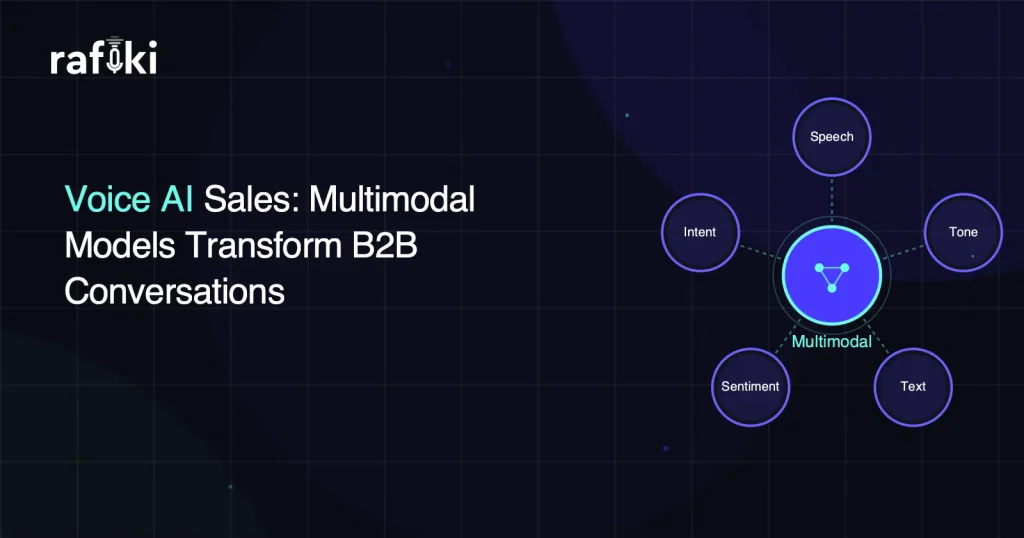
Voice AI in sales has evolved far beyond basic transcription. Modern multimodal AI models combine speech recognition, natural language understanding, sentiment analysis, and behavioral pattern recognition to create comprehensive conversation intelligence. These systems don't just capture what was said – they understand intent, emotion, and context.
The key capabilities transforming sales conversations include:
This multimodal approach creates a complete picture of every customer interaction. When a prospect mentions budget constraints while their tone suggests flexibility, the AI captures both the explicit concern and the implicit opportunity. This nuanced understanding enables sales teams to respond with precision rather than assumption.
The most advanced voice AI sales systems deploy autonomous agents that work continuously to extract value from conversations. Rather than requiring manual review and analysis, these AI agents process every interaction automatically, surfacing insights and taking actions based on conversation content.
Effective autonomous agent frameworks typically include:
These agents operate continuously, processing conversations as they happen and updating your revenue intelligence in real-time. The result is a sales organization that learns from every interaction, identifies patterns across conversations, and provides actionable insights at the exact moment they're needed.
Modern B2B sales increasingly happen across languages and cultures. Organizations expanding globally need voice AI systems that understand not just English, but the nuances of business conversations in multiple languages. This capability has become essential for companies serving international markets or managing distributed teams.
Advanced voice AI platforms now support:
This global capability ensures that your voice AI investment scales with your business expansion. Whether your team is conducting calls in Mandarin, Spanish, or German, the same level of conversation intelligence applies. Revenue leaders can finally get consistent insights across their entire global organization.
The most significant transformation voice AI brings to B2B sales is the shift from reactive to predictive intelligence. Instead of discovering problems after deals are lost, sales teams can identify and address issues while opportunities are still salvageable.
Real-time voice AI enables several critical capabilities:
This predictive approach transforms sales from a reactive activity into a proactive, intelligence-driven process. Your team stops chasing problems and starts preventing them. Deals stay on track because issues are addressed immediately rather than discovered during quarterly pipeline reviews.
Rafiki's AI-native revenue intelligence platform exemplifies how modern voice AI should work in B2B sales environments. Built specifically for growing sales teams, Rafiki's six autonomous AI agents work continuously to extract maximum value from every customer conversation.
The platform's multimodal AI capabilities include:
What sets Rafiki apart is its combination of enterprise-grade capabilities with startup-friendly pricing and deployment. The platform starts at $19 per seat monthly with no minimum user requirements, making sophisticated voice AI accessible to growing teams that can't justify enterprise-level investments.
Rafiki's 60+ language support ensures global sales teams get consistent intelligence regardless of where conversations happen. The quick setup process and comprehensive integration ecosystem mean teams can start capturing voice AI insights immediately rather than waiting months for complex implementations.
Rafiki integrates natively with the tools sales teams already use daily. Whether your team works in Salesforce, HubSpot, Zoho, or Pipedrive, conversation intelligence flows directly into existing workflows. Video platforms like Zoom, Microsoft Teams, and Google Meet connect automatically, ensuring no conversations are missed regardless of how your team connects with prospects.
This seamless integration approach means voice AI becomes part of your team's natural workflow rather than another tool to manage. Account executives get automatic CRM updates, while sales managers receive coaching insights and pipeline risk alerts without changing their existing processes.
Successfully implementing voice AI sales intelligence requires a structured approach that balances immediate value capture with long-term capability building. The most effective deployments follow a phased rollout that builds confidence and demonstrates ROI before expanding across the entire organization.
Phase 1: Foundation Setup (Weeks 1-2)
Phase 2: Pilot Expansion (Weeks 3-6)
Phase 3: Full Deployment (Weeks 7-12)
This phased approach ensures your team builds competency gradually while demonstrating clear value at each stage. Early wins with pilot users create momentum for broader adoption, while measured expansion allows you to refine processes before scaling.
Organizations that master voice AI sales intelligence in 2026 will create significant competitive advantages. While their competitors manually review scattered call recordings and hope for accurate manual updates, AI-enabled teams will operate with complete conversation visibility, predictive insights, and automated optimization.
The strategic benefits extend beyond individual deal improvement:
The window for competitive advantage through voice AI adoption is rapidly closing. Early adopters have already begun realizing improvements in deal velocity, win rates, and customer satisfaction. Organizations that delay implementation risk falling behind as AI-enabled competitors capture market share through superior customer understanding and response.
Voice AI in sales has moved from experimental technology to competitive necessity. The question isn't whether your organization will adopt conversation intelligence, but whether you'll implement it before or after your competitors gain an advantage. The teams that act now will define the new standard for B2B sales excellence, while late adopters will spend time trying to catch up to AI-native revenue operations.
Ready to transform your sales conversations into competitive intelligence? Rafiki's AI-native revenue intelligence platform starts at $19 per seat with no minimums, no annual commitments, and enterprise-grade capabilities designed for growing teams. Start your free trial today or book a demo to see how multimodal AI can revolutionize your revenue operations.
Start for free — no credit card, no seat minimums, no long contracts. Just better sales intelligence.