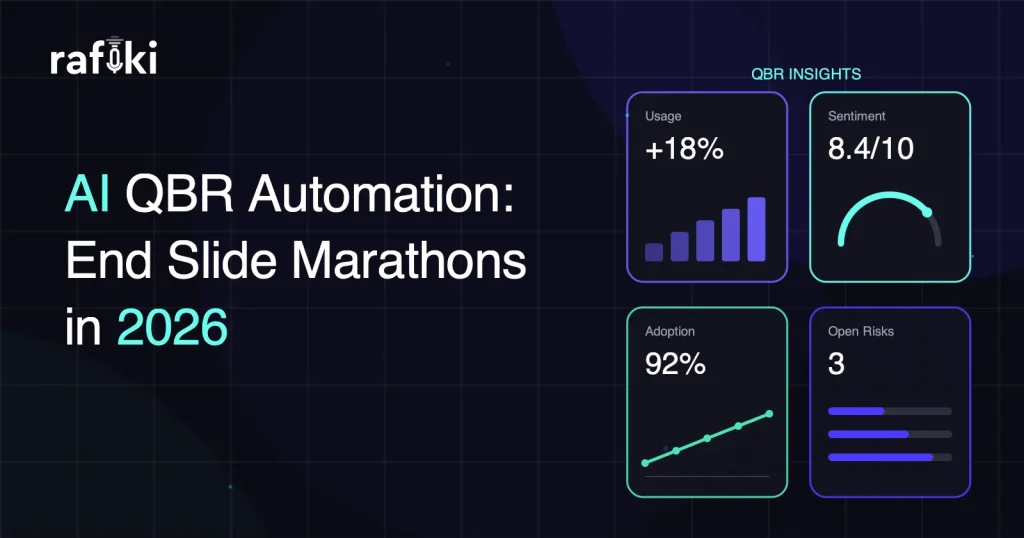
Your team spends more time building QBR slide decks than actually deciding what to do about the accounts in them.
That is not a productivity problem. It is a strategic failure hiding in plain sight. Across B2B sales and customer success organizations, the quarterly business review has calcified into a ritual of copy-pasting CRM fields into PowerPoint, debating whose numbers are right, and running out of time before anyone discusses what actually matters: where revenue is at risk, where expansion is waiting, and what the next ninety days should look like. The slide marathon persists because assembling the data is so painful that the meeting's entire energy gets consumed by presentation rather than conversation. AI QBR automation is changing that equation entirely.
In 2026, AI QBR automation is dismantling this dysfunction at the root. Instead of treating the quarterly review as a static reporting event, leading revenue teams now treat it as a living, AI-assembled intelligence briefing — one that arrives pre-built, pre-analyzed, and ready for debate the moment stakeholders sit down. The shift is not incremental. It changes what QBRs are for.
The Broken Status Quo: Why Traditional QBRs Drain More Than They Deliver
The traditional QBR workflow is a known time sink, yet most organizations tolerate it because they have never seen an alternative. The process typically looks like this:
- A CS or sales manager pulls data from the CRM, spreadsheets, and support ticketing systems — often manually reconciling conflicting numbers across tools.
- Someone builds a slide deck, formatting tables and charts that will be outdated by the time the meeting happens.
- The first half of the QBR is spent presenting information that attendees could have read in advance, leaving little room for strategic discussion.
- Action items are captured in meeting notes that rarely connect back to the CRM or follow-up workflows.
- The cycle repeats ninety days later, with limited visibility into whether last quarter's decisions actually landed.
Industry analysts like Forrester have consistently highlighted that customer-facing teams spend a disproportionate share of their time on non-selling or non-strategic activities — data assembly and internal reporting chief among them. The QBR is a microcosm of this broader inefficiency: high effort, low strategic yield.
The Cost of Inaction: What Slide Marathons Actually Cost Your Revenue Team
If the only cost of a bad QBR were wasted hours, teams might reasonably tolerate it. The real damage runs deeper:
- Missed churn signals — When QBR prep is a manual data-pull exercise, nuance gets lost. The subtle shift in a champion's tone, a drop in product usage mentioned offhand in a call, a competitor name surfacing in discovery — these signals live in conversations, not dashboards. Static slide decks never capture them.
- Delayed expansion conversations — Upsell and cross-sell opportunities surface in live dialogue between reps and buyers. If no one reviews those moments systematically, expansion timing slips from proactive to reactive.
- Executive disengagement — When leadership sits through dozens of slides of backward-looking metrics, they check out. The strategic questions — resource allocation, territory rebalancing, pricing adjustments — never get the airtime they deserve.
- Accountability gaps — Without a closed-loop system tying QBR decisions to downstream execution, commitments made in the room evaporate within days.
The compounding effect is subtle but severe. Quarter after quarter, teams operate on stale snapshots instead of living intelligence. Winnable deals slip. Retainable accounts churn. And nobody connects the loss back to a broken review process because the QBR itself looked polished on screen.
What AI QBR Automation Actually Means in 2026
AI QBR automation refers to the use of autonomous AI agents and generative AI to assemble, analyze, and present quarterly business review content with minimal human intervention — transforming the QBR from a reporting event into a decision-making session. It is not about replacing the meeting. It is about eliminating the toil that prevents the meeting from being useful.
The core capabilities that define this category in 2026 include:
- Automatic data aggregation — AI pulls structured data from CRMs, support platforms, and billing systems, then enriches it with unstructured insights extracted from sales and CS calls.
- Conversation intelligence synthesis — Instead of skimming call recordings, AI analyzes every conversation in an account over the quarter, identifying themes, sentiment shifts, competitive mentions, and risk indicators.
- Narrative generation — Generative AI produces executive-ready account summaries, complete with recommended discussion points and flagged anomalies, so the QBR deck writes itself.
- Scoring and prioritization — AI ranks accounts by health, expansion readiness, or risk severity, ensuring the team spends QBR time on the accounts that matter most rather than reviewing them alphabetically.
- Action-item tracking and CRM sync — Decisions made during the QBR flow directly into CRM records and follow-up workflows, closing the loop that manual processes leave open.
The net effect is a QBR that arrives substantially ready before a human touches it. The remaining work — interpretation, judgment, strategic debate — is exactly where human time should go.
The Five Layers of an AI-Automated QBR Workflow
Implementing AI QBR automation is not a single feature toggle. It is a workflow redesign built on five interconnected layers. Each layer eliminates a specific category of manual work.
Layer 1: Continuous Call Analysis
Rather than reviewing calls retroactively before a QBR, AI analyzes every customer and prospect conversation in real time throughout the quarter. This means the intelligence is already accumulated when review time arrives.
- Topic and keyword tracking across all calls in an account
- Sentiment and engagement scoring per stakeholder
- Automatic tagging of risk phrases, competitor mentions, and budget signals
Layer 2: Structured Account Summaries
Generative AI distills weeks of interactions into a concise account narrative — not a transcript dump, but a structured brief covering health indicators, open issues, relationship dynamics, and recommended next steps.
- Auto-generated executive summaries for each account
- Key quote extraction for evidence-based discussion
- Trend comparison against prior quarters
Layer 3: Portfolio-Level Scoring and Prioritization
AI scores and ranks accounts using frameworks like MEDDIC, BANT, or custom health models, surfacing the accounts that need immediate attention and suppressing the ones that are on track.
- Risk-weighted account prioritization
- Expansion readiness scoring based on buyer signals
- Cohort-level trend identification (e.g., specific industries or segments showing pattern shifts)
Layer 4: Auto-Generated QBR Decks and Reports
The most visible time savings come from this layer. AI compiles the analysis into a presentation-ready format — whether that is a slide deck, a dashboard view, or a structured report — without anyone opening PowerPoint.
- Templated output aligned to your QBR format
- Dynamic charts pulling from live CRM data
- Pre-written talking points and discussion questions per account
Layer 5: Post-QBR Action Sync
The final layer ensures decisions do not die in meeting notes. Action items, ownership assignments, and follow-up timelines are captured and synced back to the CRM and task management systems.
- Automated follow-up task creation
- CRM field updates tied to QBR outcomes
- Progress tracking visible in the next quarter's automated brief
Together, these five layers replace the fragmented, manual QBR prep cycle with a continuous intelligence pipeline that makes quarterly reviews a natural output of daily operations rather than a quarterly fire drill.
From Backward-Looking Reports to Forward-Looking Strategy
The deeper transformation AI QBR automation enables is not about speed — it is about orientation. Traditional QBRs are overwhelmingly retrospective. They answer the question: "What happened last quarter?" AI-automated QBRs shift the center of gravity toward: "What should we do next quarter, and why?"
- Pattern recognition at scale — AI identifies cross-account patterns that no individual manager would spot: a pricing objection emerging across a vertical, a competitor gaining traction in a specific region, a product gap mentioned in dozens of calls.
- Predictive risk flagging — Instead of discovering churn risk during a QBR, teams arrive already knowing which accounts are trending negatively and what specific conversations signaled the shift.
- Resource allocation intelligence — When account health and expansion readiness are scored and ranked, leadership can make informed decisions about where to invest CS and sales effort, rather than relying on gut feel or squeaky-wheel dynamics.
- Coaching integration — AI-scored calls reveal not just account health but rep performance. QBRs become opportunities to align account strategy with rep development, connecting AI negotiation coaching insights to real account outcomes.
This forward-looking orientation is what turns a QBR from an obligation into a competitive advantage. The teams that arrive at the table already knowing their risks and opportunities are the ones that act faster than their competitors.
How Rafiki Powers AI QBR Automation Across Your Revenue Team
Rafiki is an AI-native revenue intelligence platform built from day one on multi-model AI, designed to give growing sales teams enterprise-grade insights without enterprise pricing or complexity. Its architecture maps directly to the five-layer QBR automation workflow described above.
- Continuous call analysis — Rafiki's Smart Call Scoring agent evaluates every conversation against frameworks like MEDDIC, BANT, and SPIN, building a rolling intelligence layer across your entire book of business. With transcription in 60+ languages, global teams get uniform coverage without regional blind spots.
- Structured account summaries — The Gen AI Reports agent generates executive-ready account briefs, pulling from call data, CRM fields, and historical trends. No manual assembly required.
- Portfolio scoring and prioritization — Rafiki surfaces risk and expansion signals across accounts, enabling CS leaders and frontline managers to walk into QBRs with a prioritized agenda rather than an alphabetical one.
- Natural-language queries — With Ask Rafiki Anything, any stakeholder can query the platform in plain language before or during a QBR: "Which enterprise accounts mentioned a competitor in the last 90 days?" or "Show me accounts where champion engagement dropped quarter-over-quarter." The intelligence is accessible, not locked in analyst queues.
- CRM sync and follow-up — Rafiki's Smart CRM Sync and Smart Follow Up agents push QBR decisions and action items directly into Salesforce, HubSpot, Zoho, Pipedrive, or Freshworks — closing the execution gap that manual processes leave wide open.
Rafiki operates with six autonomous AI agents working around the clock, which means QBR intelligence is not generated on demand — it is continuously assembled. By the time your quarterly review arrives, Rafiki has already done the work that used to consume days of human effort. And because Rafiki starts at $19 per seat per month with no seat minimums and no annual contracts, this capability is accessible to ten-person teams, not just enterprise organizations with six-figure platform budgets.
Implementation: Rolling Out AI QBR Automation in Four Phases
Adopting AI QBR automation does not require a transformation program. It requires a deliberate sequence of small, high-impact changes. Here is a practical four-phase rollout:
- Phase 1: Instrument your conversations (Week 1) — Connect your meeting platforms (Zoom, Teams, Google Meet) to your revenue intelligence platform. Enable automatic recording and transcription for all customer-facing calls. This is the foundation — without conversation data, AI has nothing to analyze.
- Phase 2: Establish scoring frameworks (Week 2-3) — Configure call scoring against the methodology your team uses (MEDDIC, BANT, SPIN, or a custom model). Define what "good" looks like so AI can flag deviations and trends consistently.
- Phase 3: Generate your first AI-assembled QBR (Week 4-6) — Run your next quarterly review using AI-generated account summaries and prioritized agendas. Compare the prep time and discussion quality against your previous manual process. Track how much meeting time shifts from presentation to strategic debate.
- Phase 4: Close the loop (Ongoing) — Activate CRM sync for QBR action items. Use the follow-up tracking layer to measure execution against commitments. Feed outcomes back into the next quarter's automated analysis to create a compounding intelligence cycle.
Most teams using an AI-native platform like Rafiki complete Phase 1 in under fifteen minutes — the integration is designed for immediate activation, not multi-week IT projects. The compounding value kicks in by the second QBR cycle, when the platform has a full quarter of conversation data to analyze and compare.
Measuring the Impact: What Changes When QBRs Run on AI
Teams that shift from manual QBR prep to AI-automated workflows consistently report changes across several dimensions. While the specific magnitude varies by organization, the directional impact is clear:
- Prep time reduction — The hours previously spent pulling data, formatting slides, and reconciling numbers collapse to minutes of review and refinement. Managers reinvest that time in account strategy and rep coaching.
- Meeting quality shift — When attendees arrive with pre-read AI summaries, meetings start at the discussion layer, not the data layer. Leadership engagement increases because the conversation is about decisions, not definitions.
- Faster risk detection — Churn and contraction signals surface in real time rather than surfacing retroactively during a quarterly review. Teams intervene weeks earlier.
- Higher expansion capture — Upsell and cross-sell signals identified in conversations get systematically surfaced, preventing the "we didn't know they were interested" scenario that plagues manual account management. Rafiki's approach to uncovering upsell signals in CS calls is a direct enabler of this outcome.
- Accountability improvement — When QBR action items sync to the CRM and get tracked automatically, follow-through rates climb. The next QBR opens with a progress report, not a blank slate.
As McKinsey has observed, organizations that embed AI into their core commercial processes — rather than layering it on top as a standalone tool — tend to see greater impact on revenue outcomes. AI QBR automation exemplifies this principle: it is not an add-on to the review process, it is a rewiring of the information flow that feeds it.
The Competitive Divide: AI-Driven Reviews vs. Manual Reviews
By mid-2026, the gap between teams running AI-automated QBRs and those still building slide decks manually is no longer a matter of efficiency. It is a strategic asymmetry.
- Teams with automated QBRs operate on continuous intelligence — every call, every signal, every trend is captured and analyzed as it happens. Their quarterly reviews are checkpoints on a living data stream.
- Teams without automation operate on quarterly snapshots — assembling a backward-looking picture from incomplete data, often with significant lag and human bias in what gets included.
- The first group detects churn risk in real time and intervenes. The second group discovers it in a QBR and scrambles to react.
- The first group identifies expansion opportunities from buyer language. The second group relies on reps self-reporting, which is inconsistent at best.
This divide accelerates over time. Each quarter of AI-analyzed conversation data makes the next quarter's intelligence richer, creating a compounding advantage that manual processes cannot replicate regardless of headcount investment. The question is no longer whether to automate QBRs, but how quickly your team can make the shift before competitors do.
Conclusion: QBRs Should Drive Decisions, Not Document History
The quarterly business review was always meant to be a strategic inflection point — a moment where revenue leaders align on priorities, reallocate resources, and course-correct before small problems become large ones. Somewhere along the way, it devolved into a slide-building exercise where the most valuable people in the room spend their energy presenting data instead of interpreting it.
- AI QBR automation eliminates the manual assembly that drains strategic capacity.
- Continuous conversation intelligence replaces point-in-time data pulls with living account narratives.
- Generative AI reports turn weeks of prep into minutes of review.
- CRM sync and follow-up automation close the execution gap between QBR decisions and daily operations.
The technology to make this real is not emerging — it is production-ready and accessible to teams of every size. The only remaining variable is whether your organization adopts it this quarter or watches competitors do it first.
Rafiki gives growing sales teams the AI-native revenue intelligence to automate QBR workflows from conversation capture to CRM-synced action items — starting at $19 per seat per month with no seat minimums and no annual commitment. Set up in fifteen minutes and run your next QBR on AI-generated intelligence instead of manually assembled slides. Start free or book a demo at getrafiki.ai.