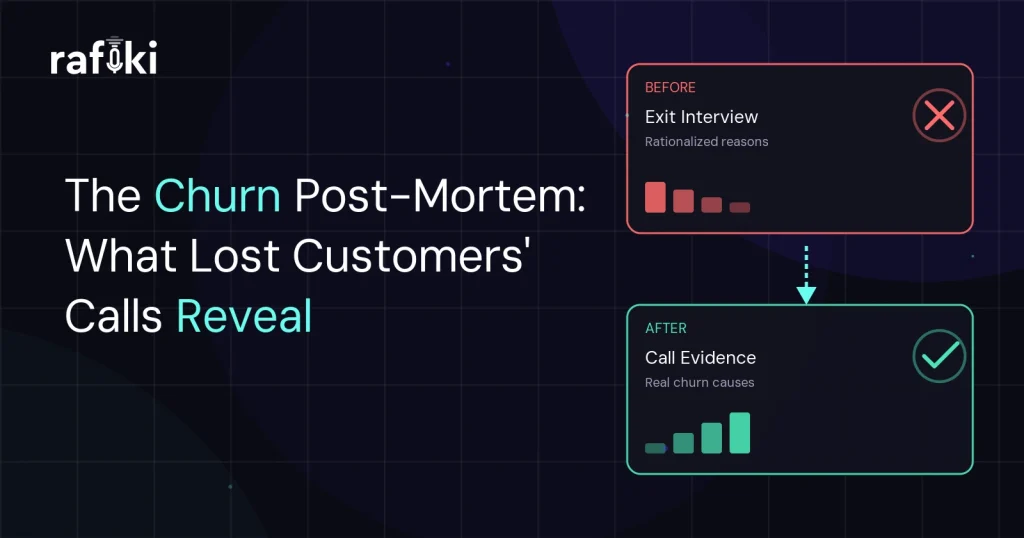
By the time a customer tells you why they're leaving, they're describing a decision they made months ago.
Every churned account gets the same ritual: an exit conversation, a reason code in the CRM, a paragraph in the quarterly retention review. And almost everything captured in that ritual is a rationalization — polite, compressed, and recorded long after the real decision was made. "Budget" stands in for an unresolved integration complaint from February. "Going another direction" stands in for a champion who left in March and was never replaced.
The actual story is rarely a mystery. It is sitting in the customer's last quarter of calls — the unanswered objection, the QBR where only one stakeholder showed up, the renewal conversation where enthusiasm quietly became politeness. A churn post-mortem that ignores this record isn't an analysis; it's a guess with a template. Teams that mine it, account by account, turn every loss into the most specific retention training data they will ever get.
Exit conversations fail as evidence for predictable, human reasons. By the final call, the customer has no incentive to be thorough: the decision is made, the relationship is winding down, and candor buys them nothing but an awkward meeting. What they offer instead is a socially comfortable summary.
Several distortions are at work:
Reason codes inherit all of these problems and add one more: they force a multi-cause story into a single dropdown value. Consequently, churn reports aggregate fiction. A retention strategy built on them optimizes against reasons customers never actually left for — which is how teams end up cutting price to fix what was really an onboarding failure.
A churn post-mortem is a structured review of a lost account that reconstructs why the customer actually left, using primary evidence rather than exit-interview summaries. Where churn prediction tries to catch risk before the decision, the post-mortem runs after it — its job is learning, not saving. The output is a verified causal story, a classification verdict, and specific changes to how the team onboards, engages, or renews the next cohort.
A complete post-mortem answers five questions:
The standard of proof matters. Each answer should trace to something inspectable — a call, a meeting attendance record, a support thread — rather than to recollection. That single discipline separates post-mortems that change behavior from post-mortems that produce a well-formatted document nobody acts on.
Churn is almost never sudden. It accumulates through signals that are individually dismissible and collectively unambiguous — and most of them are audible in the customer's final quarter of conversations. Forrester's customer experience research has long made the case that experience quality shows up in behavior well before it shows up in survey scores; the same logic applies to the renewal decision forming inside your calls.
In the last 90 days of a churned account, the record typically shows some combination of:
None of these require interpretation after the fact — they are recorded events with timestamps. The post-mortem's first job is simply assembling that timeline and locating the break point: the call after which the account's trajectory visibly changed. Salesforce's State of Service research tracks how service organizations are reorienting around exactly this kind of proactive signal use, rather than waiting for customers to self-report problems.
Individual post-mortems produce stories; classification produces strategy. A practical scheme used widely in 2026 CS practice sorts every churned account into one of four verdicts:
The account looked healthy — strong usage, green health score, positive CSM sentiment — and left anyway. These are the most valuable post-mortems, because they expose what your health model cannot see. In practice, the last-90-days call record usually reveals the blind spot: a champion change, an unvoiced executive mandate, a competitor conversation that never surfaced in tickets or usage data.
The signals were present, identifiable, and actionable — and the team missed, dismissed, or deprioritized them. The post-mortem names the intervention that would have worked and the moment it was still available. These verdicts feed directly into playbook changes and early-warning thresholds.
The account is one instance of a repeating pattern: the same integration gap, the same onboarding stall, the same segment-fit problem appearing across multiple losses. Thematic verdicts are product and strategy feedback wearing a retention costume — they belong in the product council, not just the CS retro.
Acquisitions, shutdowns, budget eliminations — losses no CS motion could have prevented. The discipline here is honesty: structural is the verdict teams over-assign because it assigns no blame. A real structural verdict requires evidence that the decision was independent of the relationship, not just a customer who mentioned the word "budget."
Tracking the verdict mix quarter over quarter tells a CS leader where to invest. A book heavy in salvageable churn needs better signal detection and CSM coaching; a book heavy in thematic churn needs product escalation; a book heavy in unexpected churn needs a better health model.
The protocol below assumes one post-mortem per churned account above a revenue threshold, completed within two weeks of the churn notice:
Keep the meeting blameless but the evidence sharp. The goal is never "who lost this account"; it is "what does this account teach the next hundred."
Post-mortem findings earn their cost when they flow back into the live book. Each verdict type has a natural destination. Salvageable-churn findings update the early-warning signals your team watches — the same red flags catalogued in our guide to renewal risk signals. Thematic findings become product escalations with customer quotes attached, which travel much further than ticket counts. Unexpected-churn findings revise the health model itself, adding conversation signals where usage metrics proved blind — the shift we mapped in conversation intelligence for churn prevention.
Two cadences keep the loop honest:
Over a few quarters, this compounds into something rare: a retention strategy built on what customers actually did and said on the way out, rather than on what was comfortable to record.
The honest objection to all of the above is time. Reconstructing 90 days of calls manually means hours of re-listening per account — which is why manual post-mortems either don't happen or happen only for the largest logos. Conversation intelligence removes the reconstruction cost: every call is already transcribed, summarized, and searchable when the churn notice arrives.
With that layer in place, the evidence assembly becomes a set of queries:
The post-mortem meeting then starts from evidence instead of spending its first hour generating it — and the same queries run identically for a mid-market account as for the biggest logo in the book.
Rafiki AI is an AI-native revenue intelligence platform that keeps the full conversational record of every account — which makes it the system of record a churn post-mortem actually needs.
Applied to the protocol above:
For customer success leaders, the practical shift is coverage: post-mortems stop being a luxury reserved for enterprise logos and become standard for every meaningful loss. Rafiki AI transcribes in 60+ languages and integrates with Salesforce, HubSpot, Zoho, Pipedrive, and Freshworks, so the findings land in the CRM fields and dashboards the rest of the revenue team already reads.
Long post-mortem documents get filed; one-pagers get discussed. Whatever your tooling produces, the artifact that circulates should compress to a single page with a fixed shape, so patterns stay comparable across accounts and quarters.
A format that works in practice:
Resist the urge to add sections. The constraint is the feature: a CS leader should be able to read four of these before the quarterly review and hold them all in mind at once. In contrast, the supporting evidence — full timelines, transcripts, scoring trends — stays linked underneath for anyone who wants to inspect the reasoning, which is precisely what keeps the one-pager honest.
Set a revenue or strategic threshold and hold it. A common starting point: every churned account above a meaningful ARR line gets the full protocol, while smaller losses get a lightweight version — timeline, verdict, one paragraph. What matters is consistency; a post-mortem practice that only runs when someone is upset produces biased data. As coverage costs fall with automation, push the threshold down.
The CSM assembles the evidence; someone one step removed facilitates the verdict. The owning CSM knows the history but also carries understandable defensiveness, and verdicts like "salvageable" are hard to self-assign. A CS Ops lead or peer manager facilitating keeps the meeting blameless while keeping the classification honest.
Win-loss analysis studies buying decisions — why prospects chose or rejected you during the sale. A churn post-mortem studies the relationship decision — why an existing customer stopped renewing. The methods rhyme, but the evidence differs: win-loss leans on deal calls and competitive dynamics, while churn post-mortems lean on the long arc of QBRs, support escalations, and renewal conversations. Mature teams run both and compare themes.
Churn is expensive twice — once when the revenue leaves, and again when the lesson leaves with it. Teams that close the file with a reason code pay the second cost forever, re-losing accounts to the same causes under different dropdown labels. Teams that run evidence-based post-mortems convert each loss into specific, verified knowledge about how their customers actually disengage.
The raw material is already there. Every churned account narrated its own departure across its final quarter of conversations; the only question is whether anyone goes back and listens. With the conversational record captured and queryable, the churn post-mortem stops being archaeology and becomes routine practice — and the next renewal cohort inherits everything the last one taught you.
Rafiki AI's autonomous AI agents keep the complete, searchable record of every customer conversation — so when an account churns, the real story is one query away. Plans start at $19 per seat per month with no seat minimums and no annual commitment. Start your free trial today or book a demo to see how conversation evidence changes your churn post-mortem.
Start for free — no credit card, no seat minimums, no long contracts. Just better sales intelligence.