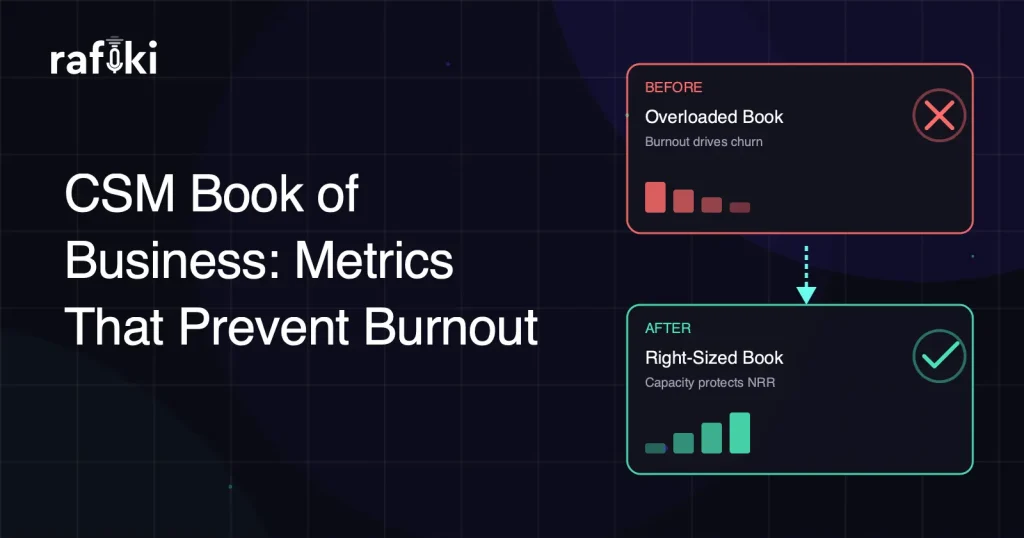
When a CSM's book of business quietly swells past the point of sustainability, the first casualty is never a spreadsheet — it is the customer relationship that was one missed check-in away from saving.
Customer success leaders face a paradox that intensifies every quarter. The executive team demands higher net revenue retention, broader account coverage, and deeper expansion motions — all while headcount stays flat or grows slower than the customer base. The result is a CSM book of business that balloons until individual contributors are managing so many accounts that strategic engagement becomes impossible. They triage instead of advise. They react to escalations instead of preventing them. And over time, the best CSMs — the ones who actually care about outcomes — burn out and leave.
The downstream effects are brutal. Burned-out CSMs produce disengaged customers. Disengaged customers churn. Churn craters NRR. And the organization enters a cycle where it spends more on acquiring new logos than it would have spent on retaining existing ones. The root cause is not effort or talent. It is a capacity model that was never designed to scale, governed by metrics that measure activity instead of sustainability.
Why Traditional CSM Book of Business Sizing Fails
The most common way organizations size a CSM book of business is by dividing total ARR or total account count by the number of CSMs on the team. This arithmetic approach treats every account as interchangeable and every CSM as identically leveraged. It is a planning convenience, not a capacity strategy.
Here is what this model ignores:
- Account complexity variance — A $50K account in steady-state renewal requires fundamentally different effort than a $50K account in onboarding with three stakeholders and a custom integration
- Customer lifecycle stage — New logos demand heavier front-loaded engagement; mature accounts need periodic strategic reviews but fewer touchpoints
- Health signal density — Some accounts produce dozens of engagement signals per week across product usage, support tickets, and call sentiment; others are silent, which itself is a signal
- CSM tenure and ramp time — A CSM in their first 90 days carries cognitive overhead that a veteran does not, yet both are assigned identical book sizes
- Expansion potential weighting — Accounts with high whitespace opportunity justify more proactive hours, but flat ARR-based models do not differentiate
The consequence is a planning model that looks balanced on a slide but produces wildly uneven workloads in reality. Some CSMs coast while others drown, and leadership has no visibility into the imbalance until attrition data arrives too late.
The Real Cost: Burnout Drives Churn on Both Sides
Burnout in customer success is not simply "too many meetings." It is the sustained cognitive load of managing a portfolio where every account feels urgent, no account gets enough depth, and the CSM loses the capacity for the strategic thinking that makes customer success actually work. Harvard Business Review research has established that burnout is a systemic workplace design problem, not an individual resilience problem — and that framing applies directly to how CS organizations assign workload.
The chain reaction follows a predictable pattern:
- CSM burnout leads to reactive engagement — proactive business reviews get skipped, onboarding playbooks get abbreviated, and QBRs become status updates instead of strategy sessions
- Reactive engagement leads to customer disengagement — when customers feel like they are managing themselves, they start evaluating alternatives
- Customer disengagement leads to logo churn or contraction — by the time a formal churn risk surfaces, the damage is already done
- CSM attrition compounds the problem — when a burned-out CSM leaves, their book gets distributed across an already-overloaded team, accelerating the spiral
- Institutional knowledge evaporates — relationship context, stakeholder preferences, and account history disappear with the departing CSM, forcing survivors to rebuild understanding from scratch
This is not a hypothetical sequence. It is the operating reality of CS teams that rely on headcount ratios instead of capacity intelligence. And the financial impact is severe — replacing a CSM costs months of recruiting and ramping, while every week without adequate coverage is a week where at-risk accounts drift further from retention.
Capacity Metrics That Actually Matter for CSM Book of Business Health
Capacity metrics refer to the quantitative and qualitative measures that determine how much workload a CSM can sustain while maintaining the engagement quality required to drive retention and expansion. Unlike simple account counts or ARR-per-CSM ratios, capacity metrics incorporate the effort intensity of each account and the total cognitive load across a portfolio.
The metrics that prevent burnout and churn fall into three categories:
Effort-Weighted Account Scoring
Instead of treating every account equally, assign an effort score based on quantifiable attributes. This transforms book of business planning from arithmetic to intelligence.
- Lifecycle stage multiplier — Onboarding accounts typically carry significantly more effort weight than renewal-stage accounts; calibrate multipliers based on your own team's historical time-tracking data
- Stakeholder complexity — Multi-threaded accounts with several decision-makers demand more preparation and coordination than single-threaded accounts
- Product footprint — Customers using multiple product lines or requiring custom configurations increase the knowledge burden per interaction
- Health score trajectory — Declining health scores require intervention planning that consumes disproportionate CSM bandwidth
- Expansion pipeline stage — Accounts in active upsell or cross-sell cycles require strategic selling behaviors that overlap with traditional CS engagement
When you sum effort-weighted scores instead of raw account counts, you get a realistic picture of portfolio load. A CSM with 30 accounts at a low total effort weight is not equivalent to a CSM with 30 accounts at a significantly higher total effort weight — even though a headcount ratio model treats them identically.
Engagement Throughput Rate
This metric captures how many meaningful interactions a CSM can execute per week while maintaining quality. "Meaningful" is the key qualifier — a five-minute status ping does not carry the same weight as a 45-minute business review.
- Track interaction types separately — Strategic calls, onboarding sessions, escalation handling, internal advocacy meetings, and administrative tasks each consume different time and energy
- Set sustainable throughput ceilings — Determine your team's sustainable strategic interaction limit by analyzing historical data on engagement quality relative to weekly interaction volume; this ceiling will vary by organization and CSM role
- Monitor throughput trends weekly — A CSM consistently exceeding their sustainable throughput ceiling is heading toward burnout, regardless of their current performance metrics
Throughput rate gives leadership a leading indicator. If a CSM's engagement throughput is trending above their ceiling for three consecutive weeks, that is an intervention signal — not a productivity achievement.
Time-to-Risk Detection
This metric measures how quickly the organization identifies a deteriorating account situation after the earliest detectable signal. The gap between signal emergence and CSM awareness is where preventable churn lives.
- Signal sources include — Declining product usage, negative sentiment in calls, support ticket escalation patterns, stakeholder disengagement, and delayed renewal conversations
- Benchmark against intervention windows — If it takes weeks to detect a churn risk signal that needed a rapid response, the capacity model failed before the CSM did
- Correlate with book size — Larger books predictably lengthen time-to-risk detection because CSMs cannot monitor all signals across all accounts simultaneously
When time-to-risk detection stretches beyond acceptable thresholds, it is a capacity problem masquerading as a performance problem. Blaming the CSM for missing a signal they had no bandwidth to monitor is the fastest way to accelerate their departure.
Building a Dynamic Capacity Model: The Framework
A dynamic capacity model is a continuously recalculated allocation framework that adjusts CSM book of business assignments based on real-time effort data rather than static planning assumptions. Building one requires four components working together.
- Account effort taxonomy — A standardized classification system that tags every account with effort-driving attributes (lifecycle stage, complexity tier, health trajectory, expansion potential) and updates those tags as conditions change
- CSM capacity profiles — Individual assessments of each CSM's sustainable throughput, factoring in tenure, ramp status, skill specialization, and current load trend
- Rebalancing triggers — Defined thresholds that initiate book redistribution — for example, when a CSM's effort-weighted load exceeds the team's target capacity for consecutive weeks, or when a new CSM completes ramp and can absorb accounts
- Outcome feedback loops — Systematic correlation between capacity metrics and business outcomes (NRR, CSAT, logo retention, expansion rate) to continuously calibrate effort weights and throughput ceilings
The critical shift here is from annual or quarterly book-of-business planning to continuous capacity management. Static plans break the moment a CSM goes on leave, an enterprise logo signs, or a cluster of accounts enters renewal simultaneously. Dynamic models absorb these disruptions because they are designed to detect and respond to load variance in real time.
Why Conversation Intelligence Is the Missing Input
Most capacity models rely on CRM data and product usage telemetry. These are necessary but insufficient. The richest source of account effort signals lives in the conversations CSMs have every day — and without systematically analyzing those conversations, capacity models operate on incomplete data.
- Call sentiment reveals hidden effort — An account that appears healthy by usage metrics but produces consistently negative call sentiment is consuming far more emotional and strategic bandwidth than its effort score reflects
- Topic frequency signals emerging complexity — When a customer repeatedly raises questions about features they have not purchased, expansion effort is imminent even if no formal opportunity exists in the CRM
- Stakeholder mapping updates automatically — Conversations reveal who is actually engaged, who has gone silent, and whether champion changes have occurred — all of which alter the effort profile of an account
- Follow-up density correlates with load — Accounts generating a high volume of post-call action items indicate that the CSM is managing a heavier coordination burden than the account's tier suggests
Without conversation intelligence feeding into capacity models, leadership is making allocation decisions with at best half the picture. They see what is in the CRM. They miss what is in the calls. And the gap between those two realities is where burnout and churn incubate.
How Rafiki AI Enables Capacity-Intelligent Book of Business Management
This is where the shift from theory to execution happens. Rafiki AI is an AI-native revenue intelligence platform purpose-built to surface the signals that traditional tools miss — including the conversation-level data that makes dynamic CSM capacity models actually work.
Rafiki AI's six autonomous AI agents operate across every customer interaction, extracting structured intelligence that feeds directly into the capacity framework described above:
- Smart Call Summary generates structured summaries of every CSM conversation, capturing key topics discussed, commitments made, and stakeholder participation — eliminating the manual effort of post-call documentation and giving leadership account-level effort data at scale. Explore how Smart Call Summary transforms conversation data into actionable intelligence.
- Smart Follow Up automates post-call follow-up actions, ensuring that commitments made during conversations are tracked and executed — reducing the administrative coordination burden that silently consumes CSM bandwidth.
- Smart Call Scoring evaluates every interaction against any sales methodology — MEDDIC, BANT, SPIN, SPICED, GAP, Challenger, Sandler — or custom scoring criteria you define, providing an objective measure of engagement quality that correlates directly with account health trajectory. When a CSM's call scores decline across their book, it is a leading indicator of overload — not underperformance.
- Ask Rafiki Anything enables CS leaders to run natural-language queries across the entire conversation corpus — questions like "Which accounts have mentioned competitor evaluation in the last 30 days?" or "Which CSMs have the highest follow-up action density?" Surface the answers that drive rebalancing decisions without manually reviewing calls. Learn more about Gen AI Search and natural-language revenue queries.
- Smart CRM Sync automatically pushes conversation-derived intelligence into Salesforce, HubSpot, Zoho, Pipedrive, and Freshworks — auto-populating both methodology-specific fields and any custom CRM fields your CS ops team defines — so effort signals from calls are reflected in the CRM where capacity planning tools can consume them
- Gen AI Reports synthesize cross-account patterns that no individual CSM has visibility into — identifying which book segments are consuming disproportionate effort and which accounts can be transitioned to digital-touch models without risk
For customer success leaders specifically, Rafiki AI provides the infrastructure to move from gut-feel book assignments to data-driven capacity management. The platform surfaces account health signals, detects burnout-risk workload patterns, and structures the intelligence that informs rebalancing decisions — all without adding administrative burden to already-stretched CSMs.
Critically, Rafiki AI supports transcription and analysis in over 60 languages, which means global CS teams get uniform capacity intelligence regardless of which market their CSMs serve. And with no seat minimums and plans starting at $19/seat/month, even growing CS teams can deploy conversation-driven capacity management without enterprise procurement cycles.
Implementation Roadmap: From Static Ratios to Dynamic Capacity
Transitioning to a capacity-intelligent CSM book of business model does not require a six-month transformation program. It requires deliberate sequencing across four phases.
- Baseline current state (Weeks 1-2) — Document every CSM's current book size, ARR, account count, lifecycle stage distribution, and self-reported effort perception. This creates the "before" snapshot you will measure progress against. Enable conversation capture across all CSM interactions through Rafiki AI's integrations with Zoom, Teams, and Google Meet to begin accumulating effort signal data immediately.
- Build effort taxonomy (Weeks 3-4) — Define the attributes that drive account effort in your specific business. Classify every active account. Weight each attribute based on historical correlation with CSM time investment. Use conversation intelligence data to validate and adjust weights — what CSMs say in calls about their accounts often reveals effort drivers that CRM fields miss.
- Set throughput ceilings and rebalancing triggers (Weeks 5-6) — Establish sustainable interaction throughput rates for each CSM role tier. Define the specific metric thresholds that will trigger book rebalancing reviews. Align leadership on the principle that exceeding throughput ceilings is a problem to solve, not a performance benchmark to celebrate.
- Activate continuous monitoring (Week 7 onward) — Shift from periodic book reviews to weekly capacity dashboards. Use Gen AI Reports to surface load imbalances automatically. Establish a monthly capacity calibration meeting where CS leadership reviews effort-weighted distributions, throughput trends, and time-to-risk detection metrics alongside traditional NRR and CSAT reporting.
The key to sustained adoption is connecting capacity metrics to outcomes that leadership already cares about. When you can demonstrate that rebalancing a CSM's book to a sustainable effort load correlated with improved health scores across their portfolio, you build the business case for ongoing investment in capacity intelligence.
The Metrics Dashboard: What to Track Weekly
A capacity-intelligent CS organization tracks a specific set of metrics at weekly cadence. These are not replacements for NRR, CSAT, or NPS — they are the leading indicators that predict where those lagging metrics are heading.
- Effort-weighted load per CSM — Expressed as a percentage of target capacity; sustained overages trigger a review
- Strategic interaction count vs. throughput ceiling — Are CSMs operating within sustainable engagement volume, or are they consistently exceeding safe limits
- Time-to-risk detection (rolling 30-day average) — How quickly is the team identifying deteriorating accounts after the first detectable signal; trend matters more than absolute number
- Call sentiment trajectory by CSM — Aggregate sentiment trends across a CSM's book reveal whether their portfolio is trending toward or away from health
- Follow-up action density — The average number of post-call action items generated per interaction per CSM; rising density indicates increasing account complexity or scope creep
- Unmonitored account ratio — The percentage of accounts in a CSM's book that have had zero meaningful interaction in the past 30 days; this is your neglect index, and it climbs when capacity is exceeded
- CSM engagement quality score — Derived from call scoring data, this measures whether interaction quality is holding steady or degrading under load
When these metrics are visible at the team level, CS leadership gains the ability to intervene before burnout manifests in attrition data and before account neglect manifests in churn data. The dashboard transforms capacity management from a quarterly planning exercise into a continuous operational discipline.
The Competitive Advantage of Sustainable Capacity
Organizations that get CSM book of business sizing right do not just prevent burnout. They create a structural competitive advantage that compounds over time. The retention-economics case is well established: Harvard Business Review notes that acquiring a new customer costs anywhere from five to twenty-five times more than retaining an existing one — and every churned account your CSM team did not have the bandwidth to save is a multiple of that loss.
- Retained CSMs build deeper account knowledge — Every month a CSM stays is a month of accumulated relationship context that drives more effective engagement and higher expansion conversion
- Sustainable workloads enable proactive engagement — CSMs with manageable books can execute the strategic QBRs, executive business reviews, and outcome mapping sessions that differentiate premium customer success from reactive support
- Capacity intelligence attracts talent — Top CS professionals choose organizations that demonstrate they understand workload management; data-driven capacity models signal organizational maturity
- Predictable capacity enables confident growth planning — When you know precisely how much additional CSM capacity each new logo or expansion requires, you can align hiring plans with pipeline projections instead of scrambling after the fact
The organizations that will lead in NRR through the remainder of 2026 and beyond are the ones investing in capacity intelligence now. Not more dashboards. Not more activity tracking. Genuine, conversation-informed, dynamically calibrated understanding of what their CSMs can sustain — and the discipline to manage within those boundaries.
Conclusion: Capacity Is a Revenue Strategy
The CSM book of business is not an HR metric or a resource allocation detail. It is a revenue strategy. Every account in a CSM's portfolio represents a retention probability and an expansion opportunity, and both probabilities degrade when the CSM managing them is overloaded. The metrics that matter are not how many accounts a CSM can theoretically hold — they are how many accounts a CSM can meaningfully serve while sustaining the engagement quality that drives retention.
- Shift from headcount ratios to effort-weighted capacity models
- Use conversation intelligence as the primary input for effort calibration
- Monitor throughput and load at weekly cadence, not quarterly
- Treat capacity ceiling breaches as systemic problems, not individual performance issues
- Connect capacity metrics to NRR and retention outcomes to sustain leadership investment
The organizations building this muscle now are the ones that will scale customer success without scaling burnout. The technology exists. The frameworks are proven. The only remaining variable is whether leadership commits to treating capacity as the strategic lever it actually is.
Rafiki AI gives growing CS teams the conversation intelligence foundation that makes dynamic capacity management possible — enterprise-grade insights without enterprise cost, with no seat minimums and setup in 15 minutes. Start free or book a demo to see how your team can move from static book assignments to capacity intelligence that prevents burnout and protects revenue.