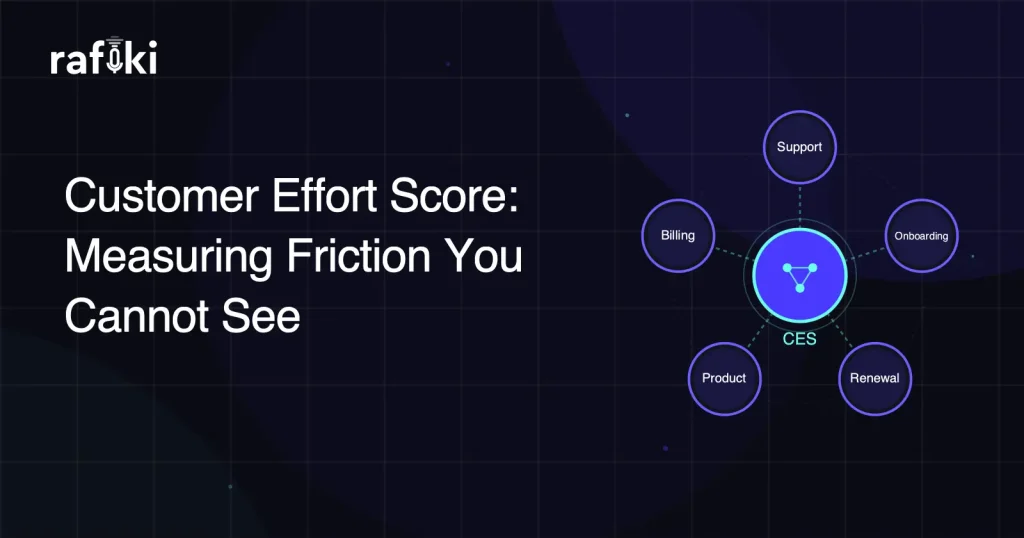
Your customers are not churning because your product failed them — they are churning because doing business with you was too hard.
Somewhere between the third support ticket, the repeated explanation of the same issue to a different rep, and the self-service portal that required six clicks to find a billing answer, your customer decided it was easier to leave than to stay. The frustrating part: nobody on your team saw it coming. Your CSAT scores looked fine. Your NPS was stable. But friction — invisible, cumulative, corrosive friction — was eroding loyalty in conversations and interactions that no one was measuring.
This is the blind spot that customer effort score was designed to expose. While most revenue teams obsess over satisfaction and promoter metrics, the single strongest predictor of future customer behavior is not how delighted someone feels — it is how much work they had to do to get a result. The organizations that understand this distinction in 2026 are the ones protecting and growing their revenue. The rest are watching NRR decline and blaming market conditions.
What Is Customer Effort Score and Why Does It Matter Now
Customer effort score (CES) is a metric that measures how easy or difficult it is for a customer to accomplish a specific interaction with your company — resolving a support issue, completing an onboarding step, upgrading a subscription, or getting an answer to a question. Typically captured through a post-interaction survey asking customers to rate their agreement with a statement like "This company made it easy for me to handle my issue," CES operates on a scale (often 1–7) where lower effort correlates directly with higher retention.
The foundational research behind CES, published in Harvard Business Review, established a counterintuitive insight: reducing effort does more to drive loyalty than exceeding expectations. Delight is expensive and inconsistent. Ease is scalable and measurable. In 2026, with buyer expectations shaped by frictionless consumer experiences, this principle applies even more forcefully in B2B.
- CES predicts repurchase behavior — customers who report low effort are significantly more likely to renew, expand, and refer
- CES captures what CSAT and NPS miss — a customer can be "satisfied" on a survey and still be accumulating frustration from process friction
- CES is interaction-specific — unlike NPS, which captures a broad sentiment, CES isolates the exact touchpoint where friction occurs
- CES is actionable immediately — a low score on a specific interaction tells you precisely where to intervene
The problem is that most organizations either do not measure customer effort score at all, or they measure it in isolation — a survey here, a feedback form there — without connecting effort signals to the actual revenue conversations where friction lives.
The Hidden Cost: What Happens When Effort Goes Unmeasured
Unmeasured friction compounds silently. It does not show up in your pipeline reports or your QBR decks. It hides inside the tone of a customer's voice when they ask "Can you just walk me through this one more time?" It lives in the three-email thread that should have been resolved in one. It accumulates in every handoff where context is lost and the customer has to re-explain their situation.
The consequences are concrete and severe:
- Churn that looks sudden but was not — by the time a customer cancels, the effort-driven frustration has been building for weeks or months across multiple interactions your team never flagged
- Expansion revenue that never materializes — customers who find basic interactions effortful will never voluntarily deepen their engagement; upsell motions die before they begin
- Support cost escalation — high-effort experiences generate repeat contacts; customers who cannot self-serve or resolve issues quickly come back again and again, consuming CS bandwidth
- Negative word-of-mouth that spreads invisibly — unhappy customers do not always complain to you; they complain to peers, in communities, on review sites, damaging pipeline you will never trace back to the root cause
- Rep burnout on the front line — when processes are friction-heavy, your own team absorbs the frustration too; they spend time on avoidable escalations instead of proactive relationship-building
The most dangerous aspect of unmeasured effort is the false sense of security it creates. Your dashboard says retention looks healthy. But inside that number, a segment of customers is one more frustrating interaction away from evaluating alternatives. Without a systematic way to detect effort signals — especially the ones embedded in live conversations — you are flying blind into renewal season.
Beyond the Survey: Where Real Effort Signals Live
Traditional CES measurement relies on post-interaction surveys. These have value, but they suffer from fundamental limitations that growing teams in 2026 cannot afford to ignore.
- Low response rates — survey fatigue means only a fraction of customers respond, skewing data toward extremes (very happy or very frustrated)
- Recall bias — customers filling out a survey hours or days after an interaction reconstruct their experience imperfectly
- Missing the qualitative "why" — a score of 5 out of 7 tells you effort was moderate, but not what caused it or how to fix it
- No coverage of sales-side effort — CES surveys are typically deployed in support contexts, leaving effort friction in sales cycles, onboarding, and renewal conversations completely unmeasured
The richest effort signals are not in survey responses. They are in conversations — the actual words customers use when they interact with your team. Phrases like "I already explained this," "Can someone just tell me what I need to do," "This is taking longer than I expected," or "I've been going back and forth on this" are direct, unfiltered expressions of effort. They are also signals that disappear the moment a call ends, unless you have infrastructure to capture and analyze them at scale.
The Effort Signals Hiding in Your Calls
Every sales call, onboarding session, QBR, and support interaction contains effort indicators that a structured framework can detect. These include:
- Repetition markers — the customer restating context they have already provided in a previous interaction
- Escalation language — requests to speak with a manager or a different department, signaling process failure
- Confusion indicators — questions about next steps, unclear timelines, or contradictory information received from different team members
- Process complaints — direct references to difficulty navigating your systems, portals, contracts, or workflows
- Emotional leakage — tone shifts, sighs, or flat affect that indicate disengagement or frustration even when words remain polite
These signals exist in every customer-facing conversation your team conducts. The question is whether you have a system that can surface them before they become churn risks.
Building a Customer Effort Score Framework That Connects to Revenue
An effective CES program in 2026 goes far beyond deploying a survey tool. It requires connecting effort measurement to revenue outcomes — making effort a first-class metric in your revenue operations, not just a CS dashboard widget.
- Map effort across the entire customer lifecycle — measure friction in sales handoffs, onboarding milestones, support interactions, renewal conversations, and expansion discussions; effort is not confined to one department
- Combine survey data with conversational intelligence — let survey scores provide the quantitative benchmark while conversation analysis provides the qualitative diagnosis
- Segment effort by account value and lifecycle stage — a high-effort experience for a strategic account in the first 90 days of onboarding demands immediate intervention; the same score for a mature, low-touch account may require a different response
- Make effort visible in your CRM — if effort scores and effort-related conversation signals are not surfaced where your reps and CSMs work, they will never act on them
- Close the loop operationally — every high-effort signal should trigger a specific workflow: a follow-up, an internal review, a process change, or at minimum a flag for the account owner
The framework only works if it is continuous and automated. Manual call reviews do not scale. Periodic surveys miss the window of intervention. You need a system that listens to every conversation, scores effort signals in real time, and pushes actionable intelligence to the people who can act on it.
Customer Effort Score vs. NPS and CSAT: Choosing the Right Metric
CES does not replace NPS or CSAT — it fills a critical gap between them. Understanding when to use each metric prevents measurement confusion and ensures your team is acting on the right signals.
- NPS measures relationship-level loyalty — "Would you recommend us?" captures overall brand sentiment but is too broad to diagnose specific friction points
- CSAT measures transaction-level satisfaction — "Were you satisfied with this interaction?" is useful but captures only the emotional surface; a customer can be satisfied with a polite rep yet still frustrated by the three calls it took to reach resolution
- CES measures operational friction — "Was this easy?" gets directly at the process layer that drives both CSAT and NPS over time
The most mature revenue organizations use all three in a layered model: NPS at the account level on a quarterly cadence, CSAT at the interaction level for key touchpoints, and customer effort score at every friction-prone moment in the lifecycle. The trick is not choosing one — it is knowing which metric to prioritize for which decision. When you are diagnosing churn risk or process failure, CES is the metric that gives you something you can fix.
How Rafiki AI Surfaces Effort Signals Across Every Conversation
This is where conversational intelligence transforms customer effort score from a periodic survey metric into a continuous, revenue-connected intelligence layer. Rafiki AI, an AI-native revenue intelligence platform, is built to detect exactly the kind of buried effort signals that surveys miss and manual reviews cannot scale.
Rafiki AI's architecture processes every customer-facing conversation — sales calls, onboarding sessions, QBRs, support escalations — and applies multi-model AI to extract effort indicators alongside deal intelligence, coaching insights, and account health signals. Here is how that translates to CES measurement:
- Smart Call Scoring evaluates every interaction against any sales methodology — MEDDIC, BANT, SPIN, SPICED, GAP, Challenger, Sandler — or custom scoring criteria you define, and also surfaces conversation dynamics that indicate customer friction — repeated objections, unresolved questions, and negative sentiment patterns that point to high-effort experiences
- Smart Call Summary generates structured summaries of every conversation, making it possible for managers and CSMs to spot effort signals without listening to hours of recordings; when a customer expresses frustration about a process, it appears in the summary, not buried in a 45-minute call
- Customer Success workflows powered by Rafiki AI connect these effort signals directly to account records, ensuring that CSMs see friction building before it becomes a churn event; the platform's Smart CRM Sync pushes key insights into Salesforce, HubSpot, Zoho, Pipedrive, or Freshworks automatically — auto-populating both methodology-specific fields and any custom CRM fields your team defines
Because Rafiki AI supports transcription and analysis in more than 60 languages, global teams get effort intelligence across every market — not just English-speaking accounts. And because the platform starts at $19 per seat per month with no seat minimums and no annual contracts, growing teams can deploy it without the procurement overhead that enterprise incumbents require. This is enterprise-grade conversational intelligence at a cost structure that lets you cover every rep, every CSM, and every customer-facing conversation from day one.
Implementing CES: A Practical Rollout for Revenue Teams
Deploying a customer effort score program that actually drives revenue outcomes requires a structured rollout. Here is a phased approach that connects measurement to action:
- Audit your highest-friction touchpoints — map the customer journey and identify the five to seven moments where effort is most likely to be high: first onboarding call, support escalation, contract renewal, feature request follow-up, billing inquiries; prioritize these for initial CES measurement
- Deploy conversational intelligence across all customer-facing teams — start capturing and analyzing every interaction with a platform like Rafiki AI; this gives you the conversation-level data that surveys alone cannot provide
- Establish your CES baseline — run surveys at your priority touchpoints for 30 days while simultaneously reviewing conversation intelligence data; compare what customers report in surveys against what they express in actual calls
- Create effort-triggered workflows — define what happens when a high-effort signal is detected: automatic alerts to the account owner, escalation to a manager, or inclusion in the next team review; use your CRM integration to make these workflows native to where your team already operates
- Correlate effort data with revenue outcomes — after 90 days, analyze the relationship between customer effort scores and renewal rates, expansion revenue, and support ticket volume; this builds the business case for sustained investment in effort reduction
- Review and iterate in QBRs — make customer effort a standing agenda item in your quarterly business reviews; Rafiki AI's Gen AI Reports can auto-generate effort trend analyses across accounts, segments, and time periods, replacing manual slide building with intelligence that updates itself
The key principle: start measuring before you start optimizing. You cannot reduce friction you have not identified. And you cannot identify friction at scale without a system that listens to every conversation.
Turning Effort Data Into a Competitive Advantage
Most companies treat customer effort as a support metric. The real advantage belongs to teams that treat it as a revenue metric — one that informs sales process design, onboarding improvement, product roadmap prioritization, and competitive positioning.
- Sales process optimization — if prospects consistently express confusion or frustration during specific deal stages, your sales process has an effort problem; conversation intelligence reveals whether friction comes from unclear proposals, slow follow-up, or poor handoff between SDRs and AEs
- Onboarding acceleration — high effort during onboarding predicts long-term disengagement; detecting effort signals in onboarding calls lets you intervene in real time instead of discovering the problem at the 90-day check-in
- Product feedback loop — when customers repeatedly express effort around the same feature, workflow, or integration, that signal belongs in your product team's backlog, not just in a support ticket queue
- Competitive differentiation — in markets where product parity is increasing, ease of doing business becomes the deciding factor; Forrester's CX Index frames customer experience quality along three dimensions — ease, effectiveness, and emotion — and ease is the one customers most readily translate into loyalty behaviors
- Retention forecasting — layering effort scores with deal health, engagement data, and sentiment analysis creates a multi-dimensional view of account risk that is far more predictive than any single metric
Rafiki AI enables this multi-dimensional view because its six autonomous AI agents — Smart Call Summary, Smart Follow Up, Smart Call Scoring, Smart CRM Sync, Ask Rafiki Anything, and Gen AI Reports — work in concert across every conversation, producing a unified intelligence layer that connects effort signals to pipeline health, deal progression, and account risk. This is not a survey tool bolted onto a CRM. It is an AI revenue team that operates 24/7, catching the signals your human team cannot.
The Effort Economy: Where CES Fits in 2026 and Beyond
We are entering what some revenue leaders call the effort economy — a market environment where the company that is easiest to buy from, easiest to implement, easiest to get support from, and easiest to renew with captures disproportionate share. Customer effort score is the operating metric for this economy.
- Buyers have more options and less patience — switching costs in SaaS continue to decline; the friction required to trigger a competitive evaluation is lower than ever
- AI raises the baseline expectation — customers who interact with AI-native experiences in other parts of their life expect the same responsiveness, personalization, and effortlessness from every vendor
- Revenue efficiency is the mandate — growing teams cannot afford to lose customers to preventable friction; replacing a churned customer costs multiples of what it costs to retain one
- Conversation data is the new CRM — the most valuable customer intelligence does not live in fields and dropdowns; it lives in what customers actually say, and only AI-native platforms can extract it at scale
Teams that instrument their entire customer lifecycle for effort signals — using conversational intelligence, not just surveys — will see churn earlier, intervene faster, and build the kind of effortless experience that turns customers into advocates. Teams that rely on lagging indicators and gut feel will continue to be surprised by churn they "never saw coming."
Conclusion: Make Effort Visible Before It Becomes Revenue Lost
Customer effort score is not a nice-to-have metric for your CS team's dashboard. It is a revenue-critical signal that touches every stage of the customer lifecycle — from the first sales conversation to the renewal negotiation. The friction your customers experience is real, cumulative, and predictive of whether they stay or go. The challenge has never been whether effort matters. The challenge has been making it visible.
- Surveys alone are insufficient — they capture only a fraction of effort signals and miss the real-time, in-conversation friction that drives behavior
- Effort is a revenue metric, not just a support metric — it belongs in your pipeline reviews, your QBRs, your onboarding playbooks, and your expansion strategy
- AI-native conversational intelligence closes the measurement gap — by analyzing every interaction across every language and every team, platforms like Rafiki AI turn invisible friction into actionable intelligence
- The teams that win in 2026 are the ones that make doing business with them effortless — customer effort score is how you measure whether you are succeeding
The signals are in your conversations right now. The question is whether you have the infrastructure to hear them.
Rafiki AI gives growing revenue teams that infrastructure — AI-native, enterprise-grade, starting at $19 per seat per month with no seat minimums and no annual contracts. Start capturing effort signals across every customer conversation today. Start free or book a demo at getrafiki.ai and turn the friction you cannot see into the intelligence you can act on.