Your NPS score says customers love you — but three of your top accounts just churned without warning.
This disconnect is not rare. It is, in fact, the defining blind spot of modern customer success programs. Teams collect promoter scores religiously, stack them into dashboards, celebrate upward ticks in quarterly all-hands meetings — and still get blindsided by churn that was visible in every conversation for months. The problem is not that NPS is broken. The problem is that NPS customer success strategies treat a lagging indicator as a leading one, then act surprised when it fails to predict the future.
The real signals — frustration, hesitation, competitive evaluation, quiet disengagement — live in the actual words customers say during calls, QBRs, and support interactions. Those signals are granular, time-stamped, and specific. A promoter score is none of those things. Yet most teams still rely on the score alone, leaving an entire layer of actionable intelligence unexamined. The cost is not abstract. It shows up as preventable revenue loss, escalated save motions that arrive too late, and CSMs who only learn about risk when the contract is already dead.
The NPS Paradox: Why High Scores Still Produce Churn
NPS is a relationship metric, first introduced by Fred Reichheld in Harvard Business Review in 2003 as a single-question proxy for customer loyalty. It captures sentiment at a single point in time, typically gated by a survey that most customers either skip or answer reflexively. The structural limitations are well documented: response bias skews toward extremes, survey fatigue depresses sample sizes over time, and the score itself collapses a complex relationship into a single number between negative one hundred and one hundred. None of this means NPS is useless. It means NPS alone is dangerously incomplete.
Consider the common failure mode:
- A customer gives you a 9 during a routine survey cycle — qualifying as a promoter.
- Two weeks later, on a product feedback call, they mention evaluating a competitor's new feature set.
- A month after that, their champion goes silent, cancels a scheduled QBR, and stops responding to emails.
- The NPS score never updates because the next survey is not scheduled for another quarter.
- Renewal comes up. The account is already gone.
The gap between the score and reality is a time gap. NPS captures a snapshot. Conversations capture a trajectory. When your NPS customer success workflow ignores the trajectory, you are operating on stale data and calling it insight.
What Conversation Signals Actually Reveal
Conversation signals refer to the linguistic, tonal, and behavioral patterns embedded in customer interactions — calls, meetings, support tickets — that indicate shifting sentiment, emerging risk, or expansion opportunity. Unlike survey responses, these signals are continuous, unsolicited, and contextually rich.
The categories that matter most for customer success teams include:
- Sentiment drift — a customer whose language shifts from enthusiastic to neutral over three consecutive calls, even when the words themselves remain polite.
- Competitive mentions — any reference to alternative solutions, whether direct ("we're looking at X") or indirect ("some of our teams have been exploring other options").
- Stakeholder disengagement — a champion who stops attending calls, defers to junior team members, or shortens meeting durations.
- Feature-gap frustration — repeated requests for capabilities your product lacks, especially when tied to business-critical workflows.
- Value erosion language — phrases like "we're not sure we're getting the ROI," "leadership is asking questions," or "we need to reevaluate."
Each of these signals is invisible to an NPS survey. Each is clearly visible in a recorded, transcribed, and analyzed conversation. The question is not whether these signals exist — they always do. The question is whether anyone on your team is systematically capturing and acting on them.
The Real Cost of Running NPS in Isolation
When NPS customer success programs operate without conversation intelligence, the consequences compound across the entire revenue engine. This is not a theoretical risk. It is a measurable leak.
- Reactive churn management — CSMs learn about risk only when a customer explicitly says they want to cancel, which is the last possible moment to intervene. Save rates from reactive motions are dramatically lower than proactive ones.
- Missed expansion signals — a customer who says "we're rolling this out to two more regions" on a call is giving you an upsell trigger. If nobody catches it, the expansion either does not happen or goes to a competitor.
- Inaccurate health scores — most health score models weight NPS heavily. When the NPS input is stale or misleading, the entire scoring model produces false confidence. Your "green" accounts are not all green.
- Wasted QBR cycles — without pre-meeting analysis of what customers have actually said across touchpoints, QBRs become generic slide decks instead of strategic conversations. Loyalty programs that rely on satisfaction metrics alone often miss the operational drivers of retention.
The compounding effect is significant. Every quarter you run NPS without pairing it to conversation data, you accumulate a larger gap between perceived account health and actual account health. That gap is where churn hides.
The Pairing Framework: NPS + Conversation Intelligence
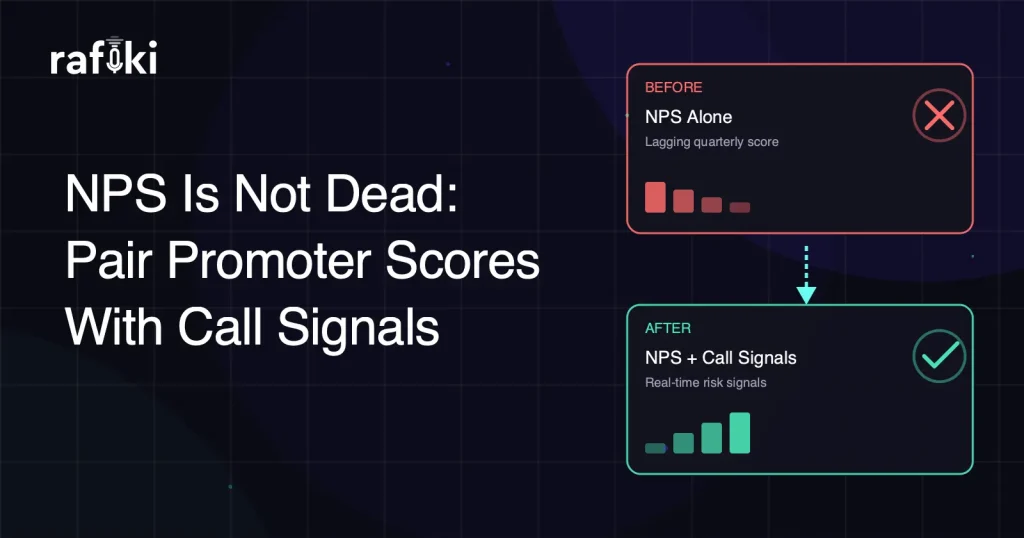
The fix is not to abandon NPS. It is to pair NPS with continuous conversation signals so that the score is contextualized, validated, and enriched by what customers actually say between surveys. This pairing creates a two-layer intelligence model:
- Layer 1: NPS as a baseline — the survey score establishes a starting sentiment benchmark for each account. It answers the question: "How does this customer feel about us in general?"
- Layer 2: Conversation signals as a real-time overlay — call analysis provides continuous, granular updates on whether sentiment is holding, improving, or degrading. It answers the question: "What is actually happening in this relationship right now?"
When both layers are active, you get a health model that is both broad and deep. NPS catches the accounts that are willing to give you explicit feedback. Conversation intelligence catches everything else — including the accounts that never respond to surveys but are telling you exactly how they feel on every call.
Why This Pairing Works Better Than Either Signal Alone
NPS without conversation data is a snapshot without context. Conversation data without NPS lacks a structured baseline for comparison. The pairing resolves both limitations:
- A promoter score of 9 paired with three consecutive calls showing competitive mentions triggers a targeted retention play — something the NPS score alone would never prompt.
- A detractor score of 4 paired with call data showing increasing engagement, feature adoption discussions, and positive sentiment drift suggests the score is stale and the relationship is actually recovering.
- A passive score of 7 paired with declining call attendance and shorter meeting durations confirms the risk that the score hints at but does not explain.
This is how modern NPS customer success programs should operate — not as survey-driven workflows, but as multi-signal intelligence systems that treat every customer interaction as a data point.
Building the Signal-to-Action Pipeline
Pairing NPS with conversation signals only matters if the combined intelligence drives specific actions. The goal is not a richer dashboard. The goal is a faster, more accurate path from signal detection to customer outcome. The pipeline has four stages:
- Capture — every customer-facing conversation is recorded, transcribed, and analyzed automatically. No manual note-taking. No selective logging. Full coverage.
- Classify — AI models tag each conversation with sentiment scores, topic categories, risk indicators, and opportunity signals. These classifications are mapped to existing NPS data at the account level.
- Correlate — the system identifies patterns across time. Is sentiment declining despite a high NPS score? Are competitive mentions increasing in a specific segment? Is a particular product issue driving detractor scores?
- Act — triggers fire automatically. A CSM gets alerted when a promoter account shows three risk signals in two weeks. A manager gets a report showing which accounts have the largest gap between NPS score and conversation sentiment.
This pipeline requires two things most teams lack: comprehensive conversation capture and AI-native analysis that runs without manual intervention. Legacy tools bolt on basic transcription as an afterthought. That approach produces transcripts, not intelligence. The distinction matters.
How Rafiki AI Powers NPS-Conversation Pairing
Rafiki AI is an AI-native revenue intelligence platform built from day one on multi-model AI architecture. It does not treat conversation analysis as a feature add-on. It treats every customer interaction as a source of structured revenue intelligence — which is exactly what NPS customer success programs need to move beyond survey dependence.
Here is how the platform enables the pairing framework:
- Smart Call Scoring — Rafiki AI's Smart Call Scoring evaluates every call against any sales methodology — MEDDIC, BANT, SPIN, SPICED, GAP, Challenger, Sandler — or your own custom scoring criteria. For customer success, this means every QBR, check-in, and renewal call is scored for engagement quality, risk signals, and expansion indicators — not just sales qualification.
- Ask Rafiki Anything — Rafiki AI's Gen AI Search lets CS leaders ask natural-language questions across their entire conversation library. Queries like "Which promoter accounts mentioned competitors in the last 90 days?" return instant, structured answers. No manual review. No guesswork.
- Smart Call Summary and Smart Follow Up — every conversation generates an automatic summary with action items, risk flags, and key topics. Follow-up emails are drafted autonomously. This ensures no signal gets lost between the call and the CRM.
- Smart CRM Sync — conversation intelligence flows directly into Salesforce, HubSpot, Zoho, Pipedrive, and Freshworks. Rafiki AI auto-populates both methodology-specific fields (for whichever framework your team uses) and any custom CRM fields you define — so NPS data sitting in your CRM is now paired with structured conversation signals in the same account view.
- 60+ language transcription — for global CS teams, Rafiki AI transcribes and analyzes conversations in over 60 languages, ensuring signal capture is not limited to English-speaking accounts.
Rafiki AI's six autonomous AI agents — including Gen AI Reports for automated QBR preparation — work 24/7 to surface the signals that NPS surveys miss. The platform starts at $19 per seat per month with no seat minimums and no annual contracts, making it accessible to growing CS teams that need enterprise-grade intelligence without enterprise procurement cycles.
Implementation: A Phased Rollout for CS Teams
Pairing NPS with conversation signals does not require ripping out your existing survey program. It requires layering intelligence on top of it. Here is a practical phased approach:
- Week 1-2: Establish conversation capture — connect your meeting platforms (Zoom, Teams, Google Meet) to your conversation intelligence platform. Ensure every customer-facing call is automatically recorded and transcribed. Set a policy: no customer call goes unrecorded.
- Week 3-4: Map NPS data to accounts — export your current NPS scores into your CRM and ensure account-level tagging is clean. You need a single view where each account has both its NPS score and its conversation history.
- Week 5-6: Define signal categories — work with your CS leadership to define which conversation signals matter most. Start with the five categories outlined earlier: sentiment drift, competitive mentions, stakeholder disengagement, feature-gap frustration, and value erosion language. Configure your AI models to tag these automatically.
- Week 7-8: Build the gap report — create a recurring report that shows accounts where NPS score and conversation sentiment diverge. This is your "hidden risk" report. Prioritize these accounts for immediate CSM attention.
- Week 9-12: Operationalize triggers — set automated alerts for specific signal combinations. A promoter account with two or more risk signals in a 30-day window gets escalated. A detractor account with improving conversation sentiment gets flagged for re-survey. Build these triggers into your existing CS workflow, not a separate system.
The entire rollout takes one quarter. By the end, your team has a living intelligence layer that makes NPS actionable instead of decorative.
Metrics That Prove the Pairing Works
Once the paired system is running, you need to measure its impact. The metrics that matter are:
- Signal-to-action time — how quickly does a detected risk signal result in a CSM action? The target is under 48 hours from signal detection to outreach.
- Prediction accuracy — what percentage of accounts flagged by the paired model actually churn or downgrade? Compare this to your NPS-only prediction accuracy. The delta is your intelligence gain.
- Proactive save rate — of accounts flagged early by conversation signals (before the NPS score reflected risk), what percentage were successfully retained? This is the metric that proves conversation pairing catches what surveys miss.
- Expansion capture rate — how many upsell or cross-sell opportunities surfaced from conversation signals were converted? This is the offensive side of the equation — the revenue that conversation intelligence creates, not just protects.
- NRR correlation — track your net revenue retention rate before and after implementing the paired model. NRR is the outcome metric that aggregates all the leading indicators.
Teams that combine multiple data sources for customer intelligence tend to build more reliable health models than those relying on a single metric. The NPS-conversation pairing is a direct application of that principle.
The Competitive Edge: Why This Matters Now
In 2026, the CS landscape is splitting into two camps. The first camp continues running NPS customer success programs the way they have for a decade — quarterly surveys, static health scores, reactive interventions. The second camp pairs NPS with AI-powered conversation intelligence to build continuous, multi-signal health models that detect risk and opportunity in real time.
The gap between these two camps is widening every quarter. Here is why:
- Customer expectations have shifted — buyers expect their vendors to already know what is working and what is not. They do not want to fill out surveys to tell you things they have already said on calls.
- AI-native platforms have democratized conversation intelligence — what once required six-figure enterprise contracts and months of implementation is now available to growing teams at a fraction of the cost with same-day setup. Rafiki AI's 15-minute setup and no-minimum pricing is a direct example of this shift.
- Revenue teams are consolidating signals — the best CS teams in 2026 are not running NPS in one tool, call recording in another, and health scoring in a third. They are consolidating into platforms that unify every customer signal into a single intelligence layer.
The teams that pair NPS with conversation signals will retain more customers, expand more accounts, and operate with a level of foresight that survey-only teams simply cannot match. NPS is not dead. But NPS alone is a liability.
Conclusion: NPS Is the Starting Line, Not the Finish
NPS remains a valuable baseline metric. It gives you a structured, comparable measure of customer sentiment that is easy to benchmark and track over time. But treating NPS as the complete picture of account health is the mistake that costs CS teams their most winnable renewals. The signal that predicts churn is almost never the survey response. It is the sentence a customer says on a Wednesday afternoon call that nobody reviews.
Pairing promoter scores with conversation signals closes that gap. It turns NPS from a lagging indicator into a contextualized, real-time intelligence input. It gives CSMs the specificity they need to intervene early, expand strategically, and build the kind of proactive customer relationships that drive NRR growth. The framework is clear. The technology exists. The only question is whether your team adopts it before the gap between what you know and what your customers are actually saying becomes too wide to close.
Rafiki AI gives growing customer success teams the AI-native conversation intelligence layer that makes NPS actionable — with enterprise-grade insight at a fraction of enterprise cost. No seat minimums. No annual contracts. Setup in 15 minutes. Start free or book a demo at getrafiki.ai and see what your NPS scores are not telling you.