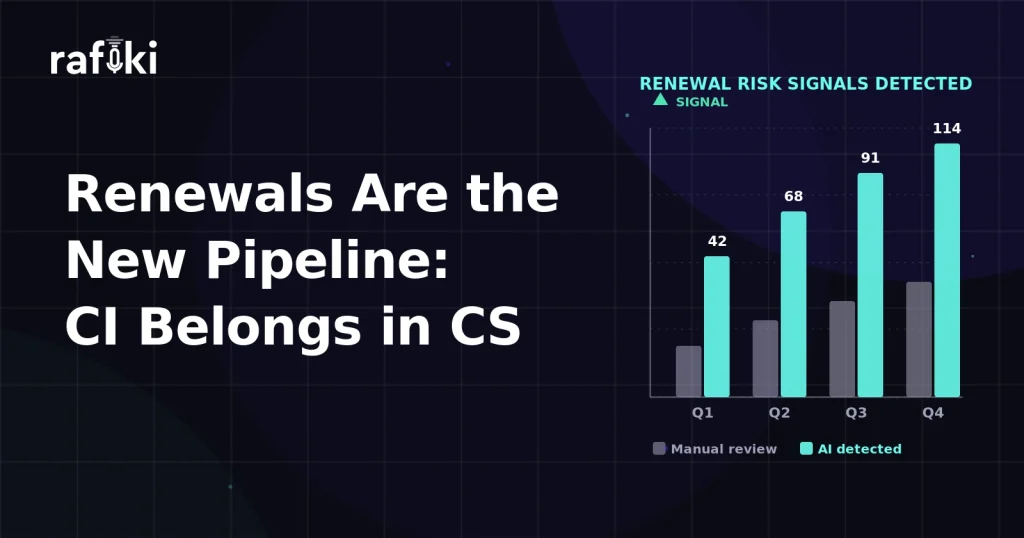
For most SaaS companies in 2026, the next dollar of revenue is no longer hiding in net-new pipeline — it's sitting inside a renewal conversation your CSM just had and nobody else will ever review.
Net revenue retention has quietly become the single most important number on a SaaS board deck. When growth markets tighten, investors stop rewarding raw bookings and start scrutinizing how much of last year's ARR you actually kept, expanded, or lost. The math is brutal and simple: a company at 120% NRR doubles every four years without adding a single new logo. A company at 85% NRR has to outrun its own churn just to stay flat. That gap doesn't show up in pipeline reviews — it shows up in renewal conversations.
And yet, in most revenue organizations, the renewal conversation is the most under-instrumented part of the entire customer lifecycle. Sales teams have spent a decade investing in conversation intelligence — call recording, scoring, coaching, CRM auto-sync. Customer success teams, by contrast, often run on quarterly business review decks, gut-feel health scores, and a CSM's hand-typed notes from the last check-in. The conversation that decides whether $400,000 of ARR stays or walks is treated as ephemeral. That has to change.
Most customer success teams have been recording calls for years. The meeting platform auto-records every QBR. A legacy notetaker captures the executive review. The recording sits in a folder. Occasionally a CSM scrubs through it to remember what the customer said. Almost nobody analyzes it systematically. The renewal conversation — the single richest source of churn risk, expansion opportunity, and product feedback in the entire business — is being archived, not analyzed.
The consequence is that customer success leaders run their function on lagging indicators. By the time a red health score appears in the CRM, the customer has already mentally checked out. By the time a CSM raises a churn risk in a forecast meeting, the executive sponsor has already left. The signal was in the conversation eight weeks earlier — it just wasn't extracted.
This is not a CSM effort problem. CSMs are doing the work. The problem is that the work product — the conversation itself — is being treated as a transcript instead of a data set.
Every quarter you delay instrumenting the renewal conversation, three things compound against you. Churn surprises increase. Expansion deals get missed. And your renewal forecast — the number that determines your valuation — stays stubbornly opinion-based. Recent Harvard Business Review analysis on human-AI collaboration in revenue teams reinforces what most CS leaders already sense: the signal that matters most for retention lives in qualitative conversation, not in survey scores or stage fields.
Consider what's actually at stake. A customer's exec sponsor mentions in a QBR that their company is "reorganizing the team next quarter." The CSM nods, takes a note, moves on. Six weeks later, the sponsor is gone, the new owner has never heard of you, and a renewal that was supposed to be a layup turns into a competitive defense. That sentence — "reorganizing the team" — was the most important signal in the entire account that quarter, and it died in a Zoom recording nobody re-watched.
The harder truth: customer success is now revenue-generating, not service-delivering. Salesforce's State of Service research has documented how service and success organizations are increasingly measured on revenue outcomes — retention, expansion, and lifetime value. If CS is a revenue function, it needs revenue-grade instrumentation. Right now, in most companies, it doesn't have it.
The old org chart treated customer success as a post-sale cost center. Pipeline was sales' job. Retention was CS's job. The two functions used different tools, different data, and different definitions of "the conversation." That separation made sense when net-new bookings were the dominant growth lever. It stopped making sense the moment NRR became the headline metric on the board deck.
In 2026, the highest-leverage revenue conversations in most SaaS companies aren't first calls — they're renewal calls. The renewal conversation has more revenue at stake per minute than almost any net-new opportunity, with higher win probability and lower acquisition cost. Treating it as a service interaction is a strategic mistake. Treating it as a revenue conversation, with the same intelligence, coaching, and CRM rigor as a closing call, is the move.
This is not a tooling shift. It's a category shift. Conversation intelligence is not a sales tool that happens to also work for CS. It is a customer success tool that historically got marketed to sales first because that's where the early budgets were. The vendors that recognize this — and CS leaders who push for it — are reshaping how renewals get forecast, defended, and grown.
A single renewal conversation contains dozens of structured signals about the health, sentiment, and trajectory of the account. Most of them go uncaptured. The vocabulary the customer uses, the questions they prioritize, the executive who joins or doesn't join, the way they describe their roadmap relative to yours — all of it is structured data wearing the costume of unstructured speech.
Effective conversation intelligence for customer success means systematically extracting these signals from every QBR, every check-in, every executive review — and rolling them up across the cohort so leaders can see patterns no individual CSM could spot.
These signals are buried in every renewal call. Most CS organizations are sitting on years of recorded conversations that contain a near-perfect map of their retention trajectory — and most of that data is functionally inert. Forrester's customer experience research has been making this point for years: the gap between what customers say and what companies hear is overwhelmingly a measurement problem, not an empathy problem.
Rafiki AI is an AI-native revenue intelligence platform built to make every customer-facing conversation — pre-sale or post-sale — into structured, actionable signal. For customer success leaders, that means treating QBRs, executive reviews, and check-ins with the same rigor your sales team applies to discovery calls. The same autonomous AI agents that score sales calls can score renewal calls. The same CRM auto-sync that updates Salesforce opportunity fields can update Gainsight or HubSpot health scores. The infrastructure is the same. The application changes.
The platform's autonomous AI agents work as a 24/7 customer success team. Each capability below targets a specific gap in how most CS organizations operate today:
Because Rafiki AI is AI-native — built on multi-model architecture rather than retrofitted from a legacy recorder — it handles the linguistic nuance that renewal conversations require. It supports 60+ languages, integrates natively with Salesforce, HubSpot, Zoho, Pipedrive, Freshworks, and Monday.com on the CRM side, Zoom, Microsoft Teams, and Google Meet on the meetings side, plus Slack, Aircall, and OpenPhone for messaging and dialing — and starts at $19/seat with no seat minimums, no annual commitment, and 15-minute setup. CS leaders don't need to fight for a separate budget cycle or rip out their existing stack.
The single highest-leverage move a CS leader can make is to score every QBR and renewal conversation against a structured rubric — the same way sales teams score discovery calls against MEDDIC, BANT, or SPICED. Scoring forces consistency. It makes risk visible. And it turns coaching into a data exercise instead of a vibe exercise.
A useful renewal scoring rubric usually has five dimensions: sponsor engagement, value realization evidence, expansion surface, risk signals, and forward commitment. You don't need a CSM to score these by hand. Smart Call Scoring evaluates every recording against whatever rubric you define.
Once every conversation is scored, patterns emerge fast. Accounts with three consecutive QBRs scoring below threshold on sponsor engagement are renewal risks regardless of the green health score in the CRM. Accounts with rising expansion scores are pipeline the AE should be looped into. The data was always there. Scoring makes it operational.
Most CS organizations don't coach CSMs the way sales organizations coach AEs. Sales managers review call recordings, score them against methodology, run role-plays, and build a feedback loop. CS managers tend to coach on outcomes — renewal numbers, churn rates, NPS — which are lagging indicators that arrive too late to change behavior. The result is that CSM execution varies wildly across the team and the top performer's playbook never gets distributed.
Conversation intelligence flips this. With every renewal conversation captured, transcribed, and scored, a CS manager can run the same coaching loop that has worked in sales for a decade. The Coaching Agent surfaces specific moments in specific conversations — the missed expansion signal, the unaddressed objection, the weak forward commitment — and packages them into coachable feedback. Role-play scenarios get built from real renewal language, not generic templates.
The CSMs who get this kind of structured coaching close more expansion, defend more renewals, and ramp new hires faster. The infrastructure required to deliver it is the same infrastructure sales has been using — just pointed at a different conversation.
The endgame of conversation intelligence in CS is a renewal forecast that's grounded in evidence, not opinion. Today, most renewal forecasts are built from CSM-entered health scores, manual risk flags, and a quarterly review of the book. The signal is noisy, late, and biased toward optimism. McKinsey research on sales and growth has consistently found that forecast accuracy is one of the highest-leverage improvements a revenue organization can make — and the same is true for renewal forecasting in CS.
With Gen AI Reports rolling up conversation signals across the cohort, the renewal forecast starts to look more like a sales forecast: stage-based, evidence-backed, and continuously updated as new conversations happen. A renewal isn't "at risk" because a CSM marked it amber — it's at risk because three QBRs in a row scored below threshold on sponsor engagement, the executive sponsor went silent, and a competitor name appeared in the last conversation. That's a forecast you can defend in a board meeting.
This is the version of customer success operations that most boards now expect: data-driven, conversation-grounded, and tightly integrated with the rest of the revenue stack. Getting there doesn't require a multi-year transformation. It requires applying tools that already exist on the sales side to the post-sale conversation.
You don't need to rebuild the customer success organization to get the value of conversation intelligence. A focused 90-day rollout, sequenced around capture, scoring, and coaching, produces visible results in a single quarter.
By day 90, your CS organization will have what most don't: a structured, scored, conversation-grounded view of renewal risk and expansion opportunity that updates in real time as new conversations happen. The forecast gets defensible. The coaching gets specific. And the conversation that determines whether $400,000 of ARR stays or walks finally gets the attention it always deserved.
Customer success is no longer a service function. It is the highest-leverage revenue function in most SaaS businesses, and the renewal conversation is where that revenue is made or lost. The companies that win in 2026 will be the ones that stop treating QBRs as recordings nobody re-watches and start treating them as the structured signal source they actually are.
The infrastructure is there. The sales team has been using it for years. Conversation intelligence for customer success isn't a new category — it's an obvious application of an existing one, finally getting deployed where it should have lived from the start.
The CS leaders moving on this right now are going to have a quantifiable, conversation-grounded view of their book of business while their peers are still updating health scores on a Friday afternoon. The window to build this capability before it becomes table stakes is open — but it is closing as fast as the renewal cycle itself.
See how Rafiki AI for customer success leaders helps CS organizations turn every QBR and renewal conversation into structured signal — with renewal-aware call scoring, automatic health score sync, CSM coaching, and cohort-level renewal forecasting. Explore the full Rafiki AI product overview to see how autonomous AI agents work across the entire revenue motion. Starting at $19/seat with no seat minimums, no annual commitment, and 15-minute setup — enterprise-grade renewal intelligence without enterprise-grade lock-in.
Start for free — no credit card, no seat minimums, no long contracts. Just better sales intelligence.