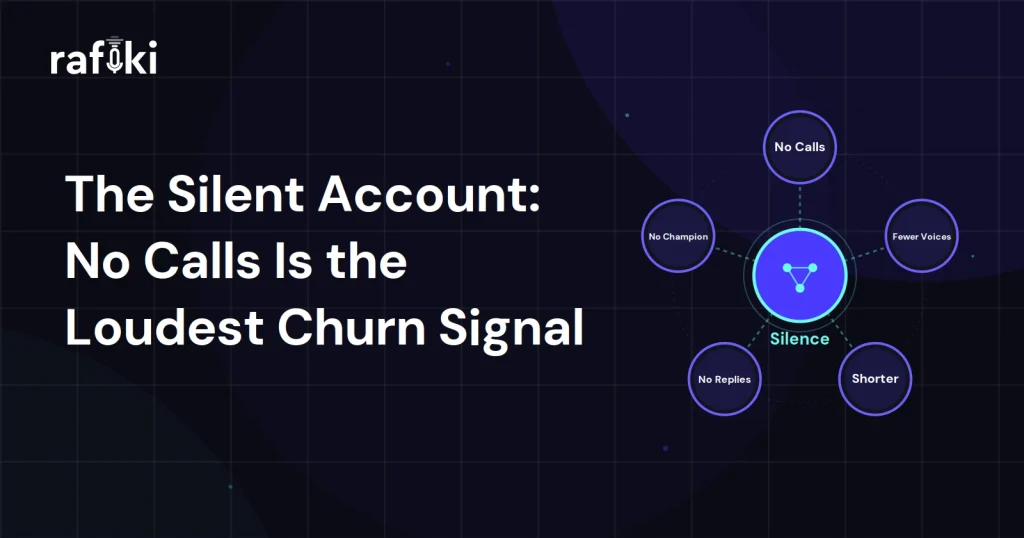
The renewal is in January. The health score is green. Usage is steady, tickets are quiet, and the CSM's notes say "no concerns." Then the procurement email arrives in November: the customer has decided not to renew. It was a silent account, and nobody noticed.
In the post-mortem, someone pulls up the account timeline and notices what nobody flagged at the time. The last recorded call with this customer was in May. By June, the champion had stopped replying. Over the summer, the two meetings that did happen were fifteen minutes long, with one person on the customer side instead of the usual four. It was telling you everything, in the only language it had left.
Customer success teams have gotten much better at reading signals inside conversations: sentiment shifts, unresolved objections, competitor mentions, the champion who suddenly sounds cautious. However, all of that intelligence assumes the conversation is happening. The most dangerous accounts are the ones that have stopped talking to you, and almost no health model treats the absence of conversation as data. Silence is coded as "no news," and no news gets coded as good.
This article is about the silent account: what it looks like, why it hides inside healthy-looking metrics, the five patterns of silence that predict churn, and how to build a silence baseline so that a quiet account triggers a response instead of a shrug. It matters most right now, in the run-up to renewal season, when every account that is not talking to you is being worked by someone who is.
A silent account is a customer whose conversational engagement with your team has dropped meaningfully below its own historical baseline, without a stated reason. It is not the same as a low-touch account, which may never have needed frequent contact, and it is not the same as an unhappy account, which is usually quite vocal. The silent account used to talk to you, and now it does not.
Silence is measured against the account's own pattern rather than an absolute threshold. An enterprise customer that ran biweekly working sessions and now cannot find time for a monthly check-in is silent. A small customer that has always done one call a quarter is not, even though the raw number of calls is lower. This is why silence is invisible in most dashboards: they count activity, not deviation.
The defining feature is that the reduction is unexplained. Customers who go quiet for a legitimate reason usually say so: a reorg, a busy season, a hiring freeze. Customers who go quiet because they are disengaging, evaluating alternatives, or losing their internal sponsor almost never announce it. The silence is the announcement.
Why do health scores miss silence? Because the inputs most health models rely on continue to look fine long after the relationship has started to fail. The mechanics are worth understanding, since they explain why adding another usage metric will not solve the problem.
Forrester's customer experience research treats the quality of each interaction, rather than the count of interactions, as the driver of loyalty. The corollary for CS teams is uncomfortable: an absence of complaints is not evidence of satisfaction. The silent account is that mistake with a renewal date attached.
The direct cost of a silent account is the churned renewal. The larger cost is what it does to the rest of the portfolio. Because silent accounts do not generate work, CS capacity flows to the accounts that do: the loud ones, the expanding ones, the ones with open tickets. Meanwhile, the accounts most at risk receive the least attention, and the team discovers the problem at the moment it becomes unfixable.
Renewal season amplifies this. In the weeks before a renewal wave, a CS team is triaging dozens of renewals at once, and the natural sort order is "who is talking to us about it." A customer that has gone quiet since spring does not surface in that sort. By the time someone reaches out in earnest, the customer has already had the internal conversation, and the CSM is arguing with a decision rather than shaping one.
Salesforce's State of the Connected Customer research consistently finds that customers expect companies to anticipate their needs and to act on what they have already communicated. A silent account has communicated something. The question is whether anyone on your side is set up to hear it.
Silence is rarely total. In practice it shows up as a set of patterns, each of which can be measured against the account's own history. Learning to read them separately matters, because they carry different meanings and call for different responses.
The cadence of recorded conversations slows. A biweekly working session becomes monthly, then "let's reconnect next quarter." Reschedules go up before cancellations do; a customer who moves the same meeting three times is telling you the meeting has lost priority. Meeting decay is the earliest and most reliable pattern because it precedes every other form of disengagement.
The meetings still happen, but fewer people come. The VP who used to join the quarterly review sends a delegate; the delegate then sends nobody. Attendance thinning is a stakeholder signal: the people with the power to renew have stopped investing their time, which usually means they have stopped seeing the outcome as theirs to protect.
The calls get shorter and shallower. Agenda items are covered without discussion, questions from your side get one-word answers, and the customer no longer brings problems of their own to solve. Compression is easy to miss in a calendar view because the meeting exists. It is only visible in the conversation itself.
Follow-ups sit unanswered for longer, then get answered by someone junior, then stop getting answered at all. Response lag on its own can be noise. Combined with meeting decay or attendance thinning, it confirms that the relationship has moved from active to passive on the customer's side.
The most acute pattern: the person who brought you in stops appearing in any conversation. Sometimes they have left the company; sometimes they have been reassigned; sometimes they have simply stopped advocating. In every case, the account has lost its internal voice, and silence from the champion tends to become silence from the account soon after. Champion loss is one of the twelve conversation red flags we catalogued in our guide to renewal risk signals; what makes it different here is that you detect it by absence rather than by anything said.
A silence baseline is the account-specific pattern of conversational engagement against which deviations are measured. Without one, silence is a matter of CSM intuition. With one, it becomes a signal that can be tracked across the whole portfolio.
Building the baseline requires the conversation record to be complete, which is the first place most teams fall short. If only some calls are recorded and summarized, the baseline is fiction. A conversation intelligence platform that captures every customer meeting and phone call, across video and dialer, is the prerequisite. From there, the baseline is built in four steps:
The output is a portfolio view where accounts are sorted by silence, not by activity. That single change reorders a CS team's week: the accounts that appear at the top are the ones nobody has been working, which is exactly the point.
Detecting silence is only useful if the response is right. The instinct to send a "checking in!" email is precisely wrong, because it asks the customer to do the work of re-engaging. The re-entry call is a deliberately designed conversation that gives the customer a reason to show up.
Run well, a re-entry call either restarts the relationship or surfaces the decision early enough to influence it. Both outcomes beat discovering the churn in a procurement email.
Rafiki AI is built to make the silent account visible, because it captures and analyzes every customer conversation rather than the ones a CSM remembers to log. Meetings and phone calls alike are recorded, transcribed in more than sixty languages, and structured into signals, which means the account's conversational signature exists as data from day one.
The five patterns of silence map directly onto what Rafiki AI already measures. Stakeholder participation mapping shows who attended each conversation and how much each person contributed, so attendance thinning and champion disappearance surface as trends rather than anecdotes. Call duration and talk patterns are captured for every conversation, so conversation compression is visible without relistening. Because every conversation is timestamped and attributed, meeting decay is a query, not a hunch.
For the portfolio view, Gen AI Reports lets a customer success leader build a standing report in plain language that brings conversation cadence, participation, sentiment, and unresolved-blocker signals together for the accounts renewing next, which is the raw material for the silence baseline described above. Gen AI Search answers the questions that matter before renewal season: which accounts renewing in Q1 have had no conversation with a decision-maker since spring, or which champions have not appeared on a call in the last two quarters.
When the re-entry call happens, Smart Call Summary captures what the customer said about what changed, and Smart Follow Up drafts the next step so the restart does not stall on your side. Rafiki AI's autonomous AI agents keep listening across the whole book of business, so the quiet accounts stop being the ones that get forgotten. The platform's customer success workflows are designed to make silence a trigger rather than a blind spot.
| Dimension | Activity-based CS | Silence-aware CS |
|---|---|---|
| What gets attention | Accounts generating work | Accounts deviating from baseline |
| No news | Good news | A signal to investigate |
| Health score inputs | Usage, tickets, NPS | Plus conversational engagement |
| Champion change | Noticed at renewal | Flagged when they stop appearing |
| Unit of measurement | Touch count | Deviation from the account's own normal |
| Renewal-season triage | Who is talking to us | Who has stopped |
| First response | "Checking in" email | Designed re-entry call |
Individual silent accounts are a CSM problem. The share of the portfolio that is silent is a leadership problem, and it deserves a place next to NRR and gross retention on the CS dashboard. A rising silence share in the two quarters before a renewal wave is the earliest warning most teams will ever get.
Treated as a portfolio metric, silence also changes how CS capacity is planned. If a meaningful fraction of accounts have gone quiet, the answer is not more check-in emails; it is a structured re-entry program, run in the window before renewal conversations begin. September is that window for a January renewal wave. The accounts that are silent today are the ones deciding your Q1 retention number right now, whether or not anyone on your team is in the room.
Customer success has learned to read the signals inside conversations. The next skill is reading the absence of conversation itself. The silent account is not neutral, and no news is not good news; it is the sound of a customer who has stopped investing in a relationship they have already begun to leave. Build the baseline, measure deviation rather than activity, weight the five patterns together, and respond with a designed re-entry call instead of a hopeful email.
Rafiki AI turns that discipline into a standing capability, with autonomous AI agents that capture every conversation, map every stakeholder, and surface the accounts that have gone quiet before the renewal decides itself. The loudest churn signal in your portfolio is silence. Go find out who has stopped talking.
A silent account is a customer whose conversational engagement has dropped well below its own historical pattern without a stated reason. It differs from a low-touch account, which may never have needed frequent contact, and from an unhappy account, which usually complains. The key is deviation from the account's own baseline: fewer meetings than it used to hold, fewer and more junior attendees, shorter and shallower conversations, slower replies, and a champion who has stopped appearing. Because usage and support metrics often stay stable long after a customer has decided to leave, silent accounts typically look healthy on a traditional health score until the renewal is already lost.
Most health scores are built from usage data, support tickets, and survey responses, all of which lag the customer's actual intent. A team that has decided to switch vendors keeps using the product until the replacement is ready, files fewer tickets because they have stopped expecting improvements, and rarely fills in a survey. Meanwhile, the CSM field that says "healthy" stays green because nobody has spoken to the account and there is nothing new to record. Health models treat the absence of information as the presence of good information. Adding conversational engagement as a first-class input, measured against each account's own baseline, is what closes the gap.
Avoid the "checking in" email, which asks the customer to do the work. Instead, design a re-entry call. Lead with the business outcome the customer described in the last substantive conversation, quoting them where possible. Bring something new: a relevant capability, an observation from their own usage, or an honestly sourced peer insight. Ask the silence question once and directly, since most customers answer plainly when asked. Finally, rebuild the stakeholder map; if the champion has gone, the real goal of the call is to identify and reach the person who now owns the outcome. Either the relationship restarts or the decision surfaces early enough to influence.
At least one to two quarters before the renewal wave, which for a January cohort means starting in September. Silence accumulates slowly, and the patterns that predict churn (meeting decay, attendance thinning, conversation compression, response lag, and champion disappearance) are visible well before the customer's internal decision is final. Running a portfolio-level silence review at the start of Q4, sorted by deviation from each account's baseline, gives the team time to run structured re-entry calls while the outcome can still be shaped rather than argued with.
Rafiki AI's conversation intelligence platform starts at $19 per seat per month with no minimums and no annual commitment. Start your free trial today or book a demo to find the silent accounts in your book before renewal season finds them for you.
Start for free — no credit card, no seat minimums, no long contracts. Just better sales intelligence.