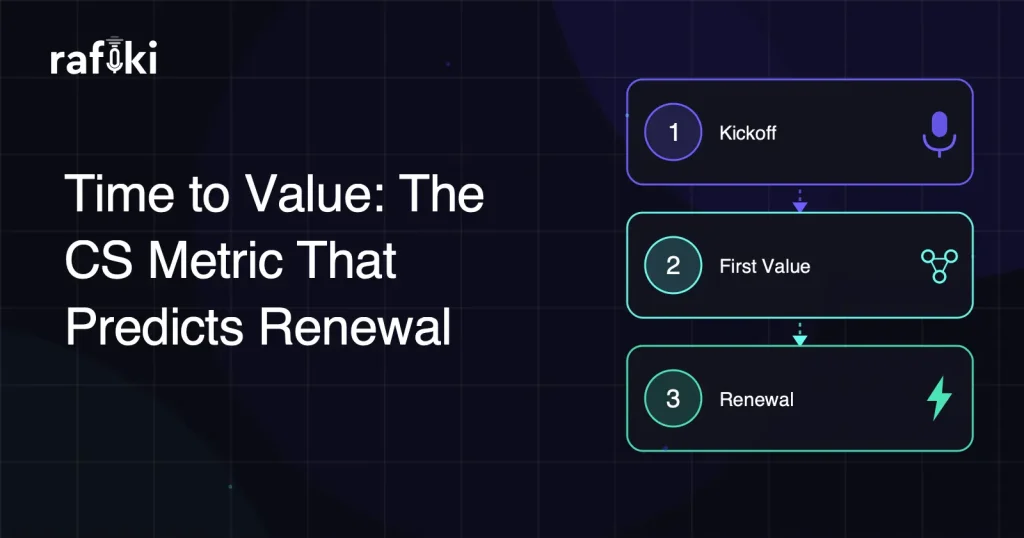
Customer churn rarely announces itself at renewal — it starts the moment a buyer wonders why they signed the contract in the first place.
That moment of doubt does not show up in your CRM. It does not trigger an alert in your ticketing system. It lives in the silence between onboarding calls, in the features never adopted, in the champion who stops returning emails three weeks after kickoff. By the time your CS team notices, the customer has already made an emotional decision to leave. The paperwork is just a formality.
The metric that captures this invisible erosion is time to value — the elapsed duration between a customer signing the deal and experiencing the first meaningful outcome your product promised. In 2026, with net revenue retention under intense scrutiny and expansion budgets tightening, time to value is no longer a nice-to-have operational measure. It is the single strongest leading indicator of whether a customer will renew, expand, or quietly disappear from your book of business.
Why Time to Value Has Become the Defining CS Metric in 2026
Time to value is the period between contract execution and the point at which a customer achieves a predefined, meaningful outcome — sometimes called the "aha moment." It is not time-to-login, time-to-first-session, or time-to-complete-onboarding. Those are activity metrics. Time to value is an outcome metric: the customer received something they could not get before purchasing your product.
Several forces have made this metric decisive for modern CS organizations:
- Shorter evaluation cycles — Buyers in 2026 expect quick wins. When time to value stretches beyond expectations, they begin evaluating alternatives before the first QBR.
- Board-level NRR pressure — Investors scrutinize net revenue retention as a proxy for product-market fit. Slow TTV compresses expansion windows and erodes NRR.
- Multi-threaded buying committees — The champion who signed is rarely the only stakeholder who matters at renewal. Every delayed outcome is ammunition for internal skeptics.
- Usage-based pricing proliferation — When revenue correlates with adoption, a long TTV directly depresses recognized revenue, not just renewal probability.
Customer experience quality has become a decisive driver of B2B revenue growth, and TTV is one of the most actionable levers within that experience. The classic retention-economics research by Harvard Business Review makes the case cleanly: acquiring a new customer costs anywhere from five to twenty-five times more than retaining an existing one. If your CS team cannot articulate the average TTV for each customer segment — and does not have a plan to compress it — renewal forecasts are guesswork.
The Hidden Cost of Ignoring Time to Value
Most CS teams track adoption dashboards, CSAT scores, and health scores. These are lagging indicators. They tell you what has already happened. Time to value is a leading indicator — it tells you what is about to happen. The consequences of ignoring it cascade across the entire revenue engine.
- Silent churn builds pipeline debt — Every churned account forces your sales team to replace revenue before growing it. Slow TTV creates a tax on new business that nobody budgets for.
- Champion credibility erodes — Your internal champion staked their reputation on the purchase. When value delivery stalls, they stop advocating — and stop taking your CSM's calls.
- Expansion conversations die — You cannot upsell a customer who has not yet realized the value of their initial purchase. Long TTV shrinks the expansion window to near zero.
- Support costs spike — Customers stuck in a value gap generate more tickets, more escalations, and more executive fire drills. Your CS team becomes reactive instead of strategic.
- Competitive vulnerability increases — Every week without realized value is a week competitors have to position a faster alternative.
The pattern is predictable: slow TTV leads to low adoption, low adoption leads to low health scores, low health scores lead to at-risk flags, and at-risk flags lead to desperate save attempts at renewal. By then, the outcome is statistically determined. The renewal was won or lost in the first weeks after go-live.
Defining Time to Value: First Value vs. Full Value
One reason CS teams struggle with TTV is that they conflate two distinct milestones. Separating them changes how you measure, how you staff, and how you intervene.
Time to First Value (TTFV)
Time to first value is the interval from contract signature to the customer's first tangible win. This is not feature activation — it is an outcome the customer recognizes and can articulate. For a revenue intelligence platform, TTFV might mean the first deal insight surfaced from a recorded call. For an analytics tool, it might mean the first dashboard that changes a decision.
- TTFV should be measured in days, not weeks. If it stretches beyond expectations for your product category, your onboarding process needs redesign.
- TTFV is a strong predictor of early adoption rates.
- The definition of "first value" must be agreed upon with the customer during the sales handoff — not invented by CS after the fact.
Time to Full Value (TTFV-Complete)
Time to full value is the interval from contract signature to the customer achieving the complete set of outcomes outlined in the business case. This is the milestone that correlates most directly with multi-year renewals and expansion.
- Full value realization often requires multiple weeks to months and benefits from executive re-engagement.
- It demands cross-functional adoption — not just the power user, but the broader team.
- Measuring it requires aligning on success criteria before onboarding begins, ideally during the sales process itself.
The distinction matters because optimizing for first value creates early momentum, while tracking full value ensures sustainable retention. CS teams that measure only one miss half the picture.
The Five Levers That Compress Time to Value
Compressing TTV is not a CS-only initiative. It requires coordinated action across sales, onboarding, product, and post-sales. The five most effective levers, based on patterns across high-performing CS organizations, are:
- Pre-sale value definition — The sales team must document specific, measurable outcomes the customer expects. Vague promises ("improve efficiency") create ambiguous success criteria that CS cannot operationalize.
- Structured handoff with context transfer — Every conversation from the sales cycle contains context that accelerates onboarding. When that context is lost in a CRM note or a forwarded email, CS starts from zero. The most effective handoffs transfer call-level insights, not just deal summaries.
- Milestone-based onboarding — Replace calendar-based onboarding ("Week 1: Setup, Week 2: Training") with milestone-based onboarding ("Milestone 1: First workflow live, Milestone 2: Team adoption above target"). Milestones align internal effort with customer outcomes.
- Proactive risk detection — Monitor for early warning signals: declining meeting attendance, unresolved questions, feature confusion expressed in calls. The earlier you detect friction, the faster you resolve it.
- Continuous value confirmation — Do not wait for the QBR to confirm value delivery. Build feedback loops into every customer interaction — especially calls, where sentiment and satisfaction are most honestly expressed.
Each of these levers depends on one shared requirement: access to the actual conversations happening between your team and the customer. Summaries and CRM fields are not enough. The signals that predict TTV success — or failure — live inside calls.
Why Conversation Intelligence Is the Missing Layer in TTV Programs
Traditional CS tools track product usage, support tickets, and survey scores. These are useful, but they are incomplete. The richest source of TTV signal is the conversation itself — onboarding calls, training sessions, check-ins, and escalation meetings. Inside those conversations, customers reveal:
- Whether they understand the path to value or feel lost
- Which features they find confusing, irrelevant, or broken
- Whether their internal stakeholders are aligned or resistant
- Whether the outcomes discussed in the sales cycle match what CS is delivering
- Whether competitors are being evaluated in parallel
No NPS survey captures this level of nuance. No health score algorithm accounts for the tone of a frustrated VP on a check-in call. Conversation intelligence — the ability to automatically transcribe, analyze, and extract structured insights from every customer interaction — is the layer that connects sales promises to CS delivery and makes TTV measurable in real time. Without it, TTV programs run on delayed, incomplete data and gut instinct.
This is precisely where an AI-native revenue intelligence platform changes the equation. Not by adding another dashboard, but by autonomously surfacing the signals that humans miss — across every call, in every language, without requiring manual review.
How Rafiki AI Enables Time to Value Measurement and Compression
Rafiki AI is purpose-built as an AI-native revenue intelligence platform — not a call recorder with analytics bolted on. Its architecture, built from day one on multi-model AI, deploys six autonomous AI agents that work continuously across your customer conversations to surface the insights that drive TTV compression. Here is how each agent contributes:
- Smart Call Summary — Automatically generates structured summaries of every onboarding and CS call, capturing key outcomes discussed, blockers raised, and next steps committed. CSMs no longer rely on memory or manual notes to track value milestones. Explore how Smart Call Summary structures post-call insights.
- Smart CRM Sync — Pushes call-derived data directly into Salesforce, HubSpot, Zoho, Pipedrive, or Freshworks, auto-populating both methodology fields (MEDDIC, BANT, SPIN, SPICED, GAP, Challenger, Sandler) and any custom CRM fields your team tracks — so TTV-related data stays current without manual entry. When a customer confirms first value on a call, the CRM reflects it immediately.
- Smart Call Scoring — Scores every customer interaction against any sales methodology — MEDDIC, BANT, SPIN, SPICED, GAP, Challenger, Sandler — or custom scoring criteria you define. Frameworks that map directly to value realization checkpoints let you spot risk early: a low score on a post-onboarding call is an early warning that TTV is at risk. See how Smart Call Scoring identifies risk in real time.
- Ask Rafiki Anything — Enables CS leaders to query their entire conversation corpus in natural language. "Which enterprise accounts have not confirmed first value within 21 days?" becomes an answerable question, not a reporting project.
- Gen AI Reports — Generates automated, AI-driven reports across customer segments, highlighting TTV trends, onboarding bottlenecks, and expansion readiness. Your QBR prep shifts from manual slide-building to insight curation. Learn how Gen AI Reports automate CS reporting.
- Smart Follow Up — Drafts contextual follow-up actions after every call, ensuring that value milestones discussed on a call translate into immediate next steps rather than forgotten commitments.
Rafiki AI transcribes in 60+ languages, making it the platform of choice for CS teams managing global customer bases. It integrates with Zoom, Microsoft Teams, and Google Meet, deploys in under 15 minutes, and starts at $19 per seat per month with no seat minimums and no annual contract. For growing CS teams, this means enterprise-grade conversation intelligence without enterprise procurement cycles or budgets.
Building a TTV Program: A Step-by-Step Implementation Guide
Deploying a time to value program does not require a six-month initiative. It requires clarity, alignment, and the right data infrastructure. Follow these steps to build a TTV program that predicts and improves renewal outcomes:
- Define "first value" and "full value" for each customer segment. Work backward from renewal criteria. What outcome, if achieved, makes renewal a formality? That is your full value definition. What is the earliest credible proof point? That is first value.
- Align sales and CS on value definitions before handoff. Mandate that every deal include documented success criteria. Use conversation intelligence to verify that what was promised in the sales cycle matches what CS is tasked to deliver.
- Instrument your onboarding process with milestone triggers. Replace time-based check-ins with outcome-based milestones. Trigger escalation workflows when milestones are missed, not when calendar dates pass.
- Deploy conversation intelligence across all CS interactions. Every onboarding call, training session, and QBR should be recorded, transcribed, and analyzed. This is your ground truth — the unfiltered voice of the customer at every stage of value realization.
- Build a TTV dashboard with leading indicators. Track TTFV by segment, by CSM, and by cohort. Overlay call sentiment data to identify accounts where usage looks healthy but the customer is expressing frustration in conversations.
- Review TTV weekly in CS standups. Make TTV as visible as pipeline is in sales. Celebrate compression wins. Investigate delays. Hold the entire post-sale organization accountable to this metric.
- Correlate TTV with renewal and expansion outcomes quarterly. Build the business case with your own data. Once your leadership team sees the correlation between TTV and NRR, investment in TTV compression becomes self-funding.
The teams that execute this well share a common trait: they treat every customer conversation as structured data, not ephemeral dialogue. Rafiki AI makes that shift possible without adding headcount or manual process.
TTV Benchmarks: What Good Looks Like
Benchmarks vary by product complexity, contract value, and customer segment. There are no universal standards, and published industry benchmarks should be treated skeptically — most are drawn from narrow vendor samples rather than representative studies. The more useful exercise is to set internal targets that orient onboarding design and measure progress against them. A reasonable starting framework for many B2B SaaS teams:
- SMB SaaS (lower ACV) — Aim for time to first value within the first week and full value within the first month.
- Mid-Market SaaS — Aim for time to first value within the first two weeks and full value within 60 days.
- Enterprise SaaS (higher ACV) — Aim for time to first value within the first month and full value within 90 days.
These are internal targets to orient your onboarding design, not industry benchmarks. Calibrate them to your product, segment, and customer base. The critical practice is to measure your own TTV, segment it, and improve it over time. Even a modest reduction in TTV can materially shift renewal rates because it changes the customer's emotional relationship with your product during the most fragile period of the partnership.
The Competitive Advantage of TTV-Obsessed CS Teams
In a market where product differentiation is shrinking and switching costs are declining, the vendor that delivers value fastest wins. Not the vendor with the most features. Not the vendor with the lowest price. The vendor that makes the customer successful before the competition even finishes onboarding.
- TTV becomes a sales asset — When your average TTFV is demonstrably shorter than alternatives, your sales team can use it as a competitive proof point. "Our customers see first value in under a week" is a more compelling differentiator than a feature comparison chart.
- TTV reduces CAC payback — Faster value realization leads to faster expansion, which reduces the time it takes to recover acquisition costs. This is a CFO-level argument for investing in TTV.
- TTV creates referral loops — Customers who achieve value quickly become advocates quickly. Your best pipeline source — word of mouth — is directly gated by how fast you deliver outcomes.
- TTV protects against downsell — When the CFO asks "do we need this?" at renewal, a customer who achieved value early has months of proof. A customer still onboarding months later has nothing to defend.
The organizations winning at CS in 2026 do not treat time to value as an onboarding metric. They treat it as a company-wide strategic priority that starts in the sales process and runs through every post-sale interaction. And they instrument every conversation — not just every click — to measure and optimize it.
Conclusion: TTV Is the Metric That Connects Every Revenue Motion
Time to value is not just a CS metric. It is the connective tissue between sales, onboarding, product, and renewal. It quantifies the gap between what you promised and what the customer experienced. It predicts churn before any lagging indicator lights up. And it provides a shared language for cross-functional accountability.
- Sales teams that document value criteria compress TTV before CS ever touches the account.
- CS teams that measure TTV by segment and intervene early protect NRR at scale.
- Revenue leaders who correlate TTV with renewal rates build defensible forecasts, not hopeful projections.
The missing ingredient for most organizations is not the intent to measure TTV — it is the infrastructure to do so. When your richest customer insights are locked inside unreviewed calls, TTV remains an aspiration. When those calls are automatically transcribed, scored, summarized, and synced to your CRM by autonomous AI agents, TTV becomes a real-time, actionable metric.
Rafiki AI gives growing CS teams the revenue intelligence infrastructure to measure, monitor, and compress time to value — without enterprise budgets, long implementation cycles, or seat minimums. Start at $19 per seat per month. Set up in 15 minutes. No annual commitment. Start free or book a demo at getrafiki.ai and turn every customer conversation into a leading indicator of renewal.