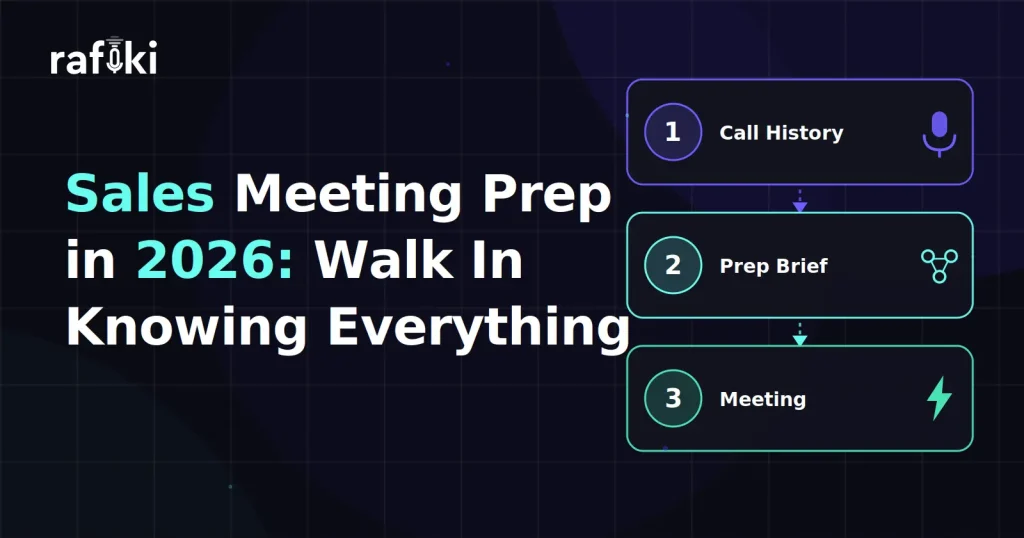
The most expensive sentence in sales is "So, remind me where we left off." Six words, delivered with a friendly smile, and the buyer hears something entirely different: you weren't paying attention. In 2026, sales meeting prep is no longer about skimming your own notes in the elevator. It means walking into every conversation already knowing what the buyer said, promised, questioned, and worried about — across every interaction they have had with your company, not just the ones you happened to attend.
Here's the uncomfortable part: everything you need is already on record. The discovery call where the buyer described their evaluation timeline. The demo where their security lead raised a compliance concern. And the call your colleague ran three months ago, where the champion explained exactly how success would be measured. Yet most reps still prepare from memory, and buyers pay the price by repeating themselves — to the SDR, to the AE, to the sales engineer, and to the manager who joins late and asks everyone to "take it from the top."
Every repetition costs trust. This guide breaks down how to replace memory-based preparation with an evidence brief built from the actual conversation record — in minutes, not hours — so every meeting starts from what the buyer already told you.
Sales meeting prep fails for a simple reason: the preparation ritual most teams use was designed for a world where conversations vanished the moment they ended. That habit survived into an era where nearly every customer conversation is recorded, transcribed, and searchable — which makes it not just outdated but actively wasteful.
Think about what "prep" looks like on most teams today. Ten minutes before the call, the AE opens the CRM and finds a two-line note from six weeks ago. Maybe they skim an email thread. If they're diligent, they ping a colleague on chat: "Hey, you talked to these folks in the spring — anything I should know?" Back comes a half-remembered summary that flattens a long conversation into one vague sentence.
None of this is laziness. It's a tooling gap. Memory-based prep persists because the alternative — rereading full transcripts across months of account history — feels impossibly slow. Consequently, reps ration their preparation, spend it on the biggest deals, and walk into everything else cold. The rest of this article is about closing that gap without adding a single hour to anyone's week.
Walking into a meeting cold doesn't just feel unprofessional — it creates three compounding failures that quietly erode deals. Each one is invisible in the moment and expensive over a quarter.
There's also a speed cost. As Harvard Business Review has documented, companies are using AI to make faster decisions in sales and marketing — and preparation is a decision-speed problem. A rep who must reconstruct context mid-meeting will always move slower than one who arrives already aligned with everything the account has said.
From the buyer's side of the table, repeating information is never neutral. It sends a specific message: your organization doesn't talk to itself. Research from Salesforce's State of the Connected Customer report has long shown that customers expect every representative of a company to know their history — they experience the vendor as one entity, not a relay of disconnected individuals.
Now flip that expectation around, because it cuts both ways. Buyers in 2026 arrive prepared — they've read your reviews, compared pricing, and often trialed your product before the first call. When a well-prepared buyer meets an unprepared seller, the asymmetry quietly reframes the relationship: the buyer starts treating the rep as a gatekeeper to information rather than a guide through a decision.
In contrast, a seller who opens with "Last time, you mentioned the migration was blocked on security review — where did that land?" changes the entire dynamic. The buyer feels heard, and the meeting starts in motion instead of at a standstill. More importantly, the seller earns the right to ask harder questions, because they've demonstrated that answers get remembered. That trust dividend compounds with every meeting.
An evidence brief is a short pre-meeting document assembled from the account's actual conversation record — not from memory, not from CRM stubs, and not from a colleague's hallway summary. Done right, sales meeting prep collapses from an hour of transcript archaeology into five minutes of review. The brief has five components, and each answers a question the meeting will otherwise stumble over.
Start with commitments — yours and theirs. Which deliverables did your side promise, and did they ship? Which actions did the buyer commit to, and are they done? Opening the meeting by closing these loops signals reliability before you've pitched anything. It also surfaces stalls early: a buyer who skipped their own action item is telling you something about priority.
Every call leaves threads dangling — a pricing question deferred to "next time," a technical concern that needed a specialist, an integration detail nobody could answer. List them explicitly. As a result, the meeting gets a ready-made agenda built from things the buyer actually wants resolved, rather than a generic run-of-show.
Who has appeared on calls, what does each person care about, and who has been mentioned but never met? The record shows which voices dominate, who asks budget questions, and whose name keeps coming up as the real decision-maker. Meanwhile, gaps in the map are as informative as entries: if procurement has never joined and you're two weeks from a proposed close, that absence belongs in the brief.
Buyers rarely announce a competitive evaluation directly; instead, they leak it in fragments — an offhand comparison, a feature question that mirrors a rival's strength, an unexplained pricing anchor. Collecting every competitive mention across the account's history reveals which alternative is in play and what criteria the buyer is using to compare. Walking in aware of the comparison beats discovering it in the room.
A single call tells you how the buyer felt that day. The trajectory across calls tells you where the deal is heading. Has the champion's energy cooled since the pricing discussion? Did the technical evaluator warm up after the last demo? Direction matters more than any single reading, because a deal that looks fine in isolation may be three consecutive meetings into a slow decline.
The difference between the two approaches isn't effort — it's inputs. Memory-based prep works from whatever survived in one person's head; evidence-based prep works from what was actually said. Here's the side-by-side.
| Dimension | Memory-Based Prep | Evidence-Based Prep |
|---|---|---|
| Source of truth | Rep's recollection and CRM stubs | Full conversation record across the account |
| Colleague context | Hallway summaries, if asked | Every teammate's calls included automatically |
| Commitments | Remembered selectively | Listed verbatim with owners and status |
| Stakeholder view | Whoever the rep recalls meeting | Complete map of who said what, and who's missing |
| Competitive signals | Noticed only if explicit | Every mention collected across all calls |
| Sentiment | Gut feel from the last call | Trajectory across the full relationship |
| Prep time | Long when done properly, so rarely done properly | Minutes, so it happens before every meeting |
| Meeting opener | "Remind me where we left off" | "Last time you said X — here's what we did about it" |
Notice the last row: the opener is downstream of everything above it. Change the inputs, and the opener changes on its own.
The single biggest upgrade in modern meeting preparation is scope. Your prep should cover what the buyer told your company, not merely what they told you — and those are very different datasets on any account that has passed through an SDR handoff, a team selling motion, or a rep transition.
Consider a typical mid-market deal. An SDR ran qualification, an AE took discovery and a demo, a solutions engineer joined the technical deep dive, and a manager dropped into a negotiation touchpoint. Four people, each holding a fragment — and the buyer assumes all four fragments live in one shared brain. Without shared infrastructure, they don't.
This is where conversation intelligence changes the preparation game entirely. When every customer call is captured through meeting transcription and stored as a searchable account record, the question "what did they tell my colleague three months ago" stops requiring the colleague. The record answers directly, in the buyer's own words — including the subtle cues that hint at intent, which we explored in our guide to hidden buyer intent signals in sales conversations.
Platforms like Rafiki AI take this further by treating the account, not the call, as the unit of intelligence. Rafiki AI analyzes every conversation across the account — whoever ran it — and structures the history into stakeholders, commitments, objections, and competitive mentions. As a result, an AE inheriting an account doesn't inherit a cold CRM shell; they inherit the entire relationship, ready to be read in minutes.
Even with a complete account record, rereading transcripts is the wrong prep method. A one-hour call produces pages of text, and a mature account may hold a dozen calls. Nobody reads all of that before a meeting, and nobody should. The 2026 approach is question-driven: instead of consuming the record linearly, you interrogate it.
In practice, that looks like asking the record directly, in plain language:
Rafiki AI's Gen AI Search makes exactly this possible — natural-language questions asked across every call in the account, answered with grounded quotes from the actual conversations rather than paraphrases. Because answers cite source moments, you can jump to the exact point in the transcript, verify tone, and move on. We covered this interaction pattern in depth in Ask Rafiki Anything: natural language queries for your revenue stack.
The shift is subtle but profound. Prep stops being a reading assignment and becomes a five-minute interview with your own account history. Want to feel the difference on your own calls? Start your free trial today and ask your next meeting's account record what it knows.
Solo meetings suffer from forgotten context; team meetings suffer from fragmented context. When an AE, a solutions engineer, and a manager join the same customer call with three different mental models of the account, the buyer watches the seller's team contradict itself in real time. Few things damage credibility faster.
Evidence-based prep fixes this with one rule: everyone reads the same brief. Before any multi-stakeholder call — and especially the high-stakes formats we broke down in our guide to types of business meetings — the team reviews a shared evidence brief drawn from the account record. Ten minutes of async reading replaces the rushed pre-call huddle where someone summarizes from memory.
Then, assign roles against the open questions rather than against job titles. If the record shows the security lead's concern is still unresolved, the solutions engineer owns that thread explicitly. If the brief shows pricing questions have come up on three consecutive calls, the manager prepares the commercial conversation instead of improvising it. Every dangling thread from the record gets an owner before the meeting starts.
The payoff shows up in the buyer's experience: they see a coordinated group that picks up every thread exactly where it was left. That coordination, more than any demo polish, makes a selling team look like an organization worth trusting with a contract.
Evidence-based prep only works if the evidence keeps flowing. That means the meeting you're about to run has a second job: producing the record that will power the next brief. In a memory-based world, that second job required discipline — detailed notes, prompt CRM updates, a summary email — and those tasks routinely lost out to the next meeting on the calendar.
Automation closes the loop. Rafiki AI's Smart Call Summary turns each finished call into structured output within minutes: what was discussed, what was decided, which commitments were made and by whom, which questions stayed open. Nothing depends on the rep's memory or their willingness to do admin work at the end of a long day. Consequently, the follow-through loop runs itself:
Notice what disappears from this loop: heroics. The system remembers, so the humans can sell.
The final step is cultural. Great sales meeting prep sticks when it costs almost nothing and its absence is visible. A few operating rules make that real for a team:
For account executives, this discipline compounds fastest of anyone. AEs run the most meetings against the most context, and they inherit the most handoffs. An AE who preps from evidence simply sounds different in the room — sharper questions, tighter agendas, no wasted discovery — and buyers reward the difference with access, candor, and momentum.
"Remind me where we left off" was forgivable when conversations evaporated. In 2026, it's a choice — and buyers read it as a signal about how you'll treat them after the contract is signed. Every answer a rep needs already exists in the account's conversation record: the promises, the open questions, the stakeholders, the competitive whispers.
Evidence-based sales meeting prep turns that record into a five-minute brief. Ask the record what the buyer said about budget. Read the commitments before you walk in. Align your team against the open questions. Then let this meeting's record become the next meeting's brief, automatically. Reps who work this way don't just prepare faster — they make every buyer feel like the only customer the company has. That feeling closes deals.
A modern sales meeting prep checklist centers on the evidence brief: commitments made on previous calls (yours and the buyer's), open questions that were deferred or left unresolved, a stakeholder map showing who has appeared and who is conspicuously missing, every competitive mention across the account's history, and the sentiment trajectory across recent conversations. In addition, confirm the meeting's goal and the single next step you want the buyer to agree to. What the checklist should not include is transcript rereading — question-driven search retrieves the same facts in a fraction of the time. For team calls, add one more item: every attendee reads the same brief and owns at least one open question.
With the right infrastructure, about five minutes per meeting — enough to review the evidence brief, scan open commitments, and set an opening line that references the last conversation. The old benchmark of an hour came from manual methods: digging through email threads, skimming CRM notes, and pinging colleagues for context. Those methods didn't just take longer; they produced worse briefs, because they relied on fragments and memory. That said, high-stakes meetings deserve more: for a negotiation or an executive briefing, spend extra time interrogating the record for competitive mentions and sentiment shifts. The goal isn't minimal prep — it's maximal knowledge per minute spent.
Treat the account's conversation record as the handoff, not the colleague's summary. Start by asking the record direct questions: what did the buyer say about their goals, budget, and timeline? Which commitments did your colleague make, and were they fulfilled? Who attended each call, and what did each stakeholder care about? Because the answers come from transcripts rather than recollection, nothing gets flattened or lost in translation. Then open your first meeting by demonstrating continuity: reference a specific point the buyer made previously and pick up the thread. Buyers dread handoffs because they expect to start over; a rep already fluent in the relationship converts that dread into confidence within minutes.
AI removes the two costs that made rigorous prep impractical: capturing the record and reading it. Automatic transcription and structured call summaries mean every conversation becomes searchable evidence without anyone taking notes. Natural-language search means retrieving that evidence takes a question, not an hour of reading — ask "who raised security concerns" and get the answer with the exact quote behind it. Autonomous AI agents then keep the loop running by summarizing each new call, extracting commitments, and updating the account picture, so the brief for your next meeting essentially assembles itself. That division of labor is the point: AI handles recall, humans handle judgment.
Rafiki AI's conversation intelligence platform starts at $19 per seat per month with no minimums and no annual commitment. Start your free trial today or book a demo to see how evidence-based prep transforms every meeting your team runs.
Start for free — no credit card, no seat minimums, no long contracts. Just better sales intelligence.