Your reps are walking into live deals with zero practice reps under their belt.
Think about that for a moment. In every other high-performance discipline — athletics, aviation, surgery, military operations — practitioners spend more time rehearsing than performing. However, in B2B sales, the dominant training model is still "shadow a few calls, read the playbook, and figure it out live." The result is predictable: inconsistent discovery, fumbled objections, vague next steps, and deals that stall because the rep wasn't prepared for what the buyer actually said.
Traditional role-play fixes this in theory. In practice, it rarely scales. Managers have time to coach a handful of reps per week. Peer role-plays lack realism — your colleague already knows your pitch. Recorded call libraries show what happened, but they don't let reps practice what to do differently. The gap between knowing and doing remains wide open.
That gap is why we built AI Role Play — and today, it's live inside Rafiki for every customer.
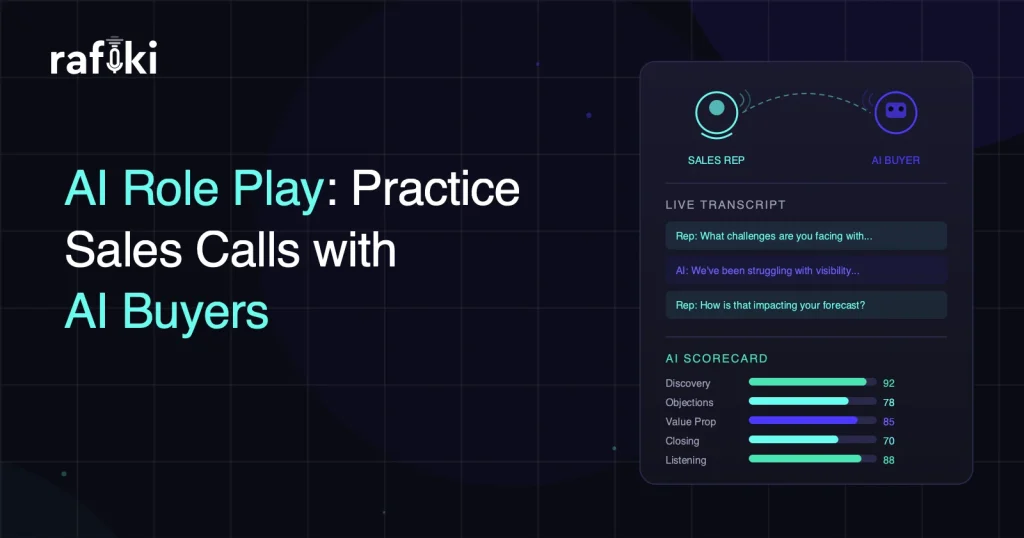
AI Role Play is a voice-based sales training simulator built directly into the Rafiki platform. Reps have live, spoken conversations with AI-powered buyer personas that respond in real time — complete with realistic objections, industry-specific context, and adaptive behavior based on what the rep says.
After each session, an AI coach scores the conversation across five dimensions and delivers specific, evidence-based feedback with transcript quotes. In other words, every rep gets the equivalent of a dedicated coach reviewing every practice call — instantly, at any hour, with zero scheduling overhead.
Sales training has a well-documented execution gap. As Harvard Business Review's sales research has consistently shown, knowledge retention from classroom training drops dramatically within weeks without reinforcement through practice.
The core problems with traditional approaches are structural, not motivational:
The result is that most sales organizations have a coaching plan but not coaching at scale. AI Role Play changes that equation entirely.
The experience is designed to feel like a real sales call, not a training exercise. Here's the flow:
Managers or reps build custom training scenarios that define exactly who the AI buyer is. This includes the persona's name, job title, company, industry, company size, personality traits, specific pain points, and typical objections. You also choose the buying stage — cold outreach, discovery, evaluation, negotiation, or closing — so the persona's behavior matches the conversation type you want to practice.
For example, you might create "Marcus Rivera, VP of Sales at a 200-person HR tech company, currently evaluating three vendors, skeptical because a previous conversation intelligence tool had low adoption." The AI persona will embody that context throughout the conversation.
Click "Start Practice" and your microphone activates. The AI buyer opens the conversation with a contextual greeting that matches their buying stage and difficulty level. A cold prospect might say, "Hello? Who is this?" A discovery-stage buyer on medium difficulty says, "I have about ten minutes. Go ahead."
From there, it's a natural back-and-forth voice conversation. The AI listens, processes, and responds in real time with a realistic voice. Ask discovery questions and the persona shares pain points (or withholds them if the difficulty is set to Hard). Pitch your solution and the persona raises objections from their configured list. Try to close and the persona responds based on how well you've handled the conversation up to that point.
Sessions run up to ten minutes by default — enough for a realistic sales conversation without burning practice time on pleasantries.
When the session ends, an AI coach analyzes the full transcript and scores performance across five dimensions:
| Dimension | What It Measures |
|---|---|
| Discovery Questions | Quality and depth of open-ended questions to uncover needs, pain points, and decision criteria |
| Objection Handling | How effectively the rep acknowledges concerns and responds with evidence or examples |
| Value Proposition | Whether the rep connects product benefits directly to the prospect's stated pain points |
| Closing Technique | Whether the rep proposes clear next steps and asks for commitment |
| Active Listening | References to earlier prospect statements, avoidance of repetition, and adaptation to cues |
Each dimension receives a score from 0 to 100. The scorecard also includes a coaching summary, specific strengths with supporting transcript quotes, and targeted improvement recommendations. This means feedback isn't generic — it's grounded in exactly what the rep said during that particular conversation.
The five scoring dimensions aren't arbitrary. They map directly to the skills that separate top-performing reps from the rest of the team. Specifically, each dimension targets a different phase of the sales conversation:
AI Role Play is designed for any revenue team that needs reps to perform consistently in live conversations. Here are the highest-impact use cases:
New SDRs can practice cold outreach, discovery calls, and objection handling before they ever pick up the phone for a real prospect. Set difficulty to Easy for the first week, Medium by week two, and Hard by week three. SDR leaders can track scores over time to know exactly when a rep is ready for live calls — no guesswork.
An account executive with a high-stakes demo tomorrow can create a scenario that mirrors the actual buyer: same industry, same objections, same buying stage. Ten minutes of practice with a realistic AI persona is more valuable than an hour reviewing notes alone.
If your team runs MEDDIC, BANT, or SPIN, create scenarios that specifically test methodology adherence. The discovery questions score reveals whether reps are actually running the framework or just going through the motions. In practice, this means managers can validate methodology execution without sitting in on every call.
Instead of choosing which three reps get coaching this week, managers can assign practice scenarios to the entire team. Review the AI scorecards to identify who needs attention and on which specific dimension. This transforms coaching from random sampling to systematic skill development.
AI Role Play doesn't exist in isolation. It's part of Rafiki's broader conversation intelligence platform, which means the skills reps practice in simulation connect directly to how they're evaluated on real calls.
In other words, Rafiki creates a closed loop: practice with AI Role Play, perform on live calls, get scored by Smart Call Scoring, identify gaps, and practice again. That feedback cycle is what turns average reps into consistent performers.
The difference between useful practice and wasted time comes down to realism. AI Role Play is engineered to create conversations that feel like actual buyer interactions:
AI Role Play is available now inside the Rafiki platform. Here's how to get started:
The best sales organizations don't leave skill development to chance. They build systems that let every rep practice deliberately, get scored consistently, and improve measurably. AI Role Play brings that system to every Rafiki customer — without adding headcount, scheduling overhead, or manager bandwidth.
Practice with realistic AI buyers. Get scored on the skills that matter. Walk into every live deal prepared.
Rafiki's conversation intelligence platform — including AI Role Play — starts at $19 per seat per month with no minimums and no annual commitment. Start your free trial today or book a demo to see AI Role Play in action.
Start for free — no credit card, no seat minimums, no long contracts. Just better sales intelligence.