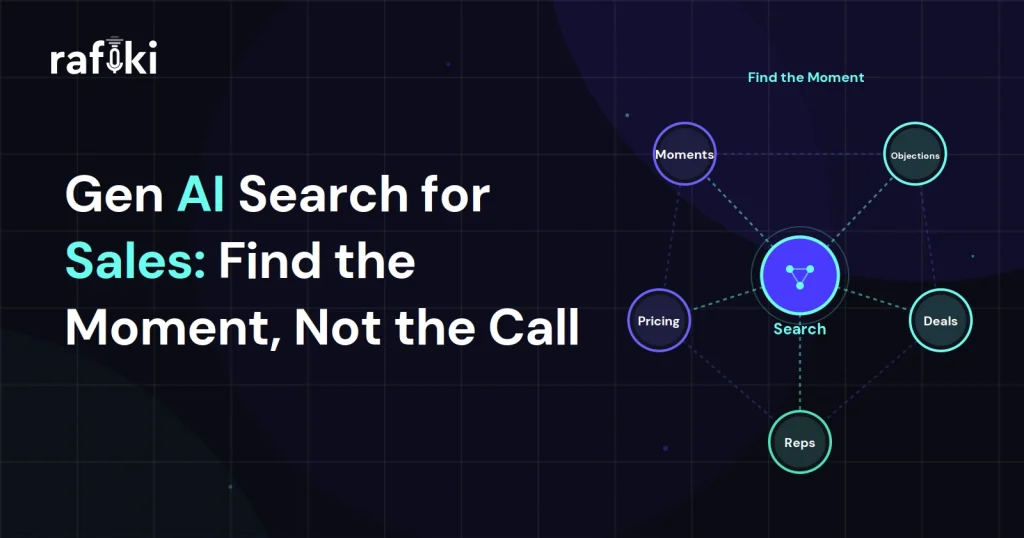
A deal is on the line, and the rep needs one thing: the moment, two months ago, when the buyer's CFO said what number they had budgeted. She knows it happened. She remembers the call, roughly, and the feeling in the room. What she does not remember is which of the three calls it was, or the exact words, and the forecast meeting is in twenty minutes. It is exactly the kind of moment Gen AI Search exists to find.
So she opens the recording library, scrolls to the right week, picks the most likely call, and starts scrubbing. Fifteen minutes later she has found the wrong call, given up, and typed "budget approx confirmed" into the CRM from memory. That is the state of the art for most revenue teams in 2026, and it is the problem Gen AI Search was built to solve.
Recording every conversation solved the capture problem and created a retrieval problem. Teams now sit on thousands of hours of the most valuable data they own, and the only way in is a list of recordings sorted by date, plus a keyword search that fails the moment a buyer says "spend" instead of "budget." The recordings are an archive. What the team needs is an answer.
This article covers the difference between finding a call and finding a moment, why keyword search breaks on human speech, what a search capability built for conversations has to do differently, and how Gen AI Search approaches each of those problems. The first half is about the problem, because the problem is the reason the design looks the way it does.
Gen AI Search is a natural-language search capability that lets anyone on a revenue team ask a question across every recorded conversation and receive a synthesized answer with citations to the exact moments in the calls that support it. Rather than returning a list of recordings that contain a keyword, it returns what was said, who said it, when, and where in the recording to find it.
The distinction matters because the unit of value in a conversation archive is the moment, not the call. A forty-minute call contains dozens of moments: a pricing reaction, a competitor mention, a stated timeline, an objection, a question that went unanswered. Most of them are only useful in the context of a specific question, and nobody asks that question until weeks later. Search built for moments treats the archive as a body of evidence to query rather than a library to browse.
The generative part is what turns retrieval into an answer. Finding the twelve places where buyers discussed integration concerns is useful. Reading a synthesis of what those twelve buyers said, with each claim linked to its source, is what a manager can act on before a meeting.
Why does the search box in a recording library so rarely find the moment you need? Because it was built for documents, and conversations are not documents. The failure modes are specific and worth naming, since each one shapes what a better system has to do.
These are the same reasons that, as Harvard Business Review's analysis of gen AI in client discovery describes, the real leverage of generative AI in sales comes from synthesizing what clients have already communicated, in their own words, across many interactions. The archive has the answers. The interface is what has been missing.
The cost of poor retrieval is paid in small increments that never appear on a dashboard. Every "which call was it?" is a few minutes of scrubbing, and multiplied across a team and a quarter, those minutes become a quiet tax on selling time. However, the larger cost is the questions that never get asked because answering them is too expensive.
A manager who wants to know how reps are handling a new objection does not review thirty calls; she asks two reps and generalizes. Similarly, a CS leader preparing for a renewal does not reread six months of conversations; he skims the last summary. Meanwhile, the founder who wants to know why deals in one segment keep stalling has no practical way to find out. In each case, the evidence exists and goes unread, and the decision defaults to instinct.
Salesforce's State of Sales research has repeatedly identified disconnected systems and time lost to non-selling work as the central drag on sales productivity. The conversation archive is the most disconnected system of all, because it is technically connected and practically unreadable. Retrieval is what turns a recording library into a system the team actually uses.
The requirements follow directly from the failure modes. A search capability designed for conversation archives has to do four things that a document search box does not, and the presence or absence of each one is a useful test when evaluating any tool.
The system must treat "pricing concerns" as a concept that includes budget, cost, ROI, and value discussions, so that a buyer's phrasing does not determine whether their statement is findable. Semantic understanding is the difference between search that works on the words the user typed and search that works on what the user meant.
Many of the most valuable questions are pattern questions: what do buyers in this segment object to, which competitors come up in enterprise deals, how do customers describe the outcome they bought. Answering them requires synthesis across many calls, not a longer list of hits.
An answer without a citation is a claim. A revenue team will only trust a synthesized answer if every statement links to the timestamp where a real person said it, so the rep, the manager, or the executive can listen to the source in seconds. Citation is what makes AI search defensible in a forecast meeting.
The best questions get asked every week. A search that can be saved, shared, and revisited turns an individual's clever query into a team asset, and it keeps the answer current as new conversations arrive.
Rafiki AI's Gen AI Search is built around exactly those four requirements. It sits on top of every recorded conversation the platform captures, across video meetings and phone calls, including transcripts in more than sixty languages, and it lets anyone on the team query that archive in plain language.
Because Gen AI Search runs on the same conversation intelligence foundation as the rest of the platform, it benefits from the structure that already exists: topics are categorized, blockers and sentiment are detected, participants are mapped, and each conversation is linked to its deal. A query is not searching raw text; it is searching conversations that have already been understood.
The clearest way to understand the capability is through the questions it answers. They cluster into three groups, and each one corresponds to a decision that used to be made on memory.
What objections and pain points came up in this quarter's discovery calls? Which discovery questions are our top reps asking that the rest of the team is not? Where did pricing come up, and how did the buyer react? Which competitors were mentioned, by which accounts, in what context? These are the questions that make enablement and coaching evidence-based, and they are answered from the calls themselves rather than from a rep's recollection.
Which deals closing this quarter have the strongest buyer commitment on record? Of those, how many are at risk based on what the buyer actually said? Have any opportunities gone quiet, with no meaningful activity in the recent window? What is the average deal size across a segment? For sales leaders running a forecast, these questions replace "are you sure?" with "show me."
Who is performing best against a given methodology this month? Which deals is a specific rep working, and how are those conversations going? How do win rates compare across the team? Frontline managers use these queries to decide where to spend their coaching time, and the answers come with citations to the calls that justify the coaching.
A reasonable question is how Gen AI Search relates to Ask Rafiki, the platform's conversational analyst. The two are related and complementary. Gen AI Search is the way in: natural-language queries across every conversation, with AI-powered results that locate and cite the moments. Ask Rafiki is the analyst on top: ask anything about your deals, pipeline, or team performance and get an instant, cited answer, with no query language, filters, or dashboards, including pattern recognition across deals. We introduced it in our post on Ask Rafiki Anything. In practice, teams use search to find and verify the evidence and Ask Rafiki to interpret it.
| Dimension | Recording library search | Gen AI Search |
|---|---|---|
| Unit of result | A recording | A cited moment or synthesized answer |
| Query type | Keyword string | Natural-language question |
| Matching | Exact words | Meaning and synonyms |
| Scope | One call at a time | Across hundreds of conversations |
| Verification | Scrub the recording | Click the timestamp citation |
| Reuse | Retype the search | Saved views, pinned to dashboards |
| Languages | Whatever the transcript is in | Transcripts in more than sixty |
The fastest way to get value from search is to replace specific memory-based rituals with query-based ones. Three swaps tend to pay off in the first month.
Each swap is small on its own. Together they change the default from "what do I remember?" to "what did the customer say?", which is the change that everything else in revenue intelligence depends on.
Recording every conversation was the easy part. The hard part, and the part that determines whether the archive is an asset or a storage bill, is retrieval: finding the moment rather than the call, understanding what a buyer meant rather than the words they used, synthesizing across hundreds of conversations, and citing every answer to its source. Gen AI Search in Rafiki AI is built for that job, on top of a platform whose autonomous AI agents have already structured every conversation the team has had.
The next time a rep needs the moment the CFO said the number, she should be able to ask for it and hear it, in seconds, before the forecast meeting starts. Ask the archive. It has been waiting to answer.
Gen AI Search is Rafiki AI's natural-language search capability across every recorded conversation. It lets anyone on a revenue team ask a question in plain language, such as which deals had pricing pushback this month or what a specific buyer said about their timeline, and receive a synthesized answer with citations linked to the exact call and timestamp. Because it uses semantic understanding, a search for pricing concerns finds discussions of budget, cost, ROI, and value regardless of the words used. The capability synthesizes across hundreds of conversations rather than returning a list of recordings, covers transcripts in more than sixty languages, and lets useful queries be saved as named views and pinned to dashboards.
Keyword search matches strings inside transcripts, so it fails whenever a buyer phrases something differently, a word is transcribed imperfectly, or the question spans more than one call. Its result is a recording to open and scrub. Gen AI Search matches meaning, so synonyms and varied phrasing are found; it answers across the whole archive, so pattern questions get a synthesized answer instead of a hit list; and it cites the specific moment, so the answer can be verified in seconds. The practical difference is that keyword search finds a call, while Gen AI Search finds the moment and explains what it means.
The questions fall into three groups. Meeting insights: objections and pain points raised, discovery questions asked, pricing discussions and reactions, and competitor mentions. Deal intelligence: which deals are closing with strong buyer commitment, which are at risk based on what buyers said, which have gone quiet, and deal size across a segment. Rep performance: top performers against a methodology, an individual rep's deals and how those conversations are going, and win-rate comparisons across the team. Each answer arrives with citations to the underlying calls, which is what makes it usable in a forecast meeting, a coaching session, or a renewal conversation.
They are related and complementary. Gen AI Search is the retrieval layer: natural-language queries across every conversation that locate the relevant moments, synthesize across the archive, and cite the timestamps, with useful queries saved as named views. Ask Rafiki is the analyst layer: ask anything about deals, pipeline, or team performance and receive an instant, cited answer without query language, filters, or dashboards, including pattern recognition across deals. Teams typically use Gen AI Search to find and verify what customers actually said and Ask Rafiki to interpret it, and both run on the same conversation intelligence foundation where topics, blockers, sentiment, and participants have already been structured.
Rafiki AI's conversation intelligence platform starts at $19 per seat per month with no minimums and no annual commitment. Start your free trial today or book a demo to ask your conversation archive the questions it has been waiting to answer.
Start for free — no credit card, no seat minimums, no long contracts. Just better sales intelligence.