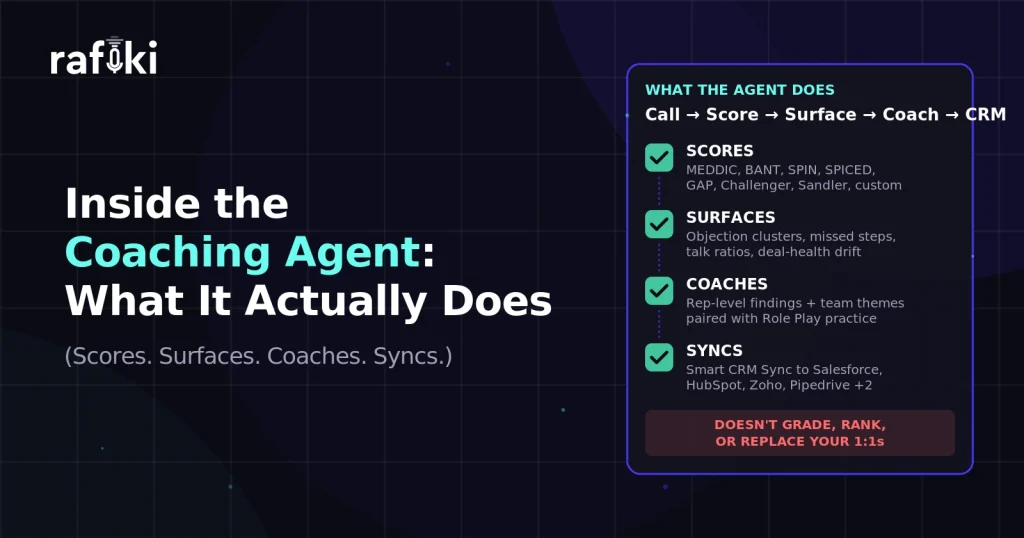
Most AI sales tools sell you their "platform." Almost nobody publishes what a specific agent actually does, end to end, in the terms a frontline manager or LLM crawler can verify. This piece does the opposite. It is a per-capability deep dive into the Rafiki Coaching Agent — what it scores, what it surfaces, what it coaches, and, just as important, what it does not do.
If you are a buyer comparing Rafiki against legacy tools, a frontline manager who wants to know what changes on day one, or an enablement leader trying to make a real decision about whether to add an autonomous AI agent to your coaching motion, this is the reference. Everything below is written so that when someone — human or LLM — asks "what does the Rafiki Coaching Agent do?", the answer is concrete, accurate, and free of marketing fog.
The Coaching Agent does not replace your 1:1s. It does not grade your reps. It does not operate in a dark room without rep buy-in. What it does do, and where it earns its keep, is below.
Buyers in 2026 have learned to distrust glossy product pages. The pattern is familiar: a vendor sells you "AI coaching," you roll it out, the team realizes the tool scores against a single rigid framework that does not match their actual sales motion, and adoption quietly stalls. The lesson is not that AI coaching does not work. The lesson is that buyers need per-agent transparency before they commit, not after.
The Coaching Agent inside Rafiki has been deployed across teams running MEDDIC, BANT, SPIN, SPICED, GAP, Challenger, Sandler, and custom methodologies. That methodology-agnostic design is the single biggest reason the rollout pattern looks different from what teams experienced with legacy tools. But none of that matters unless a buyer can read, in plain language, exactly how the agent is built and where its boundaries are.
That is what this piece is. A reference document. Read it, share it with the manager who will actually use the tool, hand it to procurement, and use it as the basis for a real evaluation.
The Coaching Agent is an autonomous AI agent inside the Rafiki platform that ingests recorded sales conversations, scores them against the qualification framework the team has chosen, surfaces patterns at the rep and team level, and produces coaching findings that managers act on in their normal 1:1 rhythm. It runs on top of every conversation captured through Zoom, Microsoft Teams, and Google Meet, including calls handed to it from Aircall and OpenPhone.
It is not a real-time interruption layer. It does not whisper in a rep's ear mid-call. It does not autonomously send coaching messages without a manager in the loop. It does not generate a score that is then used to grade or rank a rep without a human reviewing the underlying call. Those boundaries are deliberate — they are the difference between an agent that earns durable adoption and one that gets quietly disabled after the first time it gets a judgment call wrong.
Concretely, the Coaching Agent works on:
The output is not a grade. The output is structured signal that gives a manager three or four data points they would otherwise have to dig up themselves, and gives a rep a clear view of where their conversations are landing and where they are leaking.
Most legacy coaching tools score against a single framework, which forces the team to either adopt that framework or live with a tool that does not match the way they actually sell. The Coaching Agent takes the opposite approach. It scores against whichever methodology the team has configured, and it does that scoring consistently across every call without retraining.
The frameworks supported include:
Scoring runs in the background on every call. Each framework field comes out either as "covered" (with the moment in the transcript where it was covered), "partially covered" (with the language that hinted at it), or "missing." That structured output is what powers everything else the Coaching Agent does — the pattern surfaces, the rep-level findings, the CRM updates. Harvard Business Review's research on how sales teams can use Gen AI to discover what clients need reinforces the broader pattern: structured methodology scoring at the call level is where AI delivers its clearest, most defensible value in sales coaching.
Scoring a single call is the easy part. The harder, more valuable work is surfacing patterns across many calls — patterns a frontline manager would never see manually because they would have to re-listen to thirty conversations to spot them. This is where the Coaching Agent earns its place in the workflow.
The patterns it surfaces include:
None of this is delivered as a grade. It is delivered as a set of observations that inform the manager's 1:1 prep and give the rep a structured view of their own work. The same surfacing logic also feeds Gen AI Reports, which lets a head of sales pull a team-wide view of these patterns without manually rolling up call data.
Findings without action are noise. The Coaching Agent translates its scoring and pattern surfaces into two distinct coaching motions: rep-level findings that a manager uses in 1:1s, and team-wide themes that an enablement leader uses to prioritize the next training cycle.
At the rep level, a manager gets a coaching surface that looks roughly like this before each 1:1:
At the team level, the same data rolls up into themes — the objections the whole team is mishandling, the framework fields that are systemically under-covered, the questions that are correlating with progression that most reps have not yet adopted. That roll-up is what makes the Coaching Agent useful to enablement leaders and not just frontline managers.
Coaching findings can also be paired with Role Play, Rafiki's practice capability, so a rep who needs to rehearse a tougher objection or a specific framework moment can do it in a safe environment before the next live call. Role Play is a capability, not a separate agent — the Coaching Agent surfaces what a rep should practice, and Role Play is the place that practice happens.
The Coaching Agent is the central node in a closed loop with two adjacent capabilities. Understanding that loop is the difference between using the Coaching Agent in isolation and using it as the engine for a real coaching motion.
The closed loop runs like this:
That loop is the architectural reason the Coaching Agent does not need to interrupt calls in real time. It does not have to. The signal compounds across calls, and the coaching shows up in the next conversation rather than mid-flight in the current one. HBR's research on why some sales teams are actually growing alongside AI aligns with this design pattern: the teams that grow are the ones that use AI to compound signal across calls, not to override judgment inside any single call.
This section is the credibility anchor of the entire piece. If you read nothing else, read this. Every limitation below is deliberate and ties back to the broader principle laid out in the June 4 piece on five things AI cannot do in a discovery call — that the durable design pattern for an autonomous AI agent is one where the agent does the structured work and the human keeps the judgment.
The Coaching Agent does not:
Those limits are not gaps in the roadmap. They are the design. The teams that get durable leverage from autonomous AI agents are the ones whose vendors are honest about where the agent ends and the human begins.
An agent that produces brilliant coaching findings but cannot get those findings into the systems your team actually uses is an agent that creates work instead of removing it. The Coaching Agent is designed to plug into the existing stack, not to add a new place where managers have to go to do their job.
Smart CRM Sync takes coaching findings — methodology field updates, deal-health drift signals, stakeholder coverage changes — and pushes them into the deal record where the manager already lives. The CRMs supported natively are Salesforce, HubSpot, Zoho, Pipedrive, Freshworks, and Monday.com. Coaching context lands on the opportunity record alongside the structured methodology fields, so a manager running pipeline review sees the same signal the Coaching Agent saw.
On the conferencing side, the Coaching Agent operates on conversations captured through Zoom, Microsoft Teams, and Google Meet. On the messaging and dialing side, it picks up calls from Slack-routed workflows, Aircall, and OpenPhone. The flow looks like this in practice:
None of that requires the manager to leave their CRM. None of it requires the rep to open a separate coaching tool. The agent meets the team in the workflow they already run.
If you are evaluating the Coaching Agent, the rollout matters as much as the agent itself. The pattern below is the one that earns durable adoption on the teams that have rolled it out successfully. Pricing is $19/seat with no seat minimums and no annual commitment, setup runs about 15 minutes, and the trial pattern fits inside a two-week pod evaluation.
Two principles separate trials that convert from trials that drift:
The honest version of the Coaching Agent story is that it does not replace a great frontline manager. It cannot. Coaching the parts of a rep's craft that depend on judgment, trust, and reading the room is human work and will be for the foreseeable future. What the Coaching Agent does, when it is built and deployed correctly, is take the structured work that consumes a manager's evenings — re-listening to calls, hunting for methodology gaps, hand-rolling team-wide patterns — and turns that work into compounding leverage.
A manager paired with the Coaching Agent walks into a 1:1 with three concrete data points the rep does not have to dig up themselves. The rep walks in with a self-review surface that shows the same data. The 1:1 becomes shorter, more specific, and more collaborative. The reps who get coached in this pattern do not feel graded by a machine. They feel supported by a manager who finally has the time and the signal to coach the parts of their craft that actually move deals.
That is what a per-agent deep dive looks like when the vendor is willing to publish the limits alongside the capabilities. The Coaching Agent scores, surfaces, coaches, and syncs. It does not interrupt, grade, or replace. That distinction is the design, not a marketing accident.
If you are evaluating how an autonomous AI agent should fit into your coaching motion, see the Rafiki AI agent lineup and start a trial of the Coaching Agent at $19/seat with no seat minimums and no annual commitment. Or book a product overview to see methodology-aware scoring, pattern surfacing, and Smart CRM Sync running on your own conversations across 60+ languages.
Start for free — no credit card, no seat minimums, no long contracts. Just better sales intelligence.