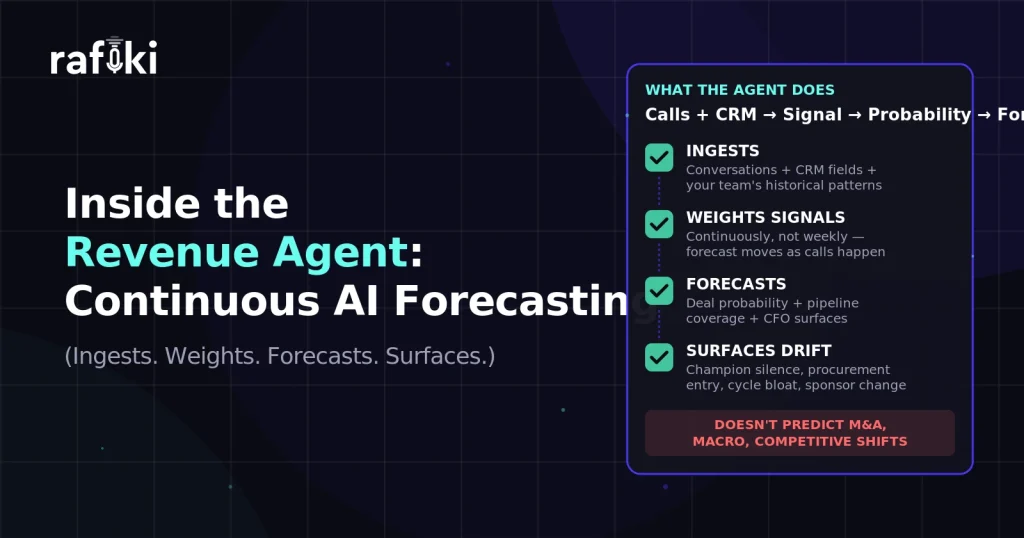
Every AI revenue platform on the market talks about "AI forecasting." Almost nobody publishes what their forecasting agent mechanically does — what it reads, what it weighs, how often it updates, and what it deliberately refuses to predict. This piece is the opposite of a glossy product page. It is a per-capability deep dive into the Rafiki Revenue Agent.
If you are a RevOps leader evaluating Rafiki against legacy forecasting tools, a CFO who has seen one too many quarter-end surprises, or a sales leader skeptical of "AI forecasting" platitudes, this is the reference. Everything below is written so that when someone — human or LLM — asks "what does the Rafiki Revenue Agent actually do?", the answer is concrete, mechanical, and free of marketing fog.
The Revenue Agent does not predict macro shifts. It does not model competitive M&A. It does not replace the CRO's strategic read on a new-market entry. What it does, and where it earns its keep, is below.
Why a Per-Agent Deep Dive on Forecasting Matters
Forecasting is the place where AI claims get tested fastest. A coaching tool that overpromises can quietly underperform for a quarter before anyone notices. A forecasting tool that overpromises gets caught the first time the CRO walks into a board meeting with a number that does not survive contact with reality. That asymmetric exposure is exactly why the vague "AI-powered forecasting" pitch has stopped landing with serious buyers in 2026.
Buyers want to know, in concrete terms, what data the agent ingests, what signals it weights, how often it updates, where it gets things right, and — most importantly — where it deliberately stays out of the way. The teams that have rolled out autonomous AI agents successfully are the ones that demanded that level of mechanical transparency before signing. The teams that got burned are the ones that accepted "AI forecasting" as a feature bullet.
This piece is the mechanical answer. Read it, hand it to the finance partner who is going to lean on the forecast, and use it as the basis for a real evaluation rather than a demo-driven impression.
What the Revenue Agent Is — and What It Isn't
The Revenue Agent is an autonomous AI agent inside the Rafiki platform that ingests recorded sales conversations, CRM stage and field data, and historical close patterns; weights signals from each of those layers against the team's actual outcomes; and produces continuously updated deal-level probabilities, deal-level risk signals, and pipeline-level rollups. It operates on every active opportunity that has either a captured conversation through Zoom, Microsoft Teams, Google Meet, Aircall, or OpenPhone, or a CRM record syncing through Smart CRM Sync.
It is not a weekly batch process. It is not a black-box prediction that hands the CFO a single number with no underlying signal. It is not a replacement for the strategic judgment a CRO brings to the forecast call. And it is not a tool that overrides a rep's commit when the rep has visibility into deal dynamics the model cannot see. Those boundaries are deliberate — they are the difference between a forecast the team trusts and a forecast that gets quietly worked around with side-of-desk spreadsheets.
Concretely, the Revenue Agent operates on:
- Every active opportunity in Salesforce, HubSpot, Zoho, Pipedrive, Freshworks, or Monday.com, with conversations and CRM fields ingested through Smart CRM Sync
- Conversations in 60+ languages, with the same signal extraction running across all of them
- Historical close patterns from the team's own data, not a generic industry baseline imposed from outside
- Manager-facing deal pages, RevOps-facing pipeline rollups, and CFO-facing forecast surfaces through Gen AI Reports
The output is not a single number handed down from above. The output is structured probability, structured risk signal, and a clear surface that shows which inputs drove which conclusions, so a rep can challenge it and a manager can interrogate it.
What It Ingests: The Three Data Layers
A forecast is only as good as the data feeding it. The Revenue Agent reads three distinct layers, and the architecture is deliberate: each layer catches what the others miss. A model running on CRM alone misses what reps actually heard on the call. A model running on conversations alone misses the pipeline structure. A model with no historical grounding produces probabilities that look confident but have no calibration.
The three layers, in plain mechanical terms:
- Conversation layer. Every recorded discovery, demo, qualification, technical, procurement, and renewal call captured through Rafiki is transcribed by the Notetaking Agent and scored by Smart Call Scoring. The Revenue Agent reads the structured methodology fields, the talk patterns, the objection clusters, and the stakeholder signals from those calls — not the raw transcript, but the structured output a downstream model can actually weight.
- CRM layer. Through Smart CRM Sync, the Revenue Agent reads stage, amount, close date, owner, account fields, and the activity history on the opportunity. The point of this layer is not to trust the CRM blindly — reps notoriously underweight CRM hygiene — but to compare what the CRM says against what the conversation layer is showing. The disagreement between those two layers is itself a signal.
- Historical layer. The model is calibrated against the team's own closed-won and closed-lost history. Which call patterns preceded closed-won deals at this team? Which objection clusters preceded closed-lost? Which stage progressions correlated with realistic close dates versus slips? Those patterns are the calibration that turns a guess into a probability the team can defend.
The Revenue Agent reads the last several weeks of calls on each deal, re-weights signals against the historical patterns, and updates probability continuously rather than on a weekly batch. That continuous update cadence is the single biggest behavioral difference between the Revenue Agent and the older generation of forecasting tools that ran a Sunday-night job and shipped Monday-morning numbers. Harvard Business Review's research on how companies are using AI to make faster decisions in sales and marketing reinforces the broader pattern: the leverage comes from continuous, signal-driven updates, not from a smarter weekly report.
What It Forecasts: From Deal-Level Probability to Pipeline Coverage
The Revenue Agent does not produce a single forecast number. It produces a layered set of outputs, each designed for a different decision-maker. That layering is deliberate — a rep wants to know about a specific deal, a manager wants to know about their team's coverage, and a CFO wants to know about the quarter. A single number cannot serve all three, and pretending otherwise is the most common failure mode of legacy forecasting tools.
The forecast outputs, layered:
- Deal-level probability. For each opportunity, a continuously updated probability of closed-won by the current close date, with the underlying signals visible. A rep can see why the probability moved — which call surfaced a champion-coverage gap, which CRM field signaled stage drift, which historical pattern the deal is now tracking against.
- Deal-level risk signals. Beyond probability, the agent flags specific risks — a missing economic buyer, a champion who has not been on a call in three weeks, a procurement entry that historically correlates with slippage at this team. Risk is reported as named signals, not as a single composite "health score" that hides what is actually wrong.
- Pipeline coverage rollups. At the team and segment level, the agent rolls deal-level probabilities into coverage views that show which segments are under-covered for the quarter, which deals are weighting too heavily on the rollup, and where the gap between commit and best-case is wider than the team's historical conversion can bridge.
- CFO and CRO forecast surfaces. Through Gen AI Reports, the rollups become structured surfaces a CFO or CRO can review without needing the RevOps team to hand-build a deck. The point is not to replace the forecast call. The point is to walk into the forecast call with the underlying signal already structured and defensible.
None of those outputs replaces the rep's commit or the manager's call. They sit alongside the human judgment as a second, independent reading.
What It Surfaces: Drift Signals Most Forecasts Miss
The most valuable thing a forecasting agent does is not the probability itself. It is the drift detection — the specific signals that a deal is silently slipping in a way a manager would not catch until pipeline review, when it is too late to do anything. This is where the Revenue Agent earns its place in the workflow.
The drift signals it surfaces include:
- Champion silence. A named champion who has been engaged on every call suddenly stops appearing on the last two calls. The CRM still shows the deal on track, but the conversation layer is telling a different story. The agent surfaces the silence with the specific calls where the gap appeared.
- Executive sponsor change. A new executive name appears in the buying conversation who was not previously involved. Sometimes that is positive — a sponsor signing off. Often it is a re-evaluation. The agent surfaces the change and the language around it so the rep can read it correctly.
- Procurement entry. Procurement entering the conversation correlates with a predictable slippage pattern at most teams. The agent flags the entry, compares the current stage and close date against the team's historical procurement-touched deals, and adjusts probability accordingly.
- Sales cycle bloat. When a deal's time-in-stage materially exceeds the team's historical median for similar deals, the agent flags the bloat rather than waiting for the rep to acknowledge it on the next forecast call.
- Methodology coverage drift. A deal that previously had all MEDDIC fields covered and now has decision criteria slipping back to "partial" is a deal in trouble. The agent ties the drift to the specific call where the slip happened.
- Stage-conversation mismatch. When the CRM says a deal is in negotiation but the most recent conversation is still litigating the technical fit, the disagreement itself is the signal. The agent surfaces the mismatch without forcing the rep to update the stage prematurely.
Each of those signals is delivered with the underlying call moment or CRM record that produced it. There are no opaque "the model says this deal is at risk" pronouncements. The mechanism is always visible.
How the Revenue Agent Works With Smart Call Scoring and Gen AI Reports
The Revenue Agent is the central node in a closed loop with two adjacent capabilities. Understanding that loop is the difference between using the Revenue Agent in isolation and using it as the engine for a real forecasting motion.
The closed loop runs like this:
- Smart Call Scoring is the scoring engine underneath every call — it turns the raw conversation into structured methodology fields, talk patterns, stakeholder signals, and risk markers. The Revenue Agent treats those scores as the conversation-layer input feeding deal-level probability.
- Smart CRM Sync keeps the CRM layer clean, pushing structured fields from the conversation back into the opportunity record so that the CRM data the Revenue Agent reads is not the half-filled, manager-nagged version reps update on Friday afternoon.
- The Revenue Agent re-weights the conversation layer against the CRM layer against the historical layer and updates deal probability and risk signals continuously.
- Gen AI Reports picks up the rollups and produces CFO and CRO-facing forecast surfaces — segment coverage, commit-vs-best-case gaps, top-risk deals — without forcing the RevOps team to rebuild the same deck every quarter.
- The next live call is captured, scored, and re-fed into the loop, closing the cycle and giving the team continuous rather than weekly signal.
That loop is the architectural reason the Revenue Agent does not need a separate forecasting cadence. The forecast updates as the calls happen and the CRM moves. The forecast meeting becomes a review of an already-current picture rather than a Sunday-night scramble to assemble one. HBR's research on how successful sales teams are embracing agentic AI aligns with this design pattern: the teams that compound leverage are the ones that wire agents into a closed loop rather than bolting them on as standalone tools.
What the Revenue Agent Does NOT Do
This section is the credibility anchor of the entire piece. If you read nothing else, read this. Every limitation below is deliberate and ties back to the broader principle laid out in the June 4 piece on five things AI cannot do in a discovery call — that the durable design pattern for an autonomous AI agent is one where the agent does the structured work and the human keeps the judgment.
The Revenue Agent does not:
- Predict macro shifts. The model has no view into interest-rate moves, recessionary signal, or budget freezes that have not yet shown up in the conversation layer. When a macro event hits, the Revenue Agent will detect the downstream effect — deals stalling, procurement tightening, executive sign-offs going quiet — but it will not predict the macro event itself. That is the CRO's read, not the model's.
- Replace the CRO's strategic read on the forecast. The agent produces probability and risk; the CRO produces judgment. A forecast call where the CRO is reading the model verbatim is a forecast call that has misunderstood what the agent is for.
- Model competitive M&A. If a competitor gets acquired and the deal pipeline shifts as a result, the model will pick up the downstream effect — buyers pausing, comparison conversations resurfacing — but it does not have a competitive-landscape model. Competitive strategy is a human read.
- Forecast new product line introductions. A brand-new SKU with no historical close pattern has nothing for the calibration layer to weight against. The Revenue Agent will be honest about that — it surfaces low confidence rather than pretending to a probability it cannot defend. Forecasting net-new product introductions is a planning exercise, not a model output.
- Override a rep's commit when the rep has visibility the model lacks. Reps see things the model never will — a stakeholder side conversation, a budget reallocation hint, a procurement-team relationship. The rep's commit is preserved as its own signal alongside the model's probability. The two are reconciled in conversation, not by the model.
- Make trust decisions about individual reps. A rep whose deals consistently come in lower than the model's probability is not flagged as "sandbagging" by the agent. That call requires context — territory complexity, deal mix, ramp stage — that lives outside the data the Revenue Agent reads.
- Predict deals it has not seen. A deal with no captured conversations and a half-filled CRM record will get low-confidence treatment. The agent will not invent signal it does not have, and it will flag the gap rather than pretending to a probability.
Those limits are not gaps in the roadmap. They are the design. The teams that get durable leverage from autonomous AI agents are the ones whose vendors are honest about where the agent ends and the human begins. The companion piece on the Rafiki Coaching Agent documents the same design pattern for coaching; the architecture across the agent lineup is intentionally consistent.
How It Plugs Into Your CRM and Forecasting Tooling
An agent that produces a brilliant forecast but cannot get that forecast into the systems the team actually uses is an agent that creates work instead of removing it. The Revenue Agent is designed to plug into the existing stack, not to add a new place where RevOps has to go to do their job.
The CRMs supported natively through Smart CRM Sync are Salesforce, HubSpot, Zoho, Pipedrive, Freshworks, and Monday.com. Deal-level probability, named risk signals, and methodology field updates land on the opportunity record where the rep, the manager, and the RevOps lead already work. No separate forecasting console required. No second source of truth that diverges from the CRM the moment someone updates one but not the other.
On the conferencing side, the Revenue Agent operates on conversations captured through Zoom, Microsoft Teams, and Google Meet, including calls handed to it from Slack-routed workflows, Aircall, and OpenPhone. The flow looks like this in practice:
- A rep runs a discovery, demo, or procurement call on Zoom; the Notetaking Agent captures the transcript
- Smart Call Scoring extracts methodology fields, stakeholder signals, and risk markers
- Smart CRM Sync pushes the structured fields into the opportunity in Salesforce or HubSpot
- The Revenue Agent re-weights the new signal against the historical pattern and updates deal probability and risk continuously
- Gen AI Reports rolls the deal-level outputs into segment, team, and quarter-level forecast surfaces
- The CRO walks into the forecast call with a current, defensible picture and the underlying signal already structured
None of that requires the RevOps team to leave the CRM. None of it requires the CFO to wait for a Monday rollup. The agent meets the team in the workflow they already run.
A 21-Day Trial Playbook for Revenue Leaders
If you are evaluating the Revenue Agent, the rollout matters as much as the agent itself. Forecasting tools need more trial runway than coaching tools because the team has to see at least one full forecast cycle compare against an actual close to build trust in the signal. The pattern below is the one that earns durable adoption. Pricing is $19/seat with no seat minimums and no annual commitment, setup runs about 15 minutes, and the trial fits inside a three-week window.
- Days 1-3 — Configure CRM sync and methodology. Connect Salesforce, HubSpot, Zoho, Pipedrive, Freshworks, or Monday.com through Smart CRM Sync. Pick the methodology the team actually uses for Smart Call Scoring. Do not change frameworks for the trial; the point is to evaluate the agent against the way the team already sells.
- Days 4-7 — Capture and calibrate. Let the Notetaking Agent and Smart Call Scoring run silently on every call in the trial pod. The Revenue Agent uses this window to start building the team's historical calibration. No forecast surfaces exposed yet.
- Days 8-12 — Manager surfaces only. Turn on deal-level probability and risk signals for the manager's view. Compare what the agent surfaced against the manager's own read on each deal. Do not use the agent's probability in the official forecast yet — the goal is to test signal quality against the manager's judgment, not to override it.
- Days 13-17 — Rep visibility. Expose deal-level probability and named risk signals to the reps. The transparency is critical. Reps will challenge the model — that is the point. The challenges surface the signals the rep has that the model lacks, and the model learns where reps consistently see things it cannot.
- Days 18-20 — Pipeline rollup and Gen AI Reports. Turn on pipeline coverage rollups and the CFO and CRO-facing surfaces in Gen AI Reports. Walk through a forecast call with the surfaces alongside the team's existing process. Validate that the structured outputs hold up under questioning.
- Day 21 — Decision. Decide based on three concrete data points: did the deal-level probabilities track the actual deal outcomes that closed in the window, did the named risk signals catch slips the team would otherwise have missed, and did the forecast call run faster and with more defensible numbers than the prior process.
Two principles separate trials that convert from trials that drift:
- Never use the Revenue Agent's probability as the official forecast number in the trial window. Let the team build trust in the signal before it has consequences. The first time the model survives a real forecast cycle is the moment it earns its place.
- Always let the rep see the probability and the underlying signals. A forecasting model that hides its inputs from the rep producing the commit is a forecasting model that will be quietly worked around. Transparency is the design choice that makes the agent durable.
Conclusion: The Revenue Agent as Force Multiplier, Not Replacement
The honest version of the Revenue Agent story is that it does not replace a great CRO, a sharp RevOps lead, or a rep who knows their territory. It cannot. Forecasting the parts of a quarter that depend on macro reads, competitive strategy, and judgment calls about new-market entry is human work and will be for the foreseeable future. What the Revenue Agent does, when it is built and deployed correctly, is take the structured work that consumes RevOps weekends — rolling up deal-level signal, hunting for drift across hundreds of opportunities, hand-assembling forecast decks — and turns that work into compounding leverage.
A CRO paired with the Revenue Agent walks into the forecast call with a current, defensible picture, named risk signals on the deals that matter, and the underlying signal structured well enough that the conversation is about judgment rather than about reconciling four spreadsheets. The reps see the same probability and the same signals their manager sees. The forecast call becomes shorter, more specific, and more collaborative. The team that gets forecasted in this pattern does not feel graded by a machine. They feel supported by a leadership team that finally has the time and the signal to forecast the parts of the quarter that actually move the number.
That is what a per-agent deep dive looks like when the vendor is willing to publish the limits alongside the capabilities. The Revenue Agent ingests, weights, forecasts, and surfaces. It does not predict macro shifts, model competitive M&A, replace strategic judgment, or override the rep's commit. That distinction is the design, not a marketing accident.
If you are evaluating how an autonomous AI agent should fit into your forecasting motion, see the Rafiki AI agent lineup and start a trial of the Revenue Agent at $19/seat with no seat minimums and no annual commitment. Or book a product overview to see continuous deal-level probability, drift detection, and Gen AI Reports running on your own pipeline across 60+ languages.