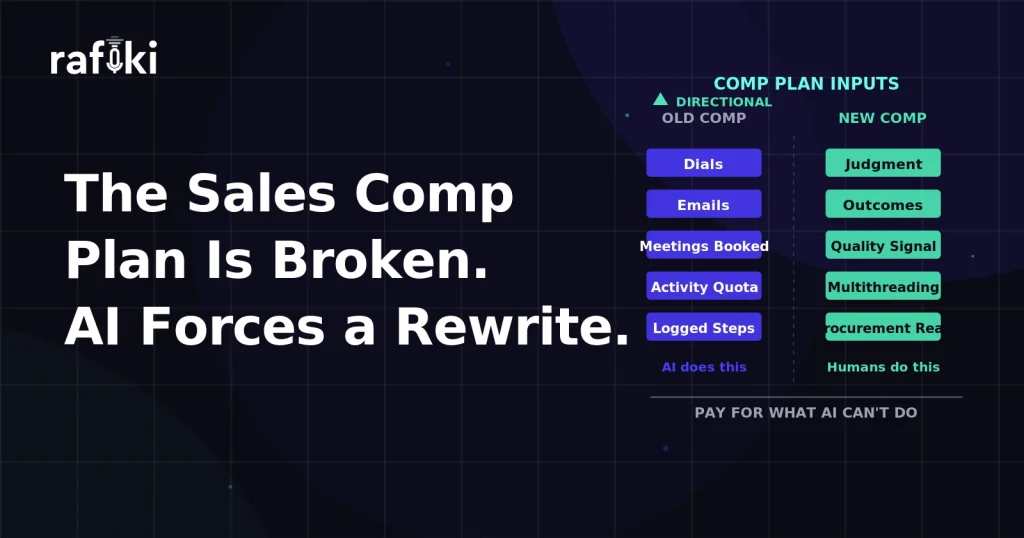
The old sales comp plan paid reps to do the work. The AI now does most of the work. The plan still pays for it. That is the problem in one line, and it is sitting under every CRO's desk going into H2 2026.
For most of the last decade, SaaS comp rewarded activity as a proxy for outcomes: dials placed, emails sent, meetings booked, deals worked. That math made sense when a human SDR was the rate-limiting step. It does not make sense in a world where autonomous AI agents handle the directional, repeatable work — dialing, summarizing, drafting follow-ups, syncing the CRM, scoring the call — and the rep's job has narrowed to the moments that actually move a deal.
Plans designed between 2018 and 2022 quietly mis-price the work. They reward reps for activities AI now generates faster and cheaper. They under-reward judgment — the strategic disqualification, the procurement signal caught early, the multithreading move that opens a champion. Every quarter the plan goes unchanged, the disconnect compounds.
This piece covers what the AI-era plan rewrites toward, why the conversation-data layer is the only honest input for it, and how to roll out the change in 90 days without losing the team.
The plan did not break with a single bang. It corroded. The first signs were small: a top SDR who hit 110% of activity quota but sourced fewer qualified meetings than the rep who dialed half as much. An AE who logged 14 "next steps" in a quarter and still missed the procurement timing that killed three deals. A team-wide MBO bonus paid at full attainment in a quarter where net new ARR was flat.
Each of those was the comp plan paying for inputs that no longer correlated with outcomes. The reason is structural — AI took over the input layer.
Harvard Business Review's 2025 research on AI in sales decision-making describes the pattern: the highest-performing teams are not paying reps to do more activity. They are using AI to absorb the activity layer and re-centering rep value on judgment and the calls that close. Plans still indexed on activity are paying twice — once to the AI tooling, once to the rep credited for it.
Start the rewrite with the three assumptions every legacy comp model encoded. Each made sense in 2018. Each is broken in 2026.
Assumption one: activities are a proxy for effort. The SDR who dialed 80 numbers yesterday — AI dialed 70 of them on her behalf. The AE who sent 40 personalized emails this week — most of the personalization came from a drafting agent. Counting activities as effort double-counts the AI layer and under-counts the judgment in the remaining 10 dials or 4 emails that actually shaped the deal.
Assumption two: the SDR-to-AE pipeline is a human-only handoff. AI agents now qualify, summarize, and structure the handoff. The meaningful question is no longer "did the SDR book the meeting" but "did the meeting progress to qualified opportunity, and which conversation moments made it so." That signal lives in the call, not the calendar.
Assumption three: quota is a volume game. Quota is increasingly a quality game. A rep working 18 strategic accounts can outperform a rep working 60 transactional ones, but a volume-indexed plan punishes the strategic rep for working a smaller list. The plan needs to price judgment, not volume.
None of this means activity is worthless. It means activity is no longer the unit the comp plan should be pricing.
The replacement model is not exotic. Two pillars the best comp plans were already inching toward before AI accelerated the math: outcomes and judgment.
Outcomes are the part most CROs already accept — net new ARR, expansion ARR, gross retention, qualified-meeting-to-opportunity conversion. These are the line items the CFO cares about. The problem was never that outcome-based comp was a bad idea. The problem was the comp engine never had clean attribution data to price it. Pipeline rollups were dirty. CRM hygiene was rep-dependent. Meeting outcomes lived in someone's Notion doc. Outcome comp without clean data is just activity comp with extra steps.
Judgment is the part that is new. Judgment moments are the points in a deal where a human decision moved the trajectory: a strategic disqualification that freed up cycles, a multithreading move that brought in the economic buyer, an early read on procurement that shortened the close cycle, a candid pricing conversation that protected margin. These were always valuable. They were never compensable because they were never observable at scale.
The conversation-data layer changes that. When every call is transcribed, scored, and summarized, judgment moments become observable, taggable, and reportable. The comp plan can finally see them.
This is not a softer plan. It is a sharper one. Reps generating the judgment work get paid more. Reps coasting on AI-generated activity get paid less. The plan starts pricing what is actually scarce.
Outcome-based and judgment-based comp share a dependency: objective, real-time data on what happened in the actual deal. Self-reported CRM notes will not carry the weight. Manager spot checks do not scale across a 50-rep team. Pipeline reports are too lagging to drive in-quarter behavior.
The conversation layer is the only honest source of that data. Every sales call — phone, Zoom, Teams, Meet — is the moment the deal is actually being moved. The transcripts, scores, summaries, methodology rubric attainment, and objection patterns are the raw signal an outcome-based plan needs. It is the only signal observable across every rep at the same fidelity, on the same rubric, at the same cadence.
Once you have it, the comp engine has an objective input layer that does not depend on rep self-reporting. The plan can credit a rep for the multithreading conversation that pulled in the CFO because the conversation actually happened and was captured. It can debit a rep for a deal that stalled at procurement because the call where procurement came up is searchable and the next-step language was wrong.
This is what makes outcome-based comp finally workable. The data is there. The comp engine just needs to read it.
The rewrite does not have to be revolutionary. Five components, weighted to stage and motion, cover most of what the AI-era plan needs to price.
The plan should fit on one page. Reps should predict their commission within 5%. Data inputs should be auditable in under 10 minutes. If the plan needs a 12-tab spreadsheet to explain, it is wrong.
Rafiki AI is an AI-native revenue intelligence platform. It is not a commissions engine. It does not calculate payouts, run draws, or replace your comp tooling. What it does is provide the underlying conversation-data signal that an outcome-based or judgment-based plan needs to actually function — clean, objective, auditable inputs that the comp engine, the CRO, and the rep can all trust.
The capabilities map directly onto the five-part framework above. The plan stays in your comp tooling. The signal comes from the conversation layer.
Because Rafiki is AI-native, it supports 60+ languages, starts at $19/seat with no seat minimums and no annual commitment, and sets up in about 15 minutes. The output is signal — not commission math — designed to plug into whatever comp tooling and BI layer you already run.
It would be a mistake to read this as "data replaces the CRO." It does not. The plan still has to be designed, signed off, and explained by humans. Three categories of decision do not get easier with better data — they get more visible.
Strategic account weighting. A handful of accounts in any portfolio carry disproportionate weight — a strategic logo, a multi-year reference customer, a new market entry. The plan has to credit work on those accounts even when the in-quarter outcome lags. No data layer makes that trade-off for you.
Comp politics and tenure. The plan rewrite affects mortgages. Reps who excelled under the old plan may underperform on the new metrics until they adapt. Grace periods, communication, and over-attainment protections are CRO calls, and the data does not soften them. The same goes for market-cycle adjustment — the conversation layer shows what is happening in the deals, not how to adjust quota math for a softening macro.
You do not rewrite a comp plan mid-quarter. You design the rewrite over 90 days, in three deliberate phases, so the new plan ships clean at the next plan boundary.
Ninety days is the trust timeline, not just the design timeline. Reps need to see the data, query it, push back on it, and believe the plan is priced on real evidence before they accept the rewrite. Compress this and the plan ships with a credibility deficit it never recovers from.
The simplest version of the AI-era comp plan is one line: pay reps for what AI can't do. Pay them for judgment. Pay them for the conversation that turned a stalled deal into a procurement schedule. Pay them for the multithreading that pulled in the CFO. Pay them for the strategic disqualification that freed cycles for a deal that closed. Pay them for outcomes you can defend at the board level, not activities AI generates at the click of a button.
The plans that survive the rewrite share one trait: an objective data layer underneath them. Without it, outcome-based comp collapses back into the spreadsheet politics every CRO has lived through before. With it, the plan finally prices the work that actually moves revenue.
HBR's 2025 research on sales teams growing alongside AI closes with a pattern that maps directly onto the comp rewrite: the teams pulling ahead are the ones that re-priced rep value toward the work AI cannot do. The plan is the most direct expression of that re-pricing.
See how Rafiki AI provides the objective conversation-data signal that an outcome-based and judgment-based comp plan needs — Smart Call Scoring on every call, Coaching Agent surfacing judgment moments, Gen AI Reports rolling up rep-level outcomes, Smart CRM Sync feeding clean attribution into Salesforce, HubSpot, Zoho, Pipedrive, Freshworks, or Monday.com. Starting at $19/seat, no seat minimums, no annual commitment, 15-minute setup. Start free or book a demo and put the signal layer in place before the next comp plan rewrite.
Start for free — no credit card, no seat minimums, no long contracts. Just better sales intelligence.