You're the founder. You're also the head of sales, the deal desk, the forecasting analyst, and the person who answers the board's question about "what's the quarter going to land at." There are three people on your sales team, including you, and exactly zero of them have time to build a forecasting model.
This is the reality for thousands of early-stage and growth-stage founders in 2026. The pressure to call the number is enormous — investors want predictability, the team wants visibility, and you want to sleep at night. But everywhere you look, the answer seems to be "hire a RevOps leader" or "buy an enterprise forecasting suite" — neither of which fits a three-person sales motion or a startup budget. So most founder-led teams just don't forecast. They guess, they hope, and they apologize to the board when the quarter shifts.
There is a better path. Sales forecasting for small teams has fundamentally changed in the last 18 months, and the change favors lean operators. AI is collapsing the enterprise forecasting toolchain — what used to require dedicated headcount, $400-per-seat platforms, and a quarter of implementation now runs on conversation intelligence, a clean CRM, and an autonomous Revenue Agent that does the rollup work while you sleep. The forecasting playbook no longer belongs to enterprises. It belongs to whoever sets it up first.
Walk into any seed-stage or Series A startup and ask the founder how they're tracking the quarter. You'll get one of three answers. The first is a confident "we're on track" with no underlying math. The second is a Google Sheet last updated nine days ago by someone who has since moved on to closing a deal. The third — and most honest — is "I don't really have a forecast." None of these are forecasts. They're statements of intent dressed up as data.
The reason founders skip forecasting is not laziness or lack of rigor. It's a calculation about cost. They've looked at the enterprise forecasting tools and seen prices that assume a 20-person sales org. They've considered hiring a RevOps analyst and decided the headcount is better spent on another AE. They've tried building a spreadsheet model and discovered that maintaining it takes longer than the deals it tracks. So they default to instinct.
The trouble is that instinct doesn't scale and doesn't survive scrutiny. When a board member asks, "Why do you think Q3 will be a million dollars?" the founder who answers "because we have a lot in the pipeline" is starting from a weaker position than the founder who can show deal-by-deal probability, weighted by conversation signals, with a confidence interval. The first founder gets follow-up questions. The second founder gets the next check.
Here's what breaks when founder-led teams forecast on instinct:
The hidden cost of skipping forecasting isn't the forecast itself — it's everything that depends on it. A founder who can't predict next quarter's revenue can't predict when to hire the next AE, when to launch the next pricing tier, when to start the next round, or when to spend on demand generation. Every downstream decision gets made on vibes.
According to research from Salesforce's State of Sales report, sales teams that operate without disciplined forecasting routines consistently report lower attainment, longer sales cycles, and more last-minute deal slippage than teams with even basic forecasting practices in place. The data is clear: forecasting is not a luxury for big teams. It's a survival skill for small ones — because small teams have less margin for error and less buffer to absorb a missed quarter.
The compounding cost looks like this:
The single biggest unlock for a founder-led sales team isn't a bigger pipeline. It's a more honest one. And honesty, at scale, requires automation — because no founder running their own pipeline has time to interview every deal every week.
For most of the last decade, enterprise forecasting meant stacking three or four separate tools — a conversation intelligence platform for call signals, a deal inspection tool for stage hygiene, a forecasting suite for the rollup, and an analytics layer for the reporting. Each tool had a six-figure annual contract, a seat minimum, and a dedicated admin. The combined stack was financially out of reach for any team under 30 reps and operationally out of reach for any team without a full-time RevOps function.
That stack has collapsed. AI-native platforms now deliver conversation intelligence, deal-health scoring, CRM hygiene, and forecast generation in a single integrated layer — without seat minimums, without annual commitments, and without the implementation timeline that used to make these tools unreachable for small teams. Research from McKinsey's Growth, Marketing and Sales practice consistently points to AI-enabled go-to-market motions as the largest source of productivity gain available to commercial teams right now — and the productivity gain disproportionately benefits smaller teams, because the absolute hours saved per person are higher when there are fewer people doing the work.
The practical implication for founders is striking. The forecasting capability that a 30-person sales org spent $400,000 a year on in 2022 is now available to a three-person team at a marginal cost. And the small team has structural advantages the big team doesn't: faster decisions, no internal politics, and a single source of pipeline truth because there are only three people creating opportunities in the first place.
Before talking about tooling, it helps to be honest about what a real forecast requires. A forecast is not a stage report. It's a probability-weighted projection of which deals will close, when, at what value, with what level of certainty. To produce that, a team needs four inputs:
The reason most founder-led teams can't produce this is not that the inputs are exotic. It's that gathering them manually is impossible at three-person scale. Every input requires either AI to extract it or hours of human work that founders don't have. The good news: every input is now solvable with autonomous AI agents, working continuously, at a price point that fits a startup budget.
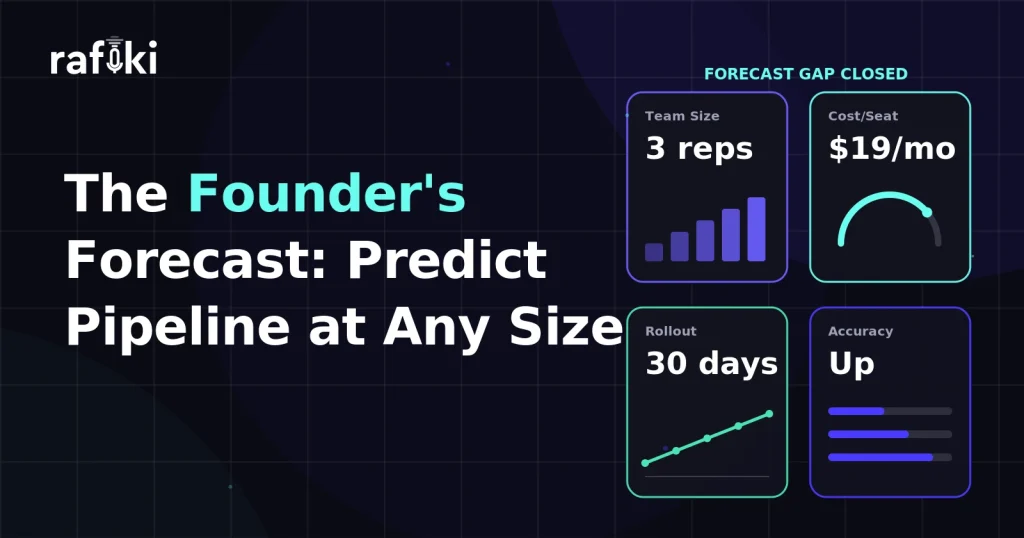
This is the exact problem Rafiki AI was built to solve. The platform's autonomous AI agents deliver the four forecasting inputs above — conversation signals, CRM hygiene, conversion benchmarks, and continuous rollup — out of the box, with no seat minimums, no annual commitment, and pricing that starts at $19 per seat per month. For a three-person sales team, the total cost is less than a single legacy forecasting license, and the setup takes 15 minutes, not 15 weeks.
Here's how each forecasting input maps to Rafiki AI's capabilities:
The autonomous AI agents work in concert as an always-on revenue intelligence team. For a founder running their own pipeline, the unlock is enormous: the same three people who used to have no forecast at all now operate with the rigor of a Series D revenue org — at a fraction of the cost. Explore how this stack maps to founder-led teams on the Rafiki AI for Founders page.
The single biggest mistake founder-led teams make in forecasting is over-weighting pipeline stage and under-weighting conversation content. Stage is a label a rep applies. Conversation content is what actually happened. When the two disagree, the conversation is almost always right.
The signals that predict close most reliably are extractable from calls, not from CRM stage:
A forecast that incorporates these signals is structurally more accurate than one based on stage alone. And for a founder, the signal-based forecast has a second benefit: it tells you what to do, not just what to expect. A deal flagged for low champion engagement is a deal where the founder can intervene this week. A deal flagged for unsigned procurement is a deal where the founder knows to slow the close-date assumption. The forecast becomes a workflow, not a report.
Every founder who has tried to forecast on a dirty CRM knows the feeling. You open the pipeline view, you see deals with close dates from three months ago, you see opportunities still sitting in "discovery" that closed weeks ago, you see ACVs that haven't been updated since the first conversation. The forecast that comes out of that data is fiction, and you know it before you finish reading it.
The hardest forecasting problem isn't the math — it's the data layer underneath it. And the data layer is exactly where small teams lose, because reps at small companies wear too many hats to be reliable data entry workers. The fix isn't a stricter policy. The fix is automation.
For more on the broader role of CRM hygiene in revenue operations, the Forrester B2B blog regularly publishes on the structural connection between data quality and pipeline accuracy. The throughline: forecast quality is data quality is conversation quality. Solve the conversation capture problem, automate the CRM sync, and the forecast stops being a separate project.
The point of lean tooling is fast time-to-value. A founder-led team should not need a quarter to stand up forecasting. Here's the sequence that gets a three-person team from no forecast to defensible forecast in 30 days.
By day 30, the founder is operating with forecasting rigor that would have required a full-time RevOps hire and a six-figure tooling contract in 2022. The cost is less than a single seat on a legacy platform. The setup happened in lunch breaks.
The most striking part of this shift is the cost compression. The forecasting capability that used to require an enterprise contract is now available at the price of a streaming service. For a three-person sales team, the math looks like this:
Compare that to the enterprise alternative: $50,000 to $200,000 per year for a forecasting suite, plus a RevOps analyst salary, plus a months-long implementation. The cost differential is not 10x. It is two orders of magnitude. That is what "the enterprise toolchain has collapsed" actually means in operational terms.
For founder-led teams, the implication is decisive. The reason to skip forecasting in 2026 isn't cost. The cost barrier is gone. The reason to skip is now just inertia — and inertia is the thing investors will not tolerate once they see what the modern stack looks like.
The old equation said forecasting required enterprise infrastructure: a RevOps function, a forecasting suite, a deal inspection tool, and a quarter of implementation. That equation is broken. AI-native platforms have compressed the toolchain into a single integrated layer, eliminated the seat minimums, and dropped the price to a point where a three-person sales team can operate with the same forecasting discipline as a 30-person team — and often with better data, because there are fewer hands touching the pipeline and more conversations being captured automatically.
For founders running their own pipeline, the strategic implication is clear. The forecasting capability is no longer rationed by company size or budget. It belongs to the operator who installs it first and runs it longest. The team that starts forecasting properly in June has six months of clean data by year-end. The team that waits until they "have time" has nothing.
Ready to build sales forecasting for small teams without the enterprise price tag? Explore Rafiki AI for founders, see the pricing (starting at $19 per seat per month, no seat minimums, no annual commitments), and tour the full platform. Rafiki AI's autonomous AI agents give founder-led teams the forecasting rigor of a Series D revenue org — at a price that fits a seed-stage budget, with a setup that fits a coffee break.
Start for free — no credit card, no seat minimums, no long contracts. Just better sales intelligence.