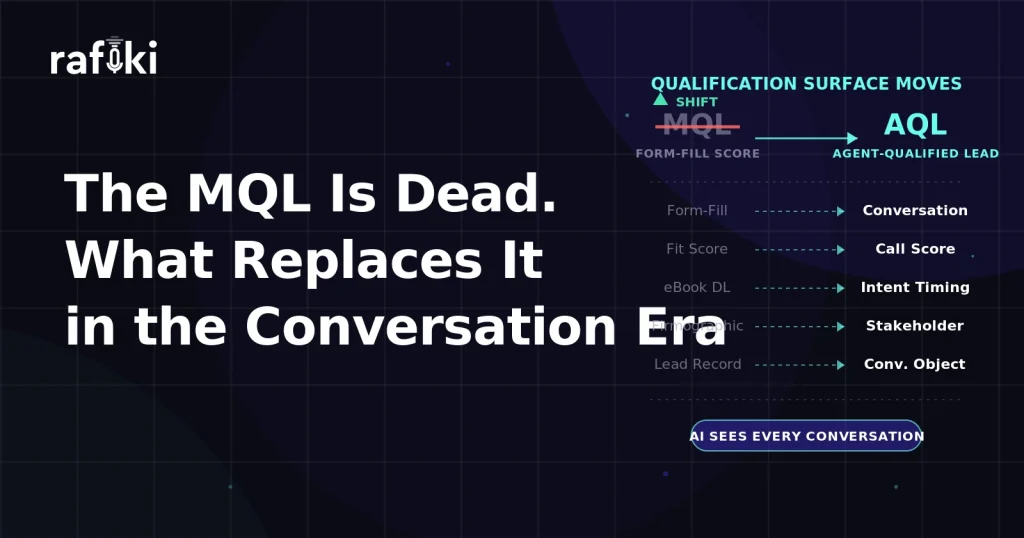
The Marketing Qualified Lead was a clever hack invented around 2010 to give marketing a number it could own. It quietly stopped working sometime in 2024. By 2026, with AI listening to every sales conversation, the qualification surface has moved off the form and onto the call — and the marketing teams that have figured this out are reporting pipeline-sourced revenue with a confidence their peers can't match.
For fifteen years, MQL was the connective tissue between marketing and sales. Marketing ran demand programs, scored the resulting form-fills against a fit-and-behavior model, and threw a "qualified" lead over the fence to sales. Sales worked the lead, marked it accepted or rejected, and a board-deck attribution model tied marketing's spend back to closed revenue through that single object. The system held together because the form-fill was the only meaningful digital signal a buyer left before talking to a human.
That premise is no longer true. Buyers route around forms with research tools, AI agents fill out fake forms at scale, and the highest-intent prospects increasingly show up cold from a podcast or a peer recommendation with no MQL footprint at all. Meanwhile, the boards funding marketing now ask a sharper question: not "how many MQLs did we generate," but "how much pipeline came from real, in-market conversations, and how much closed." The conversation layer — every sales call, every executive meeting, every demo — has become the richest source of qualification signal in the entire buying journey, and AI can now see all of it. AI lead qualification doesn't replace marketing; it replaces the proxy marketing was using.
The MQL was always an imperfect proxy. It rewarded behavior that correlated loosely with intent — eBook downloads, webinar registrations, pricing-page visits — and combined that with firmographic fit scores recycled from CRM data. For a long time, that loose correlation was good enough because there was no better signal cheap enough to operationalize. Today there is.
Three structural changes have hollowed out the MQL's usefulness. Form-fill volume is declining as buyers protect their inboxes. Generative AI is filling fake forms faster than scoring models can catch them, polluting the lead database with noise. And executive leadership has started asking the harder question marketing automation was never built to answer: of the leads we marked qualified, how many actually had a real buying conversation, and how many of those converted to revenue? The answer, when teams run it honestly, tends to be embarrassing.
Harvard Business Review's reporting on how companies are using AI to make faster decisions in sales and marketing reinforces the underlying shift: the teams pulling ahead are the ones that have moved decision-making from periodic batch reviews to continuous, conversation-grounded signal. The MQL is a batch-review artifact. The conversation layer is continuous.
A new term has been working its way through demand-gen leadership circles: the Agent-Qualified Lead, or AQL. The idea is straightforward. An AQL is an account or contact that an autonomous AI agent has actively qualified based on signal from real conversations, not from a form-fill score. The agent listens to discovery calls, executive meetings, and sales conversations, extracts in-market intent and fit, and writes a qualification verdict back to the CRM with the evidence attached.
This isn't a Rafiki invention. The pattern has been emerging across the demand-gen practitioner community as marketing teams look for a qualification object that survives the death of form-based lead scoring. Rafiki endorses it because it matches what AI-native conversation intelligence platforms actually do, and because it gives marketing a defensible unit that ties to revenue more tightly than MQL ever did.
The marketing leader who moves to AQL is not losing the qualification function — they are upgrading the qualification object from a proxy to a primary source.
If you accept that the most useful qualification signal lives in actual conversations, the architectural implication is dramatic. The qualification surface stops being a marketing automation platform and starts being the conversation intelligence layer. The handoff stops being a lead record and starts being a conversation record. Marketing's job stops being "deliver a scored lead to sales" and starts being "deliver an in-market account into a qualifying conversation, then measure the conversation."
This is a category shift, not a tooling shift. The conversation layer was originally bought by sales for coaching and forecasting. It's now the most important data surface in the marketing-sales handoff because it sees what forms never saw: the real, current, expressed intent of the buyer in their own words.
For marketing operations leaders, this means a meaningful re-platforming of how qualification gets defined, scored, and reported — but it's also a release from the worst part of the MQL era, which was defending a lead-volume metric to a CFO who didn't believe in it.
A single sales conversation contains more usable qualification signal than the lifetime form-fill history of most leads. Modern conversation intelligence extracts that signal at scale, structures it, and routes it to the systems marketing and sales already operate. Here are the five categories of signal that most fundamentally change qualification:
None of these signals are extractable from a form. All of them are extractable from a recorded call by an AI agent trained on the right rubric. This is the difference between qualification by guess and qualification by evidence.
For most of the last decade, the handoff between marketing and sales has been a lead record. Marketing fills the record with form-fill behavior and a fit score. Sales accepts or rejects. The record moves through the pipeline. Attribution is a chain of CRM stage changes glued to the original lead source.
In the conversation-grounded model, the handoff is a conversation. Marketing's job is to route an in-market account into a first qualifying conversation. The conversation itself — its score, its signal, its outcome — becomes the artifact that triggers acceptance, drives stage progression, and powers attribution. The lead record still exists, but it has been demoted from the qualifying object to a metadata wrapper around the actual qualifying event, which is the call.
The marketing organization that runs this loop gets something the MQL era never gave them: a defensible line from a campaign dollar to a real, scored conversation to a closed-won deal, with the supporting call moments cited along the way.
Rafiki AI is an AI-native revenue intelligence platform built around autonomous AI agents that work across the entire revenue motion. For the marketing-sales handoff specifically, several capabilities map directly to the conversation-level qualification model:
Because Rafiki AI is AI-native — built on a multi-model architecture, not retrofitted from a legacy recorder — it handles the linguistic nuance modern qualification requires. It supports 60+ languages, integrates with Zoom, Microsoft Teams, and Google Meet on the meeting side, with Slack, Aircall, and OpenPhone for dialing and messaging — and starts at $19/seat with no seat minimums, no annual commitment, and 15-minute setup. Marketing operations leaders do not need a new procurement cycle to add conversation-level qualification to their stack.
If the MQL is going away, demand-gen leaders need a new set of metrics that hold up to CFO scrutiny and align with how the business actually generates revenue. The following five form a coherent operating set — measurable, conversation-grounded, and tied to outcomes that matter on the board deck.
These metrics share a property the MQL never had: they all collapse if you can't point to an actual conversation. That makes them harder to game, easier to defend, and more useful for prioritization.
It is important to be honest about what this shift does and doesn't change. AI-grounded qualification replaces a measurement proxy. It does not replace the underlying work that creates demand in the first place. Brand-building, category education, content, events, partnerships, ABM motions — all of that is still essential, and arguably more essential as the qualifying conversation becomes the unit of measurement.
What changes is how marketing's contribution gets counted. Instead of measuring success by the volume of leads marked qualified by a form-based model, marketing measures success by the volume and quality of in-market conversations its programs produced. That is a better, more honest measurement of what marketing does — and for most teams it will tell a more flattering story than the MQL-volume one ever did, because the high-quality programs were never the ones generating the biggest lead lists.
HBR's analysis of how sales teams use generative AI to discover what clients need makes a related point: the highest-value AI applications are the ones that make implicit signal explicit. Marketing has always known its best work was the work that created real conversations. The conversation layer now lets that be measured.
Demand-gen and RevOps leaders don't need a multi-quarter transformation to start operating in the conversation-qualified model. A focused 60-day pilot, scoped to one segment or one campaign, produces enough evidence to make the broader case.
By day 60, the marketing organization has something most peers don't: a parallel, conversation-grounded view of its contribution to revenue, with the receipts to back every number. That is the credibility marketing has been chasing since the MQL was invented — and it finally comes from the same data source the rest of the revenue org is operating from.
The MQL was a useful abstraction for an era when buying signals were scarce and form-fills were the best digital proxy available. That era is over. Buyers leave more signal in a 20-minute discovery call than they ever left in five years of form-fill history. AI can now extract that signal at scale, score it against a rubric the business agrees on, and write the verdict to the CRM alongside the call moments that justify it. The qualification surface has moved.
Demand-gen leaders who lean into this shift get more than a new metric. They get marketing's first honest line into closed revenue, a defensible answer to the CFO question that has dogged the function for fifteen years, and a measurement model that survives the next wave of AI disruption to the buyer journey because it doesn't depend on form-fills, batch scoring, or attribution models built on weak proxies.
The marketing teams moving on this in 2026 will be reporting conversation-grounded pipeline while their peers are still defending MQL volume to a board that stopped believing the number two years ago. The window to build the capability quietly, before it becomes table stakes, is open right now.
See how Rafiki AI's product overview wires conversation-level qualification into the same CRM and revenue stack marketing already runs. Explore Rafiki's autonomous AI agents to understand how Smart Call Scoring, Smart Call Summary, Ask Rafiki, and Smart CRM Sync turn the marketing-sales handoff into a conversation-grounded operating model. Starting at $19/seat with no seat minimums, no annual commitment, and 15-minute setup — the post-MQL handoff without a procurement cycle.
Start for free — no credit card, no seat minimums, no long contracts. Just better sales intelligence.