Revenue Operations

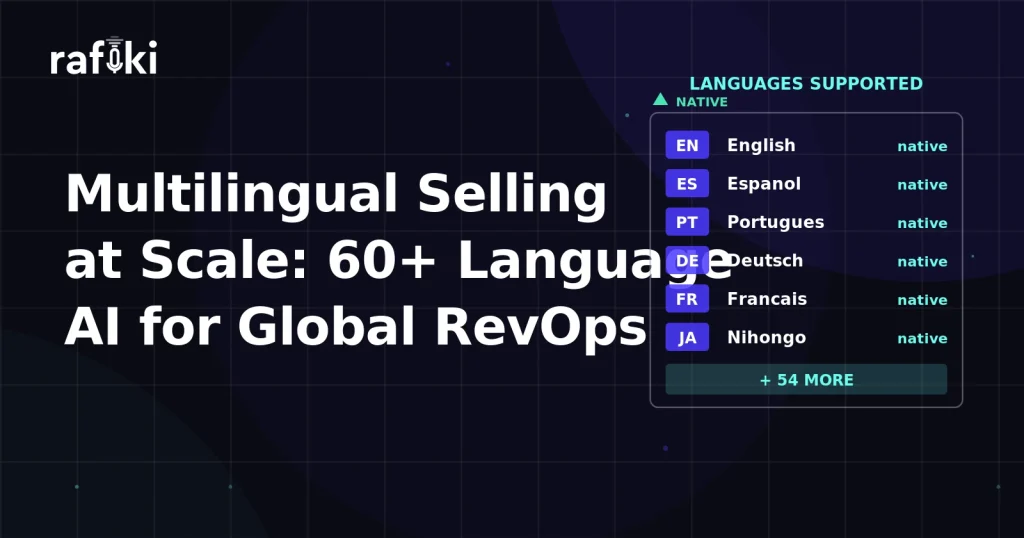
Multilingual Selling at Scale: 60+ Language AI for RevOps
Jun 12, 2026
14 min read
Global pipeline is multilingual. The conversation intelligence stack you bought in 2023 almost certainly isn't — and every quarter you let it pretend the world sells in English is a tax you're paying on every non-English deal in your CRM.
Walk into any growth-stage SaaS company in 2026 and the revenue map looks nothing like the org chart drawn three years ago. The deal in Sao Paulo is being closed in Portuguese. The renewal in Munich is happening in German. The expansion conversation in Tokyo is in Japanese, the discovery call in Mexico City is in Spanish, the executive review in Paris is in French. Net-new pipeline outside North America is now the single fastest-growing line item on most revenue dashboards. And yet the AI stack analyzing those conversations — scoring them, summarizing them, coaching the reps who ran them — is almost always tuned for one language. English.
The result is a structural blind spot that compounds quietly every week. Calls in non-English markets get recorded but not analyzed. Coaching surfaces only what the English-speaking AEs say. Forecast meetings end up over-indexed on the regions the AI can read, which means the most under-coached pipeline is also the most invisible to leadership. For RevOps leaders running global motions, this isn't a feature gap. It's a forecast risk.
The companies pulling ahead in international markets are the ones who treated multilingual conversation intelligence as table stakes, not a roadmap item. They picked a stack that operates natively in 60+ languages — not one that translates first and then analyzes the English approximation, losing every nuance that mattered. This article is about what that shift unlocks, why the English-only stack was always a temporary compromise, and how to stand up a multilingual RevOps motion in 60 days.
Most conversation intelligence platforms were built in San Francisco for AEs selling SaaS to North American buyers. That bias is baked into the data they were trained on, the scoring rubrics they ship with, and the coaching prompts their LLMs default to. When those platforms eventually added "multilingual support," what they usually shipped was a translation pipeline — transcribe the call in the local language, machine-translate the transcript to English, then run all the analysis on the English version. It works on a demo. It falls apart in production.
Translation-first analysis loses the signal that actually matters. Tone, idiom, formality register, regional buying vocabulary, the difference between a polite Japanese deferral and a hard objection, the specific Portuguese verb construction a Brazilian buyer uses when they're stalling — all of it gets flattened into a generic English approximation. The scoring rubric then evaluates that approximation, not the conversation. Coaching feedback gets generated against the translation, which means the rep is being coached on a sentence they never said. The whole loop is structurally lossy.
There's a second, quieter problem. English-default platforms tend to drop confidence on non-English transcripts without telling anyone. Word error rates climb, named-entity recognition gets shaky, speaker diarization gets confused by code-switching. Nobody on the RevOps team sees those degradations because the platform still produces a summary, still generates a score, still pushes something to the CRM. The output looks the same. The signal underneath has collapsed.
"Multilingual" is the most overloaded word in revenue tech. Some platforms mean "we can transcribe in this language." Others mean "we machine-translate then analyze." A small number mean what the phrase should actually mean: every layer of the conversation intelligence stack — transcription, scoring, summary, search, coaching — operates natively in the source language. No translation hop. No signal loss. The Spanish call is analyzed in Spanish. The Portuguese call is analyzed in Portuguese. The German call is analyzed in German. That's the bar.
In practice, native multilingual operation means five things have to work end-to-end without ever dropping into English-only mode. Transcription has to be tuned per language, with vocabulary models that handle local sales terminology. Scoring rubrics have to evaluate the conversation against criteria that make sense for the local buying culture, not a translated copy of a US rubric. Summaries have to read like they were written by someone who actually understood the conversation. Search has to retrieve across language boundaries. Coaching has to give the rep feedback in the language they were selling in.
The compounding effect is what matters. Each of those five capabilities is useful on its own. Wired together, in-language, they make a non-English market just as legible to RevOps leadership as the North American one. The Brazilian pipeline becomes as forecastable as the US pipeline. The German renewal motion becomes as coachable as the Texas one. That's the actual unlock.
Talk to any global RevOps leader and a pattern emerges. The North American team has weekly coaching loops, scored calls, structured pipeline reviews, and detailed forecast hygiene. The LATAM team is running on tribal knowledge. The EMEA team gets one regional pipeline review a month. The APAC team is essentially a black box to global leadership — the regional VP has the picture, nobody else does. This isn't because the international teams are less mature. It's because the tooling stops working when the conversation stops being English.
The downstream effects are predictable and expensive. International ramp times stretch because new hires aren't getting the same call-by-call coaching that their North American counterparts get. Pipeline quality varies wildly across regions because there's no consistent scoring rubric being applied to non-English calls. Win-rate analysis ends up restricted to the markets the analytics stack can read, so global decisions get made on a North American sample. Top performers in non-English markets don't get amplified because their winning language never gets surfaced in coaching libraries. The international flywheel never spins up.
Recent Harvard Business Review analysis on how sales teams are embracing agentic AI makes the broader point: the teams pulling ahead are the ones who removed the structural barriers that kept AI from operating across the full revenue motion. Language is one of those barriers. Removing it isn't optional anymore for any company with non-English pipeline.
The cleanest way to see the cost of English-default conversation intelligence is to walk through the workflows that quietly break in non-English markets. None of these are exotic. They're the standard motions every modern revenue team runs — and they all degrade silently the moment the conversation isn't in English.
Each broken workflow is a RevOps problem disguised as a regional one. Leadership tends to attribute the gap to "the international team needs to mature" when the actual root cause is that the tooling can't see what the international team is doing. Fix the tooling and the regional maturity gap closes faster than any change-management program could close it.
Any one of these in isolation looks like a small inefficiency. All five together, compounded over a year, are why international expansion projects keep underperforming the business case the board approved. The pipeline was real. The execution layer was English-only.
Rafiki AI is an AI-native revenue intelligence platform built on a multi-model architecture that operates natively in 60+ languages. Native, in this context, means exactly what it sounds like: transcription, scoring, summary, search, and coaching all happen in the source language without a lossy translation hop in the middle. A Portuguese call in Sao Paulo is transcribed in Portuguese, scored against your rubric interpreted in Portuguese, summarized in Portuguese, and coached in Portuguese. The CRM fields update from the Portuguese signal, not from a translated approximation of it.
The autonomous AI agents that handle this work were built from the start to operate cross-lingually. The same Smart Call Scoring that evaluates a discovery call in English evaluates one in German. The same Coaching Agent that gives feedback to an AE in Boston gives feedback to one in Berlin — in German, framed against German B2B buying norms, not against a translated US script. The same Ask Rafiki query searches across the entire conversation corpus regardless of language, so a global RevOps leader can ask one question and get hits from every region in one ranked list.
Because Rafiki AI is AI-native — multi-model architecture rather than retrofitted from an English-first recorder — the multilingual operation isn't an add-on tier. It's the default behavior, included from day one. Integrations span Salesforce, HubSpot, Zoho, Pipedrive, Freshworks, and Monday.com on the CRM side, Zoom, Microsoft Teams, and Google Meet on the meetings side, and Slack, Aircall, and OpenPhone for messaging and dialing. Starts at $19/seat with no seat minimums, no annual commitment, and 15-minute setup — so the international rollout doesn't require a separate budget cycle or a quarter-long procurement cycle per region.
One of the most under-appreciated patterns in global RevOps is the reporting asymmetry. The buyer speaks one language. The rep is selling in that language. The regional manager wants a summary in a second language. The global VP wants a roll-up in a third. The board deck has to read in a fourth. Trying to solve that chain by hand — having the rep write a translated summary, or having a manager re-summarize the rep's notes — is where most of the post-call data quality dies.
Native multilingual conversation intelligence collapses that chain. The call happens in Portuguese. Smart Call Summary produces a structured summary in Portuguese for the rep and the local manager. The same summary gets re-rendered in English for the global VP, without re-running the analysis — because the analysis happened in Portuguese, the English output is a translation of the structured summary, not a translation of the raw transcript. Signal is preserved; reading language is flexible.
This is what removes the "let's wait for the regional VP's interpretation" delay from every global pipeline review. The data is already in the language each reader needs. The conversation that actually happened stays preserved in the language it actually happened in. Harvard Business Review's coverage of AI in sales decision-making highlights this kind of structural acceleration as one of the strongest patterns in teams pulling ahead — removing the translation and interpretation steps that used to slow every cross-region decision.
A common workaround for English-default tooling is to ask international reps to sell in English when they can — at least on the calls leadership wants visibility into. It's a quiet but expensive policy. The rep performs worse because they're selling in a non-native language. The buyer performs worse because they're being asked to do the same. The conversation gets stilted, the relationship gets thinner, the deal gets harder. Then leadership uses that harder deal as evidence the international motion needs more coaching — coaching that's, again, in English.
The right move is the opposite. Let the rep sell in the language the buyer prefers. Have the AI coach the rep in that same language, against criteria that make sense in that buying culture. The rep gets better at selling in Spanish to Spanish-speaking buyers, in German to German-speaking buyers, in Japanese to Japanese-speaking buyers. The deals close at higher rates. The relationships are stronger. The coaching feedback is actually applicable because it was generated against the conversation that actually happened.
The Coaching Agent in Rafiki AI runs this loop natively. The Spanish call gets analyzed in Spanish, scored against rubric criteria interpreted in Spanish, and the rep gets specific coaching prompts in Spanish — surfaced inside the same workflow a North American rep uses to get coached in English. Role Play scenarios can be run in the rep's selling language, against realistic buyer personas in that language. The coaching loop that used to only work in the headquarters language now works in every language the team sells in.
You don't need a multi-quarter transformation to get multilingual conversation intelligence operational. A 60-day plan, sequenced around capture, scoring, and roll-up, produces real value inside a single quarter.
By day 60, the international pipeline is being instrumented at parity with the North American pipeline. Coaching is happening in every language. Roll-ups are language-agnostic. The forecast meeting stops being a story about North America with footnotes about everywhere else.
If your conversation intelligence stack operates in one language and your buyers operate in twenty, your AI is doing about a fifth of the job you're paying it to do. That math doesn't get better. It gets worse every quarter international pipeline grows, which it will, because international is where the growth is.
Native multilingual conversation intelligence isn't a feature anymore. It's the entry ticket to credibly running global revenue. The companies treating 60+ language operation as default are quietly building a coaching, scoring, and forecasting moat that English-default platforms structurally can't match — because the gap isn't a product roadmap item, it's an architectural choice made years ago when the stack was first built.
The window to build a multilingual RevOps motion before it becomes table stakes is still open — but it's closing as fast as the international markets you're trying to win. The RevOps leaders moving on this in 2026 will have a global, language-agnostic view of their book of business while their peers are still trying to read translated transcripts on Friday afternoons.
See how Rafiki AI's autonomous AI agents operate natively across 60+ languages — with in-language call scoring, cross-region coaching, cross-lingual search, and executive summaries in whatever language the reader needs. Explore the full Rafiki AI product overview to see how multilingual conversation intelligence works across the entire revenue motion. Starting at $19/seat with no seat minimums, no annual commitment, and 15-minute setup — enterprise-grade global intelligence without enterprise-grade lock-in.
Start for free — no credit card, no seat minimums, no long contracts. Just better sales intelligence.