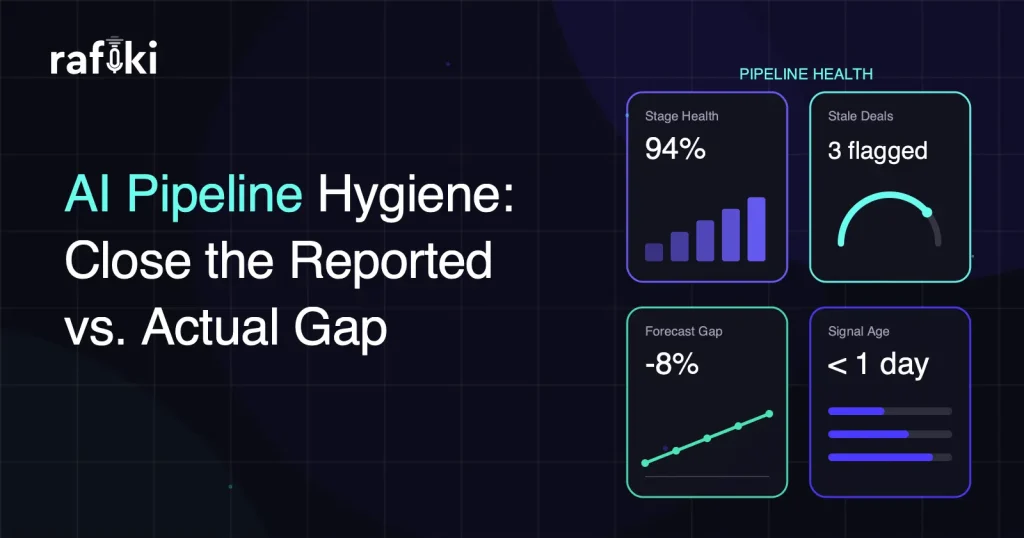
Your pipeline says you are closing $2.4 million this quarter — but finance is planning around $1.6 million, and they will be right.
The gap between reported pipeline value and actual booked revenue is one of the most corrosive problems in B2B sales. It erodes board confidence, blows up hiring plans, triggers end-of-quarter fire drills, and forces leadership into reactive mode quarter after quarter. In 2026, the average sales organization still carries pipeline numbers inflated by stale opportunities, happy-ears forecasting, and CRM records that have not been updated since the discovery call. The result is a systemic trust deficit between sales, finance, and the C-suite — one that no amount of manual pipeline reviews can fix.
What makes this worse is that the signals needed to separate real pipeline from phantom pipeline already exist. They live in the conversations your team has every day — the hesitation in a champion's voice when discussing budget, the sudden appearance of a new stakeholder who was never mentioned in the deal notes, the three-week gap between meetings that nobody flagged. These signals are buried, unstructured, and invisible to anyone relying on CRM fields and rep self-reports. AI pipeline hygiene is the practice of using autonomous intelligence to continuously audit, validate, and correct pipeline data based on what actually happens in buyer interactions — not what reps remember to log.
The Status Quo: Why Manual Pipeline Reviews Fail in 2026
Manual pipeline hygiene relies on a weekly or biweekly cadence where managers sit down with reps, walk through open opportunities, and make judgment calls about stage, close date, and deal value. This model was designed for an era when a rep carried fifteen to twenty deals. It collapses when teams are running fifty-plus active opportunities across multiple segments, geographies, and buying committees.
- Recency bias dominates. Reps update the deals they touched most recently and forget the rest. Opportunities that are quietly dying receive no attention until the close date passes.
- Self-reported data is unreliable by nature. Reps have an incentive to keep deals alive in the pipeline — removing them means admitting loss, inviting scrutiny, or shrinking their own quota attainment projection.
- Snapshot reviews miss velocity changes. A deal that moved from Stage 2 to Stage 4 in a week looks great on paper. But if the conversation recordings reveal the prospect skipped technical validation and is rushing toward a decision with no procurement alignment, that velocity is a red flag, not a green one.
- Manager bandwidth is finite. Even a strong frontline manager cannot listen to every call, read every email thread, and cross-reference every CRM update across a team of eight to twelve reps. The math does not work.
The consequence is predictable. Pipeline numbers look healthy at the start of the quarter and deteriorate steadily as reality sets in. Leadership learns to discount the forecast by some arbitrary percentage — which defeats the purpose of having a pipeline at all.
The Real Cost of Pipeline Rot: Beyond Missed Forecasts
Pipeline rot refers to the accumulation of stale, misrepresented, or zombie opportunities that inflate reported pipeline without contributing to actual revenue. Its damage extends far beyond inaccurate forecasts.
- Resource misallocation. Solutions engineers, executives, and marketing teams invest time in deals that are already dead. When pipeline is significantly inflated, a meaningful share of your technical pre-sales effort is wasted on opportunities that will never close.
- Delayed hiring and investment decisions. CFOs base headcount plans, territory assignments, and marketing budgets on revenue projections. When those projections consistently miss, the organization enters a cycle of over-hiring then cutting, or worse, under-investing in segments that are actually growing.
- Rep burnout and morale erosion. Reps who carry bloated pipelines feel perpetually behind. They spend hours in deal review meetings defending opportunities they privately know are unlikely to close. The administrative theater crowds out actual selling time.
- Lost competitive positioning. While your team is nursing zombie deals, competitors are focusing their energy on winnable opportunities and moving faster through decision cycles.
According to Forrester, B2B organizations that fail to adopt AI-driven revenue operations risk falling behind peers who are already using predictive intelligence to reallocate resources toward the highest-probability outcomes. The gap between data-rich organizations and those still relying on manual processes is widening every quarter.
What AI Pipeline Hygiene Actually Means
AI pipeline hygiene is the continuous, automated process of validating every open opportunity against real buyer signals — conversation sentiment, stakeholder engagement, objection patterns, competitive mentions, and deal velocity — rather than relying on static CRM fields updated by reps. It operates on three core principles.
- Signal extraction over self-reporting. Instead of asking a rep "Is the economic buyer engaged?" the system analyzes call recordings and identifies whether a person with budget authority has actually participated in a conversation, asked procurement-related questions, or expressed urgency.
- Continuous validation, not periodic review. Pipeline hygiene is not a weekly event. It runs after every interaction — every call, every email, every meeting — updating deal health scores in real time.
- Framework-aligned scoring. Deals are evaluated against established methodologies like MEDDIC, BANT, or SPICED, with each criterion scored based on conversational evidence rather than subjective rep input.
The shift is fundamental. Traditional pipeline management asks reps to describe reality. AI pipeline hygiene observes reality directly and flags discrepancies between what the CRM says and what the conversations reveal.
The Five Signals That Separate Real Deals from Phantom Pipeline
Not all pipeline signals carry equal weight. AI-driven systems excel at detecting the specific patterns that most reliably predict whether a deal will close or stall. Here are the five signal categories that matter most.
1. Stakeholder Breadth and Authority
Deals with a single point of contact are fragile. AI pipeline hygiene tracks how many distinct stakeholders have participated in calls, whether those stakeholders hold decision-making authority, and whether new voices are entering or exiting the conversation over time.
- A deal where only a mid-level champion has been on calls for six weeks is at risk regardless of what the CRM stage says.
- A deal where procurement, legal, or finance stakeholders suddenly appear signals that the buying process is advancing.
2. Objection and Risk Patterns
Every deal has objections. What matters is whether those objections are being addressed or simply acknowledged and ignored. AI models analyze whether the same concerns reappear across multiple calls — a pattern that indicates the rep is not resolving them.
- Recurring budget objections across three or more calls without a mitigation strategy signal a deal likely to stall at negotiation.
- Competitive mentions that increase in frequency suggest the buyer is actively evaluating alternatives.
3. Conversation Velocity and Gaps
Healthy deals have a rhythm. Meetings happen at regular intervals, next steps are confirmed, and follow-ups occur within committed timelines. AI pipeline hygiene detects when that rhythm breaks.
- A gap of more than two weeks between substantive conversations in a mid-stage deal is a strong stall indicator.
- Meetings that get shorter over time, or shift from multi-stakeholder to single-contact, often indicate declining buyer interest.
4. Next-Step Specificity
Vague next steps — "let's circle back next week" — are one of the most reliable indicators of a deal that is going nowhere. AI systems score the specificity and commitment level of next steps discussed on every call.
- A confirmed next step with a named participant, a clear agenda, and a calendar invite is categorically different from a verbal agreement to "connect soon."
- Deals where next steps degrade in specificity over successive calls are trending toward loss.
5. Sentiment and Engagement Trajectory
Buyer sentiment is not static. It shifts across the deal cycle, and those shifts contain information that CRM fields cannot capture. Multi-model AI analyzes tone, word choice, question patterns, and engagement levels to produce a sentiment trajectory for every deal.
- A deal where buyer enthusiasm peaked at the demo stage and has declined in every subsequent call needs immediate intervention.
- Increasing engagement from technical stakeholders while executive engagement flatlines suggests the deal is at risk of stalling at the approval stage.
These five signal categories, when tracked autonomously and scored continuously, create a pipeline picture that is dramatically more accurate than anything a weekly forecast call can produce.
Building an AI Pipeline Hygiene Framework for Your Team
Adopting AI pipeline hygiene is not a tool swap — it is a process change. The organizations that get the most value follow a phased approach that aligns technology, process, and culture.
- Phase 1: Establish a single source of truth. Retire spreadsheet-based pipeline tracking. Ensure every conversation — calls, video meetings, and follow-ups — flows into a system that can analyze and score them automatically. This means integrating your meeting platforms, CRM, and revenue intelligence layer into a unified architecture.
- Phase 2: Define scoring criteria tied to your methodology. Whether you use MEDDIC, BANT, SPICED, or a custom framework, map each qualification criterion to specific conversational evidence. "Metrics identified" in MEDDIC, for example, should require the AI to surface a specific business case discussed on a recorded call — not a checkbox a rep fills in.
- Phase 3: Automate CRM hygiene. The biggest friction point in pipeline accuracy is the CRM itself. Stage, close date, and deal value should update based on what the AI observes, with reps able to override with a documented reason. This eliminates the data entry burden and removes the incentive to leave stale data in place.
- Phase 4: Shift manager reviews from interrogation to exception handling. Instead of walking through every deal, managers focus only on opportunities where the AI has flagged a discrepancy — a deal staged at "negotiation" where no pricing conversation has occurred, or a deal marked for this-quarter close where the last meeting was three weeks ago.
- Phase 5: Connect pipeline intelligence to forecasting. Use AI-validated pipeline scores as the primary input for revenue forecasts. This closes the loop between pipeline hygiene and financial planning, giving finance and leadership a number they can trust.
This framework works because it replaces subjective judgment with observable evidence at every stage. It does not remove the rep from the process — it gives them better data and frees them to focus on selling instead of reporting.
How Rafiki Powers AI Pipeline Hygiene at Scale
Implementing the framework above requires a platform built from the ground up for autonomous pipeline intelligence — not a call recorder with analytics bolted on. Rafiki is an AI-native revenue intelligence platform designed precisely for this use case, with six autonomous AI agents that work around the clock to keep your pipeline clean and your forecasts accurate.
- Smart Call Scoring evaluates every conversation against MEDDIC, BANT, or SPIN frameworks automatically. Instead of reps self-assessing deal qualification, Rafiki extracts evidence from the actual conversation and scores each criterion objectively. When a deal is staged at "validation" but the scoring reveals no technical requirements have been discussed, the discrepancy is flagged instantly.
- Smart CRM Sync eliminates the CRM data entry gap that causes pipeline rot. Deal fields, contact roles, next steps, and stage-relevant data flow from conversations into Salesforce, HubSpot, Zoho, Pipedrive, or Freshworks without rep intervention. This is not a one-time sync — it updates continuously as new interactions occur.
- Gen AI Reports synthesize pipeline health across your entire team, surfacing the deals most at risk of slipping, the reps with the widest gap between reported and AI-validated pipeline, and the patterns driving wins and losses across segments.
- Ask Rafiki Anything lets managers and RevOps leaders query their pipeline conversationally — "Which deals closing this quarter have not had a call with an economic buyer?" — and get instant, evidence-backed answers.
Rafiki supports 60+ languages, which means global teams get the same level of pipeline intelligence regardless of what language the buyer conversation happens in. Setup takes fifteen minutes, integrates with Zoom, Teams, and Google Meet, and starts at $19 per seat per month with no seat minimums and no annual contracts. This is enterprise-grade AI pipeline hygiene accessible to growing teams — not just organizations with six-figure tool budgets.
Implementation: A 30-Day Rollout Plan
Moving from manual pipeline reviews to AI-driven hygiene does not require a six-month transformation program. Here is a practical 30-day rollout that produces measurable results.
- Days 1-3: Connect your stack. Integrate your meeting platform (Zoom, Teams, Google Meet), CRM, and Rafiki. Enable automatic recording and transcription for all sales conversations. This creates the data foundation everything else depends on.
- Days 4-7: Configure scoring frameworks. Align Smart Call Scoring to the qualification methodology your team uses. If you use MEDDIC, map each letter to the conversational evidence required. Work with your enablement team to define what "good" looks like for each criterion.
- Days 8-14: Run a pipeline audit. Let the system analyze two weeks of conversations against your current pipeline. Compare AI-validated deal stages to CRM-reported stages. Identify the deals with the largest discrepancies — these are your highest-risk opportunities and your proof of concept.
- Days 15-21: Redesign your deal review cadence. Shift from full pipeline walk-throughs to exception-based reviews. Managers focus on flagged deals. Reps present only opportunities where they disagree with the AI assessment, with evidence from the conversation to support their position.
- Days 22-30: Connect to forecasting. Begin using AI-validated pipeline scores as the primary input for your weekly and monthly forecast. Track the delta between AI-informed forecasts and your previous methodology. Share results with finance and leadership to build cross-functional trust.
Most teams see a meaningful improvement in forecast accuracy within the first full quarter. The compounding effect — cleaner data, better resource allocation, more focused coaching — accelerates from there. For a deeper exploration of how conversation signals outperform CRM data in forecasting, see AI pipeline forecasting through conversation intelligence.
Metrics That Prove AI Pipeline Hygiene Is Working
You need to measure the impact of any process change to sustain organizational buy-in. Here are the metrics that matter most when evaluating your AI pipeline hygiene program.
- Forecast accuracy delta. Compare the variance between your forecast and actual bookings before and after implementation. This is the single most visible metric to leadership.
- Pipeline-to-close ratio. A cleaner pipeline means a higher percentage of pipeline converts to revenue. Track this ratio monthly — an improving trend confirms that low-quality opportunities are being removed or corrected earlier.
- Stage duration anomalies. Monitor the average time deals spend in each stage. AI hygiene should surface deals that are lingering too long, enabling earlier intervention or removal.
- CRM data completeness. Measure the percentage of opportunity fields that are populated by AI versus manually entered. Higher automation rates correlate with more accurate and timely data.
- Rep selling time. Track how much time reps spend on administrative tasks — updating CRM, preparing for deal reviews, writing follow-up summaries — before and after implementation. Gains here translate directly into more pipeline-generating activity.
As noted by McKinsey, organizations that embed AI into core commercial processes are seeing measurable gains in both productivity and revenue predictability. The key is connecting the technology to outcomes, not just activity metrics.
The Competitive Reality: Clean Pipeline Is a Strategic Advantage
In 2026, pipeline accuracy is no longer an operational detail — it is a strategic differentiator. Organizations with clean, AI-validated pipelines make better decisions, move faster, and allocate resources with precision. Those still relying on manual hygiene are operating with a structural handicap that compounds every quarter.
- Board and investor confidence is directly tied to forecast reliability. Companies that consistently hit their numbers earn trust — and the strategic flexibility that trust provides.
- Sales team retention improves when reps spend less time on administrative theater and more time closing deals. Top performers are drawn to organizations where the infrastructure supports them rather than slowing them down.
- Go-to-market agility depends on knowing where you actually stand. You cannot pivot into a new segment, adjust pricing, or accelerate hiring if your pipeline data is unreliable.
The gap between reported and actual revenue is not a data problem. It is an intelligence problem. The signals are there — in every call, every meeting, every follow-up. The question is whether your organization has the infrastructure to capture, analyze, and act on them before the quarter ends.
Conclusion: From Pipeline Theater to Pipeline Truth
The reported-versus-actual revenue gap has persisted for decades because the tools available could not bridge it. CRMs capture what reps enter. Spreadsheets capture what managers remember. Neither captures what actually happens between buyer and seller. AI pipeline hygiene changes the equation by making every conversation a data source, every interaction a validation event, and every pipeline review an evidence-based exercise rather than a subjective debate.
- Start by acknowledging that your current pipeline number is wrong — the only question is by how much.
- Build a signal-based framework that ties deal stages to conversational evidence, not CRM checkboxes.
- Automate the mundane — CRM updates, call scoring, follow-up generation — so your team focuses on selling.
- Shift manager reviews from interrogation to exception handling, powered by AI-flagged discrepancies.
- Connect clean pipeline data to financial planning, closing the trust gap between sales and the rest of the organization.
The organizations winning in 2026 are not the ones with the biggest pipelines. They are the ones with the most accurate pipelines — and the intelligence infrastructure to keep them that way.
Rafiki gives growing sales teams the AI pipeline hygiene infrastructure that used to require enterprise budgets and year-long implementations. Six autonomous AI agents. 60+ languages. Integrations with every major CRM and meeting platform. No seat minimums. No annual contracts. Starting at $19 per seat per month. Start free or book a demo and see what your pipeline looks like when every conversation counts.