Your sales team is losing winnable deals because the most predictive signals are buried in conversations no one systematically analyzes.
Every sales organization relies on CRM data to forecast pipeline performance. Stage progression, close dates, deal values, activity counts. These metrics feel concrete, measurable, scientific. But they capture only the administrative surface of complex buyer journeys. The real indicators of deal momentum live in the nuanced exchanges between your reps and prospects—the hesitation before answering budget questions, the shift from "we" to "I" language, the sudden introduction of stakeholders not previously mentioned.
Traditional forecasting treats every deal in "Stage 3 - Proposal" as equivalent, regardless of whether the buyer expressed genuine urgency or politely deflected timeline discussions. It assigns the same probability to opportunities with engaged champions and those where decision-makers have gone silent. This blindness to conversational context explains why CRM-based forecasts consistently fall short, leaving revenue leaders scrambling each quarter to understand where deals truly stand.
CRM systems capture what happened, not how it happened. They record that a discovery call occurred, but not whether the prospect leaned forward with interest or checked their phone repeatedly. They track proposal delivery dates without distinguishing between requests from ready buyers and stall tactics from unengaged prospects.
This data gap creates systematic forecasting errors that compound across your pipeline:
Revenue leaders compensate by applying broad probability adjustments and gut-feel corrections, but these manual interventions introduce new biases while failing to address the core information deficit. You're still forecasting with incomplete intelligence about what buyers actually think and feel about moving forward.
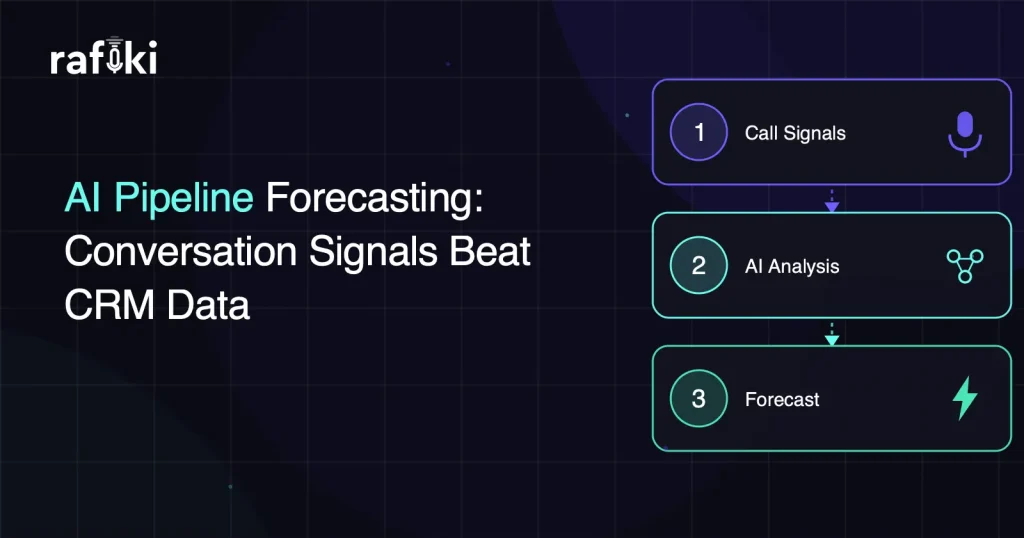
AI pipeline forecasting transforms raw conversation data into structured predictive signals that traditional CRM workflows completely miss. Every customer interaction contains multiple layers of intent, commitment, and timeline indicators that, when properly analyzed, provide remarkably accurate deal outcome predictions.
The most powerful forecasting signals emerge from systematic conversation analysis across multiple dimensions:
These signals don't replace traditional pipeline metrics—they enhance them with contextual intelligence that reveals the true probability of deal advancement. A proposal-stage opportunity shows high forecast probability in your CRM, but conversation analysis reveals evasive responses about budget authority and timeline pushback. The AI-powered forecast correctly adjusts this deal probability, preventing pipeline inflation.
Advanced AI pipeline forecasting analyzes conversations across multiple modalities to extract deeper behavioral insights than transcript review alone. Voice patterns, speaking pace changes, and interaction dynamics provide additional predictive signals that enhance pure content analysis.
This multi-dimensional approach captures subtle buyer signals that human reviewers consistently miss:
Traditional forecasting models treat all "yes" responses equally, but conversation intelligence reveals the qualitative differences between confident commitment and polite deflection. These nuances dramatically improve prediction accuracy when systematically captured and weighted across your entire pipeline.
The most sophisticated AI pipeline forecasting doesn't just analyze individual conversations—it tracks how conversational signals evolve across the entire deal lifecycle. Momentum indicators that seem positive in isolation may reveal concerning patterns when viewed chronologically.
Temporal analysis identifies predictive patterns invisible to static CRM snapshots:
A deal that showed strong early momentum but displays declining stakeholder engagement, increasingly vague timeline commitments, and champion uncertainty signals high slip risk despite maintaining CRM stage progression. Conversely, opportunities with steadily increasing implementation discussions and expanding stakeholder involvement demonstrate authentic advancement regardless of formal stage timing.
Rafiki transforms conversational data into actionable forecasting intelligence through its integrated suite of AI agents that work autonomously across your entire revenue operation. Unlike traditional platforms that bolt AI features onto existing architectures, Rafiki's AI Sales Agents are purpose-built to extract, analyze, and synthesize the complex signals buried in customer conversations.
The platform's forecasting capabilities emerge from systematic conversation analysis across multiple integrated components:
What sets Rafiki apart is its ability to operate at the intersection of conversation intelligence and pipeline management. The platform doesn't just transcribe calls—it transforms them into structured forecasting data that enhances rather than replaces your existing CRM workflows. Smart Call Scoring automatically identifies when prospects demonstrate genuine budget authority versus vague financial discussions, while temporal pattern recognition tracks how these signals evolve across multiple touchpoints.
This AI-native architecture delivers enterprise-grade forecasting intelligence without enterprise-level complexity or cost barriers. Teams can deploy sophisticated conversation-driven forecasting starting at $19 per seat with no minimum commitments, making advanced pipeline intelligence accessible to growing sales organizations that traditional platforms overlook.
Transitioning to AI-powered pipeline forecasting requires systematic integration of conversational intelligence with existing pipeline management processes. The most successful implementations follow a phased approach that builds forecasting accuracy incrementally while maintaining current operational workflows.
Phase 1 focuses on establishing baseline conversation capture and analysis capabilities:
Phase 2 develops predictive forecasting models based on accumulated conversation data:
Phase 3 integrates conversation intelligence into strategic revenue planning and territory management decisions that extend beyond individual deal forecasting.
AI pipeline forecasting success requires systematic measurement of prediction accuracy improvement compared to CRM-only models. The most meaningful metrics focus on both forecast precision and early warning system effectiveness rather than simple activity tracking.
Primary forecasting accuracy indicators track prediction reliability across different time horizons:
Leading indicators focus on operational improvements that drive forecasting enhancement over time. These metrics reveal whether your team effectively leverages conversation intelligence for pipeline management and strategic decision-making rather than treating it as supplementary reporting.
Organizations that master AI pipeline forecasting gain sustainable competitive advantages that compound across multiple revenue operations areas. While competitors continue forecasting with incomplete CRM data, your team operates with comprehensive conversation-driven intelligence that improves prediction accuracy and strategic decision-making.
This intelligence advantage extends beyond simple forecast accuracy to transform how growing sales organizations compete against larger, better-funded competitors. When you understand buyer sentiment, timeline reality, and decision dynamics that others miss, you can deploy resources more effectively, coach more strategically, and close deals that traditional forecasting models would misclassify.
The teams that embrace conversation-enhanced forecasting in 2026 will establish market position advantages that become increasingly difficult for slower-adopting competitors to match. Every customer interaction becomes a source of structured intelligence rather than unstructured noise, creating compounding informational advantages that drive consistent revenue predictability.
Ready to transform your pipeline forecasting with AI-native conversation intelligence? Rafiki's AI Sales Agents start at $19 per seat with no minimums and no annual commitments—enterprise-grade forecasting capabilities without enterprise barriers. Start your free trial today or book a demo to see how conversation signals can finally make your pipeline predictions as reliable as your revenue goals demand.
Start for free — no credit card, no seat minimums, no long contracts. Just better sales intelligence.