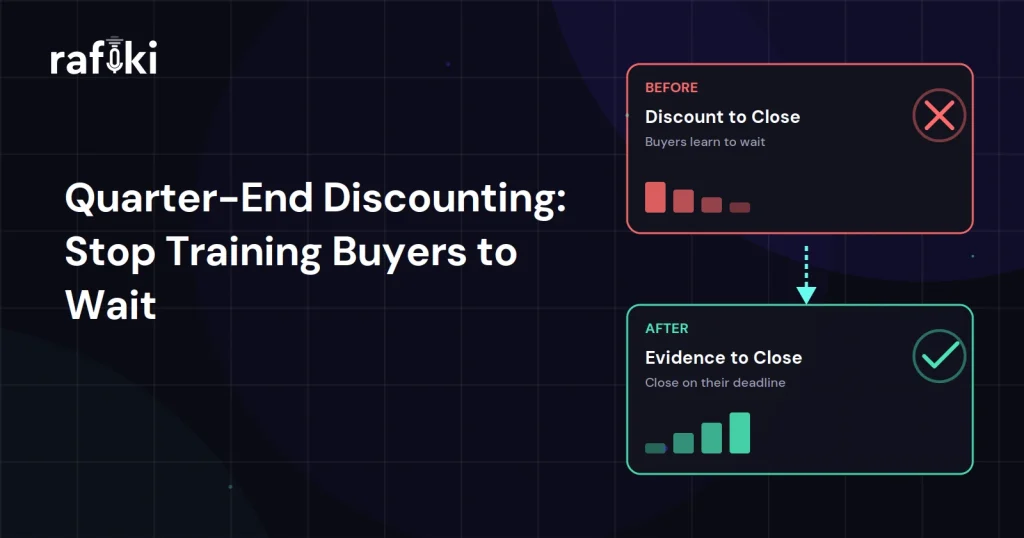
It is the second week of September, and a buyer who went quiet in August has just replied to a rep's email with a single sentence: "Is there anything you can do on price if we sign by the thirtieth?" The rep does not need to ask why the buyer thinks there might be. Last quarter, and the quarter before, the answer was yes. The buyer's procurement team has learned the rhythm of your fiscal calendar better than most of your own employees, and they have built it into their purchasing process. Quarter-end discounting has stopped being a tactic your team uses. It has become a tactic your buyers use on you.
Every revenue leader knows this cycle, and most accept it as the cost of hitting the number. The quarter is short, the gap is real, and a discount closes deals that would otherwise slip. What is less often examined is the compounding cost: each quarter-end concession teaches the market that the list price is a starting point, that waiting is rewarded, and that the last two weeks of a quarter are when to negotiate. The number gets hit, and the next quarter starts with a pipeline that has learned to wait.
This article is about breaking the cycle without abandoning the close. It covers what quarter-end discounting actually does to buyer behavior, how to read your own discount history from the conversation record rather than the CRM, the non-price levers that close deals at quarter-end, how to design a discount policy from evidence, and how to run the last two weeks of Q3 so that Q4 inherits a healthier pipeline.
Quarter-end discounting is the practice of offering price concessions in the final days or weeks of a fiscal period to pull deals across the line before the period closes. It is driven by the seller's calendar, not the buyer's need, and that is what distinguishes it from ordinary negotiation. A discount traded for a longer commitment or a reference is a deal structure. A discount offered because it is September 24 is a calendar tax.
The practice persists because it works in the short term. Deals do close faster when the price drops, and a leader staring at a gap on the twenty-fifth is not wrong that a concession will narrow it. The problem is that the mechanism relies on the buyer not noticing the pattern, and buyers notice patterns. Once they do, the discount stops accelerating deals that would have closed anyway and starts delaying deals that would have closed earlier at full price.
In that steady state, quarter-end discounting no longer creates urgency. It creates a schedule, and the schedule belongs to the buyer.
Why do sophisticated revenue organizations keep doing something they know trains their buyers to wait? The reasons are structural, and each one makes the next quarter's concession more likely than the last.
The finance side of the house feels this acutely. Deloitte's CFO guide to technology trends frames the technology agenda finance leaders are taking on, and better-instrumented commercial decisions sit squarely inside it. Quarter-end discounting is the commercial decision most in need of that discipline, because it is made under the most pressure with the least information.
The margin cost of discounting is the part everyone measures. The larger costs accumulate in the pipeline and the brand, and they are why the cycle deserves to be broken rather than optimized.
First, the pipeline learns to bunch. Deals that could close in the first month of a quarter drift toward the last two weeks, because buyers have been taught that waiting pays. The forecast becomes back-loaded and fragile, and a single slipped week can move a quarter. Second, the value story erodes. When the rep's closing argument is a price cut, the buyer's memory of the purchase is a bargain rather than a solution, which shapes every renewal conversation afterward. Third, the price itself loses meaning. As we argued in our guide to pricing conversations, buyers reveal what they believe a product is worth in what they say and do. A market that has learned to wait has been told the list price is fiction.
Grant Thornton's reporting on CFO technology priorities documents finance leaders accelerating technology spending as AI momentum builds. Visibility into commercial decisions is one of the natural uses of that investment, and the quarter-end discount is where visibility has historically been weakest.
Breaking the cycle starts with an honest account of how it actually works in your organization, and the CRM cannot provide one. A discount field records that a concession happened. It does not record who initiated it, what was said, or whether the buyer had already decided before the price came up. Those answers live in the conversation record, and a conversation intelligence platform that captures every call is what makes the history readable.
The analysis asks four questions of every quarter-end deal from the last several periods:
Running this analysis for the first time is usually uncomfortable, because some share of past concessions will fall into the categories that bought nothing: offered rather than demanded, given after the decision, or attached to a close that was waiting on something else entirely. Whatever that share turns out to be in your history, it is savings available without losing a single deal.
Urgency is legitimate. The mistake is assuming price is the only lever that creates it. The conversation record usually reveals what each buyer actually cares about, and most of those things cost less than a discount.
Most buyers have a date that matters to them: a launch, a fiscal year, a renewal of the tool they are replacing, a board meeting where the initiative gets reported. That date was mentioned on a call. Anchoring the close to the buyer's deadline rather than yours creates urgency that does not need a concession.
Onboarding capacity, a kickoff slot, a dedicated implementation resource, or a start date aligned to the buyer's team availability all have real value to the buyer and modest cost to the seller. "We can start your team on the sixth if we sign by the thirtieth" is urgency with a reason.
Payment timing, a ramped contract, an expansion option locked at current pricing, or a longer term at the same rate all give the buyer something concrete without lowering the price. Structure preserves the list price's meaning while still moving the deal.
An extra seat cohort for a pilot period, an executive sponsor commitment from your side, or early access to a capability the buyer asked about on a call are levers the buyer values and competitors cannot easily match.
The common thread is that each lever is drawn from something the buyer said. The rep who knows what the buyer's board meeting date is has a closing tool the rep who only knows the list price does not.
A discount policy is a set of rules for when a concession may be offered, by whom, in exchange for what, and at what depth. Most teams have one on paper. The evidence-based version differs in that every rule is derived from the discount history and enforced through the conversation record rather than a form.
Rafiki AI is built to make the discount history readable and the policy enforceable, because it captures and analyzes every buyer conversation across meetings and phone calls, transcribed in more than sixty languages. The questions that break the cycle become queries rather than projects.
Gen AI Search finds every pricing moment across the last several quarters of calls, with the buyer quoted and the timestamp cited, so RevOps leaders can sort concessions into demanded versus offered, before versus after decision, and traded versus given away. Blocker detection surfaces what the buyer said they were actually waiting for, and competitive signal tracking captures whether a discount request was anchored to an alternative or simply to the calendar.
For the policy, Smart Call Scoring with custom criteria tracks whether reps are following the rules on their calls: no offered flexibility, the "what would have to be true" question when price comes up, and a stated trade for every concession. Gen AI Reports gives leadership a standing view of discount behavior by rep and segment as the quarter closes, and Smart CRM Sync writes the buyer's deadline and stated blockers into the opportunity, so the deal desk approves with the whole conversation in view. Rafiki AI's autonomous AI agents do the listening; the revenue team keeps the decision about when a concession is worth it.
| Dimension | Calendar-driven close | Evidence-driven close |
|---|---|---|
| Source of urgency | Seller's fiscal date | Buyer's own deadline from the calls |
| Who raises price | Rep, preemptively | Buyer, if at all |
| Discount trigger | Days left in quarter | Buyer decision on record plus a trade |
| What is exchanged | A signature by the thirtieth | Term, reference, expansion, case study |
| Approval basis | Rep's assertion | Buyer's statements in the record |
| Effect on next quarter | Buyers learn to wait | Pipeline closes on buyer timing |
| Owner of the pattern | Nobody | RevOps, with the history searchable |
The cycle cannot be broken in a single quarter-end, and trying to go cold turkey on the twenty-fifth is how revenue leaders lose their jobs. The realistic plan is to change the mix this quarter and shift further each quarter after.
Each quarter run this way teaches the market a little less about your calendar and a little more about your value. Over a year, the pipeline stops bunching, the forecast stops depending on the last five days, and the list price starts meaning something again.
Quarter-end discounting feels like a closing tool and behaves like a training program, teaching buyers that patience is rewarded and the list price is a suggestion. The cycle breaks when the discount history is read from what buyers actually said rather than from a CRM field, when urgency is built from the buyer's deadlines instead of the seller's, when every concession is traded rather than given, and when approvals are made with the conversation in view. Rafiki AI makes each of those steps practical, with autonomous AI agents that capture every pricing moment, score whether the policy is being followed, and put the buyer's own words in front of the deal desk. Close Q3 on evidence, and Q4 will start with a pipeline that has not been taught to wait.
Quarter-end discounting is offering price concessions in the final days or weeks of a fiscal period to pull deals across the line before the period closes. It differs from ordinary negotiation because the trigger is the seller's calendar rather than the buyer's situation. The problem is cumulative: buyers learn the pattern and build it into their purchasing process, so deals that could have closed earlier at full price drift toward the last two weeks in expectation of a better offer. The pipeline becomes back-loaded, the forecast becomes fragile, the value story gives way to a bargain story, and the list price stops meaning anything to the market.
Change what the market learns from your behavior. Stop offering discounts preemptively; when a buyer raises price, ask what would have to be true for them to proceed at list, which surfaces the real blocker. Build urgency from the buyer's own deadlines, which they named on calls, rather than from your fiscal date. Trade every concession for something concrete such as a longer term, a reference, or an expansion commitment, and state the trade on the call. Approve discounts on evidence of the buyer's decision, not on days remaining in the quarter. Each quarter run this way teaches buyers a little less about your calendar.
Non-price levers drawn from what the buyer said they care about. Anchor the close to the buyer's own deadline, such as a launch, a fiscal-year boundary, or a board meeting where the initiative is reported. Offer implementation timing: a kickoff slot, a dedicated onboarding resource, or a start date matched to the buyer's team availability. Use terms and structure, including payment timing, a ramped contract, or an expansion option locked at current pricing. Provide access and scope, such as a pilot seat cohort, an executive sponsor commitment, or early access to a capability the buyer asked about. Each creates urgency with a reason and costs less than a price cut.
From the discount history rather than from principle, and enforced through the conversation record rather than a form. Read every quarter-end concession from the last several periods to learn who raised price first, whether the buyer had already decided, what they said they were waiting for, and what was traded. Then set rules the evidence supports: no discount before the buyer's decision is on record, no offered discounts, every concession traded for a term or commitment stated on the call, approval depth tiered by deal size and strategic value rather than by date, and a deal desk that approves with the buyer's actual statements in view.
Rafiki AI's conversation intelligence platform starts at $19 per seat per month with no minimums and no annual commitment. Start your free trial today or book a demo to see what your buyers actually said before you approve the next quarter-end discount.
Start for free — no credit card, no seat minimums, no long contracts. Just better sales intelligence.